Filmmakers

|
Filmmakers
|
|
 |
 |
 |
|
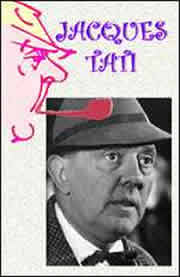 JACQUES TATI
Tati began to make his own films in 1936, but his real debut as a film director dates from the shooting in 1947 of a short subject, The School For Postmen, in which he created a new comic character, François the postman. The film was awarded the Max Linder Prize in 1949. The same year he directed his first feature film, Holiday, in which his postman François enjoyed both a commercial and critical triumph in the United States as well as in Europe, winning the Prize for the Best Screenplay at the Venice Film Festival in 1949 and the Grand Prize of French Cinema in 1950.
Although the success of Jour de fête made Tati famous virtually overnight, he refused to make a sequel containing a new series of François the postman’s adventures —to the great dismay of the producers, who had begged for more of the same. Tati proceeded to create a new character, Mr. Hulot, at the same time refining his comic technique. Mr. Hulot’s Holiday (1953) was awarded the Louis Delluc Prize, before winning prizes throughout the world. Tati did with Mr. Hulot what he refused to do with the postman: he gave him a series of sequels. The first sequel was Mon Oncle (1958), a satire on the modernization and mechanization of life which won a special prize at Cannes in 1958 and the Oscar for the Best Foreign Film at the Academy Awards in 1959. Mon Oncle was followed by two other films with Mr. Hulot, Playtime (1967), a vast ironic fresco on modern urbanism (whose enormous production expenses bankrupted Tati’s studio), and Trafic (1974), a slapstick version of automobile trade shows. In his last film, Parade (1974), a medium-length video production for Swedish television, he finally abandoned the Hulot character in favor of “Monsieur Loyal,” the master of ceremonies of a little Swedish circus in which he returns to sports parody. In 1977 the Cannes Film Festival awarded Jacques Tati a special award in recognition of his overall contribution to French cinema.
We observe in Tati’s films an unusually keen sense of observation of daily life. As he says himself, “I watch other people live, I stroll, I listen to dialogues, I observe the peculiarities, the details, the way of being which reveal the personality of the individual.” His films are always a mixture of realism — we recognize easily character types that we run into everywhere — and of poetry created by the continual gags. The main source of the comedy is, of course, Mr. Hulot’s character, whose bizarre manner of dress, long pipe, and inimitable gait leave no doubt as to his eccentricity. He is an over-grown kid, simple and innocent, but a clumsy, scatter-brained child whose thoughtlessness wreaks havoc all around him. Mr. Hulot is like a catalyst, a fermenting agent that precipitates disagreeable situations (often — but not always — without his knowledge) at the expense of other people.
Tati’s genius can be detected likewise in the originality of the soundtrack. Tati’s own character is nearly mute, and other than some background music, his universe is filled with snippets of audible dialogue, indecipherable jabbering, and everyday noises.
Filmography
Short Subjects (screenwriter and actor)
1932 Oscar, champion de tennis
1934 We Need A Brute
1935 Gay Sunday
1936 Watch Your Left (directed by René Clément)
Director, Screenwriter, Actor
1947 The School For Postmen (short subject)
1949 Holiday
1953 Mr. Hulot’s Holiday
1958 Mon Oncle
1967 Playtime
1971 Trafic
1974 Parade