A Workbook for Arguments

Companion Web Site

Exercise Set 1.3
Analyzing Visual Arguments

Instructions: For each image or video below, write a premise-and-conclusion outline of the argument that you think the image or video is trying to communicate.

Sample Exercise

Source: "on this site...a commentary," Marc Levin, 2008, http://www.flickr.com/photos/mil8/2196118315/
(1) "Big box stores" are putting local markets out of business.
(2) Local markets are an important part of America.
Therefore, (3) Big box stores are destroying an important part of America.

As with many visual arguments, this visual argument contains both text and images—but the images are what do a lot of the work. The text on this sign asserts the first premise in this outline: Big box stores are putting local markets out of business. But it doesn't say anything about the second premise. So where does that premise come from? To understand that, you need to consider the image itself. The message is presented on a fake historical marker. Historical markers are used to commemorate important pieces of national history, such as the former homes of national heroes and heroines. By presenting the claim about big box stores and local markets on a fake historical marker, the person who created this visual argument is trying to emphasize that local markets are a vanishing but important piece of American history.

There is, as with all visual arguments, some room for disagreement about exactly what argument is being communicated here. In particular, you might wonder exactly what conclusion the argument's creator intended. Is it that we should oppose big box stores? That we shouldn't shop there? Or just that it's regrettable that local markets are disappearing? The sample response here chose to go with a fairly mild conclusion. This is generally a safe choice, since it avoids attributing more to the argument's creator than he or she would accept.

  1. 1
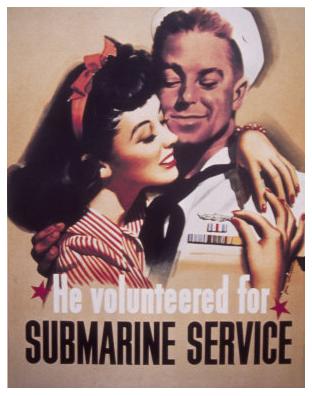
    A 1940's era poster of a pretty woman hugging a man in a sailor outfit with the caption 'He volunteered for submarine service'.
    Source: U.S. Navy, 1939
  2. 2
    Source: "When Pigs Fly - Doritos Crash the Super Bowl 2015 OFFICIAL WINNER," Nelson Talbot, YouTube, Nov 9, 2014
  3. 3
    Source: "Go Vegetarian with Angela Simmons," peta2, 2011, https://www.peta2.com/news/angela-simmons-go-vegetarian-ad/
  4. 4
    Source: StreetSmart, 2015, http://bestreetsmart.net
  5. 5
    Source: "This Is Your Brain on Drugs," Advertising Media Partnership for a Drug Free America, 1987
  6. 6
    Source: "MoneyBART," The Simpsons (Los Angeles: 20th Century Fox Television, Oct 10, 2010)
  7. 7
    Source: "Peace, Little Girl," Democratic National Committee, 1964
  8. 8
    Source: "3M Security Glass," Cea, 2010, http://www.flickr.com/photos/centralasian/5246646656/
  9. 9
    Source: "Garage Band," Android, Nov 12, 2014
  10. 10
    Source: "MORE WOMEN #ELLEFeminism," ELLEUKTV, Oct 7, 2015

Model responses

Model Response to Exercise 1
(1) Women admire men who volunteer for submarine service.
Therefore, (2) You should volunteer for submarine service (if you are a man).

It's clear that this poster is trying to convince men to volunteer to serve on submarines. There's room for interpretation, though, about exactly what the premises of the argument are. Maybe it's that women admire submariners. Maybe it's that submariners get more dates. There is no single correct answer here, but it's clear that the poster's creator intends to communicate some connection between volunteering for submarine service and getting the positive attention of women.

This brings up another point about arguments that try to convince you to do or buy something. They often rely on an assumption or "unstated premise" about what you want. The fact that women admire submariners is only a reason for you to volunteer for submarine service if you want the admiration of women. Thus, you might want to add another premise to this argument: "You want women to admire you."

Model Response to Exercise 3
(1) Angela Simmons is sexy.
(2) Angela Simmons is a vegetarian.
Therefore, (3) You should be a vegetarian.

There is a written argument embedded in the ad: (1) Eating meat is a sin. Therefore, (2) you should be a vegetarian. But the visual content of the ad is supposed to convey something extra. Your task here is to figure out how that visual aspect of the argument works.

So what should we think about the visual aspect of this ad? In a sense, the point of the ad is to make vegetarianism seem sexy. This image was part of an ad campaign by People for the Ethical Treatment of Animals (PETA). The campaign tries to get people to associate vegetarianism with sexy women. (In fact, critics said that ads like these exploit women to promote animal rights.)

The first implied premise is fairly straightforward: Angela Simmons is sexy. What about the second premise of the argument? Why should we believe it? For one thing, the fact that a recognizable celebrity appears in this particular ad makes it reasonable to infer that she is a vegetarian—or, at the very least, supports PETA's message here. But why is it relevant? That is, why would the fact that Angela Simmons is a vegetarian count as a reason for you to be a vegetarian? Maybe it doesn't, but PETA certainly seems to think that many people will take it to be relevant.

The details of a visual argument often convey more than we can easily capture in a premise-and-outline reconstruction of that argument. In particular, the apple in this image is loaded with symbolism. Although you don't need to comment on it in your answers, it might be worth discussing or thinking about what it adds to the ad.

Model Response to Exercise 5
(1) Drugs damage your brain.
Therefore, (2) You shouldn't do drugs.

If you're interpreting this video literally, you might write the premise of the argument as "Drugs fry your brain." But this is just an informal way to say that drugs damage your brain. It's clearer to say that drugs damage your brain, since it might be unclear exactly what someone means by "frying" your brain.

This video provides a good reminder that there are "wrong answers" when it comes to interpreting visual arguments, even if there isn't always a single right answer. In the ad, the frying pan (i.e., "drugs") transform a raw egg into a fried egg. On the one hand, frying an egg is not necessarily a bad thing. It transforms the egg from a rather unappealing food to one that is much more desirable. Since the video is clearly trying to convince you not to do drugs, however, it would be a mistake to interpret the argument as saying, "Drugs transform your brain from a raw, unappealing state to something that is tasty and desirable. Therefore, you should do drugs."

Model Response to Exercise 7
(1) Nuclear war would kill everyone, including your children.
(2) President Lyndon B. Johnson would prevent nuclear war if he were reelected.
Therefore, (2) You should vote for Lyndon B. Johnson.

This famous campaign ad from the 1964 U.S. Presidential election never actually says that Johnson would prevent nuclear war—much less than he would do a better job of it than his opponent in the election, Barry Goldwater. Yet, that premise is clearly implied by the video. Why else would the threats of nuclear destruction be followed by a plea to vote for Johnson, unless the campaign wanted you to believe that electing Johnson was the best way for the country to avoid nuclear war?

Notice that this argument, as written here, would be a very strong argument (assuming that the premises were reliable). So why doesn't the ad just come out and say it? By presenting us with the image of an innocent girl, followed by the frightening countdown and the image of a mushroom cloud, the video provokes emotions that a plain argument never could. This can be effective in getting people to do or believe what you want, but it doesn't make the argument any better from a logical perspective. (See Rule 5 in A Workbook for Arguments.)

Model Response to Exercise 9
(1) Interesting, original people just want to be themselves instead of being like everyone else.
(2) Owning an iPhone makes you just like everyone else.
Therefore, (3) You should buy a phone other than an iPhone—specifically, one that runs the Android operating system.

As with many visual arguments, you need to understand the context to understand the argument. In this case, you need to know, first of all, that Android is an operating system for devices that compete with iPhones and other Apple products. You should probably know that iPhones all look more or less the same, whereas Android runs on a wide range of devices. And most importantly, you need to be able to recognize that the band in the video is supposed to be very eclectic and original—not only in the sense that they play unique, eclectic music, but also that each individual member of the band is very different from the others. Once you understand those things, though, it's fairly easy to get the basic message: Interesting, creative, original people who don't want to be "just like everyone else" prefer Android-powered phones that enable them to be themselves.