The Hackett Signature Editions Collection Featuring Premium Hardcovers of Hackett Classics - Learn More Here.

An Interview with Prashant Parikh, author of Meaning Is Everywhere
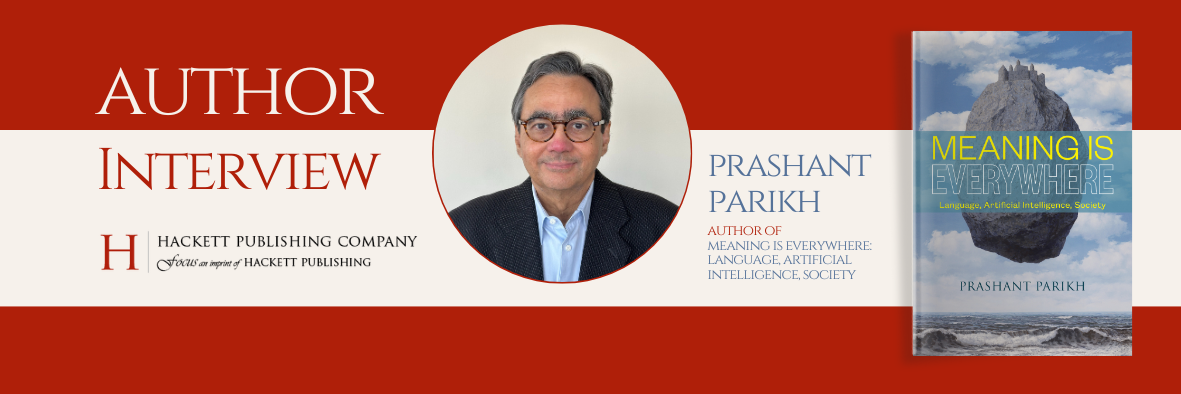
Hackett's marketing team recently had the opportunity to speak with Prashant Parikh to discuss his new Hackett book, Meaning Is Everywhere: Language, Artificial Intelligence, Society. Keep scrolling to read more about how Prashant selected the topics in his book, why he wanted to write something like Meaning Is Everywhere, which chapters he most enjoyed writing, and what he hopes readers will take away from reading his book.
Prashant, could you please introduce yourself to our readers?
I am basically an academic, writer, and entrepreneur although I have also worked in the visual arts. I studied at MIT and Stanford University in the 1970s and 1980s, mainly electrical engineering, computer science, and applied mathematics but I also took courses in philosophy and the social sciences. At Stanford, I worked with Jon Barwise and the Nobel Laureate Ken Arrow, and pioneered the application of game theory to linguistic meaning. I have since written several influential books, and a small subfield of game-theoretic semantics/pragmatics has emerged. I also write on a variety of other topics, especially the arts and politics, and I also write fiction. Lastly, in business, I am currently building an enterprise search engine based on my game-theoretic ideas about meaning.
Meaning Is Everywhere covers a wide array of topics. You have sections discussing meaning in relation to language, situations and games, modernity, and civilization. How did you choose the topics you wanted to explore in this book?
In my view of meaning, it really is everywhere, and everything is meaningful. So, I wanted to address what I thought were the most important arenas where it occurs such as language, artificial intelligence, and society. Society itself is a vast arena, and so within it, I chose to consider a variety of foundational topics including modernity, social structure, the self, power, human suffering, and what I call partial utopias.
What made you want to write a book like Meaning Is Everywhere?
While I had many aims such as introducing a wider readership and experts to new ways of thinking about meaning as it appears in language, artificial intelligence, and society, my main goal was to tackle the problem of human suffering and to show how foundational thinking about situated meaning can partially solve it.
Did you have a favorite chapter to research and write about in Meaning Is Everywhere? What was particularly enjoyable or interesting for you about this chapter?
I particularly enjoyed writing the last chapter as I really went out on a limb, writing about the three basic forms of human suffering in the world, what I call existential, physical, and social suffering, about how they might be overcome, about partial utopias, and even about the meaning of life, all topics that take a certain naivete to broach, especially in serious writing. Of course, one cannot just jump to the last chapter as there is a rigorous but lucid argument that builds step by step toward this ultimate goal.
What are you the most excited for readers to take away from picking up Meaning Is Everywhere?
Throughout the book, I have tried to emphasize a certain clarity in thought and thinking, keeping things as simple as possible but not simpler (than possible). I hope readers pick up this process in addition to the many other insights about particular topics such as how language works, or how the problem of a general human-level artificial intelligence can be approached, or how society and self are structured and can be transformed through our collective participation toward a partial utopia.
About Meaning Is Everywhere:
Meaning Is Everywhere sketches a theory of meaning from the ground up—with potentially profound consequences. In a sweeping narrative that arcs from the origins of meaning through the emergence of present-day science and technology, Prashant Parikh offers a fresh perspective on some of the most significant challenges and opportunities of the contemporary world, including the promise of AI, relief from scarcity and polarization, and the possibility of at least partial utopias.
Click here to learn more about the book!About Prashant:
A former Senior Research Scholar at Stanford University and the University of Pennsylvania, Prashant Parikh is a pioneer in the application of game theory to communication and meaning. He studied at MIT and Stanford University, and is the author of several influential books, including Language and Equilibrium (2010) and Communication and Content (2019).