The Hackett Signature Editions Collection Featuring Premium Hardcovers of Hackett Classics - Learn More Here.

New in Classics
-
![]() Argonautica
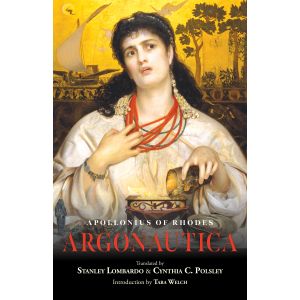
Argonautica"Anyone who's ever been fascinated by The Magnificent Seven or a Marvel Comics movie that brings together a team of great epic heroes for a noble cause will understand the archetype and the paradigm that animates Apollonius's version of the ancient myth of the Argo, in which an assemblage of highly charismatic pre-Trojan War heroes embarks on a daunting adventure. This new edition of the epic can play an invaluable role in any number of classes that involve ancient literature or that focus on heroic quests in literature of any period. Readers will be able to understand not only the story itself, but also the culture that produced it, and, further, the complicated and sometimes inconsistent values of heroism and nobility, which are both celebrated and challenged in Apollonius's great poem
Learn More
—Michael Calabrese, Professor of English, Cal State LA and translator of Piers Plowman: The A Version, revised edition (Catholic University of America Press) -
![]() From Alpha to Omega (Fifth Edition)
From Alpha to Omega (Fifth Edition)From Alpha to Omega offers an encouraging and accessible introduction to Classical Greek for today’s students. Its fifty brief lessons, each typically focused on one or two grammatical topics, reinforce students’ learning through exercises that offer practice with the target vocabulary and—beginning with Lesson 5—through translation of a short annotated selection from an ancient source. From Aesop to the New Testament, Aristotle, Arrian, Demosthenes, Lysias, Plato, Thucydides, and Xenophon, the readings include passages in which students can put their newly acquired skills to immediate (and gratifying) use. From Alpha to Omega is ideal for use in classroom settings, homeschool settings, and by self-learners. An electronic answer key for the textbook (PDF only) is available for qualified adopters. If you have adopted the text, click here to request the answer key.
Learn More -
![]() Lysistrata, Women at the Thesmophoria, Frogs
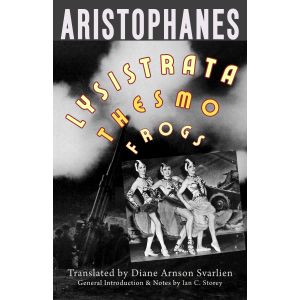
Lysistrata, Women at the Thesmophoria, Frogs"Arnson Svarlien's translation offers fresh insight into three of Aristophanes's greatest comedies. The verse flows smoothly, and throughout it is stressed that these plays belong on a stage, with guidance on how that might be accomplished. At the same time, the detailed Introduction and interpretative notes on every page show that both Arnson Svarlien and Storey are deeply committed to presenting a vibrant, modern Aristophanes, and to giving the tools needed for readers and actors to form their own opinions on matters of ongoing scholarly controversy."
Learn More
—C.W. Marshall, FRSC, Professor of Greek, The University of British Columbia -
![]() Heroides
Heroides"An excellent piece of work. Lombardo and McClure have struck the right balance between literal and lyrical, formal and informal. Each of the letters has a distinct voice–something clear in the Latin but difficult to convey.
Learn More
"There are many small pleasures for the reader looking at the Latin (duplicated line-starts and -ends, verbal effects, etc.). Most are unobtrusive, which is all to the good. This translation is not designed to be a crib, though it wouldn’t be bad as one. More importantly, the poems read well in English. There are lots of glancing references to the tropes of elegy, but they won’t slow down the first-time reader of the poems. The translators have even made something of several of the puns (e.g. verbum/vela dare), an impressive feat.
"Welch's Introduction is perfectly pitched; it gives a lot of useful information in short compass, and it does so in a lively manner, with full attention to the scholarship but not so as the general reader would notice."
–Laurel Fulkerson, Professor Emerita of Classics, Florida State University -
![]() Persians
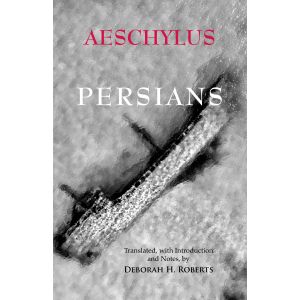
Persians"The musicality of Deborah Roberts' translation of Aeschylus' Persians, the earliest Greek tragedy that has come down to us, rivals the playwright's own astonishing lyricism. She crafts extended speeches by the drama's characters into captivating set-pieces of performance poetry. Roberts also replicates Herodotus' celebrated storytelling energy in her translation of the passages from his Histories included in this volume. In her Introduction, Roberts examines Aeschylus' drama and Herodotus' representations of Persian culture as crucial records of ancient Greek conceptions of otherness and perceptively appraises the Persians itself as a sober contemplation upon the shared human toll of political ambition and warfare’s traumas and grief, making this book urgently relevant to contemporary audiences."
Learn More
—James Bradley Wells, PhD, Edwin L. Minar Professor of Classical Studies, DePauw University -
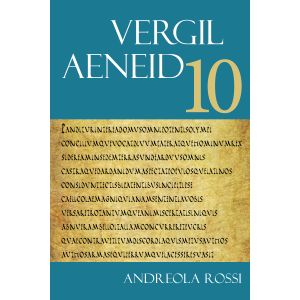
![]() Aeneid: Book 10
Aeneid: Book 10Vergil: Aeneid 10 is part of a new series of commentaries on the Aeneid. Each volume adapts, with extensive revisions and additions, the commentaries of T. E. Page (1884, 1900) and is edited by a scholar of Roman epic. The present volume offers the Latin text of Book 10 along with extensive notes and commentary designed to meet the needs of intermediate students of Latin.
“The new Vergil commentaries from Focus are an exciting resource for almost anyone reading the Aeneid in Latin. The editors recognize that developing core reading skills and involving students in the interpretive questions raised by the poem are not separate objectives. This recognition has resulted in commentaries that enticingly present basic information in a wider setting of observation and enquiry. All in all, the Focus series balances simplicity and subtlety, reminding students at all levels that increasing technical precision and stretching one’s interpretive curiosity are—fundamentally—one endeavor.”
Learn More
—Antonia Syson, late of Purdue University, in Teaching Classical Languages (CAMWS)