The Hackett Signature Editions Collection Featuring Premium Hardcovers of Hackett Classics - Learn More Here.

New in Latin American Studies
-
![]() Toward a New Humanism
Toward a New Humanism“Written in 1940 and available here for the first time ever in English, Samuel Ramos’ Toward a New Humanism is a prescient discussion of humanism, technology, mortality, and the tensions between the national and the universal. In addition to Sanchez’s thoughtful introduction, his superb translation of Ramos’s text, and the informative editorial notes running throughout, this volume is further enriched by the inclusion of translations of other, earlier, essays—written by Ramos and other influential philosophers from the period--on related topics as well as translations of assessments of Ramos’s ‘new humanism' by other leading philosophers in mid-century Mexico. More than eighty-five years after its original publication--and in this era of renewed global conflicts—Ramos’s call for a profound rethinking and reshaping of modern culture and society is as timely as when it was written, and Sanchez is to be commended for making this important text available for a new generation of readers.”
Learn More
—Manuel Vargas and Clinton Tolley, Mexican Philosophy Lab, UC San Diego -
![]() The Essential Sarmiento: Civilization, Barbarism, and Progress
The Essential Sarmiento: Civilization, Barbarism, and Progress"Domingo Sarmiento is a rhetorical and political giant whose garrulous, colorful, and troubling ideas about race, violence, politics, and literature have fascinated Spanish-language readers for over a hundred and fifty years. Thanks to William Acree's brilliant selection of writings and annotations, the sparkling translations of John Charles Chasteen, and Oscar Chamosa's excellent critical Introduction, readers of English can finally encounter this larger-than-life writer who was deeply committed to documenting his historical moment and assessing social and political ills. This book is a major—and long overdue—contribution to Latin American Studies."
Learn More
—Christopher B. Conway, The University of Texas at Arlington -
![]() Mexico, Slavery, Freedom
Mexico, Slavery, FreedomWinner of the American Historical Association's 2025 J. Franklin Jameson Award for outstanding achievement in the editing of historical sources.
"A welcome tome for the study of slavery and freedom in the African Diaspora. An extensive, and often difficult to access repository of documents has been made available in a bilingual edition that will richly benefit scholars and students alike to better understand the complexities of the Black experience in colonial and early national Mexico. Bridging normal historical chronologies, and featuring sweeping sets of documents ranging from politics, religion, economics, and social life, there is little ground left uncovered for providing windows and glimpses of the evolution of blackness in Mexico. Expertly curated, marvelously framed, and diligently translated, this is a jewel of a book for historians."
Learn More
—Ben Vinson III, Distinguished Historian of Latin America and former President of Howard University -
![]() The Suriname Writings of John Gabriel Stedman
The Suriname Writings of John Gabriel Stedman“Jared Ross Hardesty's new critical edition, The Suriname Writings of John Gabriel Stedman, makes an important and necessary intervention into the study of eighteenth-century Caribbean travel writing and natural history by foregrounding the previously unpublished diary entries Stedman authored in Suriname, rather than focusing solely on his writings printed in the metropoles of Europe. Hardesty's edition is especially useful because it includes both a transcription of Stedman's Suriname diary and a detailed appendix tracking key discrepancies between the diary and Stedman's heavily revised printed natural history. This focus on genre and the editorial process in the production of Anglophone transatlantic writing is an excellent resource for students and scholars of the eighteenth-century Caribbean and the Atlantic World. I can see this being a helpful resource in an early American or eighteenth-century history or literature course, as it would enable students to easily compare differing editions of Stedman's Suriname writings. What Hardesty's edition of The Suriname Writings of John Gabriel Stedman offers is a more accessible study of how eighteenth-century writing on maroonage, slavery, science, and abolition was heavily mediated in the print and production process, as this compiled edition offers critical insight into the gendered and racial politics of life in the colonial Caribbean as well as how printers in the metropole attempted to alter the writing of colonizing authors like Stedman.”
—Elizabeth Polcha, Drexel University
Learn More -
![]() The Mexican Revolution
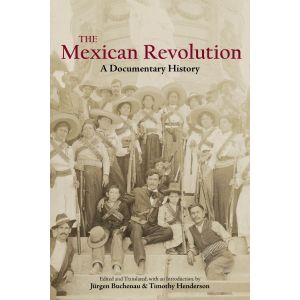
The Mexican RevolutionSelected as one of the best historical materials of 2023 by the Reference and User Services Association, a division of The American Library Association.
"Henderson and Buchenau have done an excellent and thoughtful job of collecting a wide range of voices for students to learn about the Mexican Revolution and its causes, both from ‘above’ and from ‘below’. I’m particularly appreciative of the authors’ inclusion of women’s voices and women’s issues of the era, including the point of view of the first woman elected to public office in Mexico. They deserve praise for including documents that complicate widely accepted, heroic revolutionary narratives of the period for students—such as the experience of soldaderas and the massacre of Chinese people in Torreón. It is also worth mentioning that the editors have done an admirable job in choosing documents from across Mexico’s many diverse and heterogenous regions. The general Introduction is excellent; it is both accurate and highly readable for students. It is no easy feat to succinctly describe both the events and the significance of this period in Mexican history as the authors have done here." —Sarah Osten, The University of Vermont
Learn More