The Hackett Signature Editions Collection Featuring Premium Hardcovers of Hackett Classics - Learn More Here.

Search results for: 'Aristophanes'
-
![]() Aristophanes 1: Clouds, Wasps, Birds
Aristophanes 1: Clouds, Wasps, BirdsOriginally adapted for the stage, Peter Meineck’s revised translations achieve a level of fidelity appropriate for classroom use while managing to preserve the wit and energy that led The New Yorker to judge his Clouds “The best Greek drama we’ve ever seen anywhere,” and The Times Literary Supplement to describe his Wasps as “Hugely enjoyable and very, very funny.” A general Introduction, introductions to the plays, and detailed notes on staging, history, religious practice and myth combine to make this a remarkably useful teaching text.
Learn More -
![]() Aristophanes: Frogs (Meineck Edition)
Aristophanes: Frogs (Meineck Edition)Aristophanes's classic send-up of rivalry within the ultra-competitive world of fifth-century Athenian theatre wins a new lease on life in this fresh line-for-line translation by Peter Meineck. Premiered in 2021 by Aquila Theatre and accompanied here by Meineck’s notes and wide-ranging Introduction, this Frogs offers the best view yet of a high-stakes afterlife contest between two of Athens's late great playwrights. Both are undisputed masters of tragedy. But only one can win and return to save the city.
"Peter Meineck draws on his vast experience as both theatre producer and classical scholar in this lively and thoroughly contemporary translation of Aristophanes's rambunctious but heady Frogs. In highlighting Aristophanes's own concern for spectacle, stage action, and musicality, Meineck offers flexible guidance not only for modern producers of this comedy but also for readers eager to visualize an Aristophanic play in its original setting and to marvel at its enduring comic brilliance." —Ralph M. Rosen, Vartan Gregorian Professor of the Humanities and Classical Studies, University of Pennsylvania
Learn More -
![]() Aristophanes and Menander: Three Comedies
Aristophanes and Menander: Three Comedies"No one, but no one, ever translated ancient comedy like Douglass Parker, and his death left a chasm in the landscape. This posthumous publication of three of Greek theatre's wildest plays, edited and presented by a scholar as eminent and learned as Timothy Moore, is not just something to welcome, it is something to celebrate."
Learn More
—William Levitan, Grand Valley State University -
![]() The Trials of Socrates
The Trials of SocratesLampooned in 406 B.C.E. in a blistering Aristophanic satire, Socrates was tried in 399 B.C.E. on a charge of corrupting the youth, convicted by a jury of about five hundred of his peers, and condemned to death. Glimpsed today through the extant writings of his contemporaries and near-contemporaries, he remains for us as compelling, enigmatic, and elusive a figure as Jesus or Buddha. Although present-day (like ancient Greek) opinion on "the real Socrates" diverges widely, six classic texts that any informed judgment of him must take into account appear together, for the first time, in this volume. Those of Plato and Xenophon appear in new, previously unpublished translations that combine accuracy, accessibility, and readability; that of Aristophanes' Clouds offers these same qualities in an unbowdlerized translation that captures brilliantly the bite of Aristophanes' wit. An Introduction to each text and judicious footnotes provide crucial background information and important cross-references.
Learn More -
![]() The Birds
The BirdsJeffrey Henderson's translation of Aristophanes' The Birds includes essays on Old Comedy and the Theater of Dionysus, suggestions for further reading, notes on production, and a general bibliography.
Learn More -
![]() Acharnians (Second Edition)
Acharnians (Second Edition)"Henderson has a real gift for capturing Aristophanes' voice, and does not hesitate to leap totally over the top, just like his author."
Learn More
—New England Classical Journal -
![]() Lysistrata, Women at the Thesmophoria, Frogs
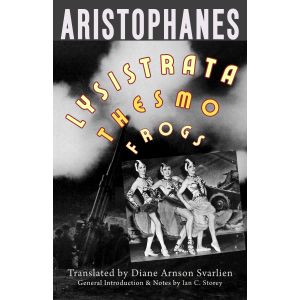
Lysistrata, Women at the Thesmophoria, Frogs"Arnson Svarlien's translation offers fresh insight into three of Aristophanes's greatest comedies. The verse flows smoothly, and throughout it is stressed that these plays belong on a stage, with guidance on how that might be accomplished. At the same time, the detailed Introduction and interpretative notes on every page show that both Arnson Svarlien and Storey are deeply committed to presenting a vibrant, modern Aristophanes, and to giving the tools needed for readers and actors to form their own opinions on matters of ongoing scholarly controversy."
Learn More
—C.W. Marshall, FRSC, Professor of Greek, The University of British Columbia -
![]() Clouds (Henderson Edition)
Clouds (Henderson Edition)Jeffrey Henderson, noted Greek scholar, has translated into English one of Aristophanes' greatest comedies. Offered with detailed notes and an enlightening introduction, this modern translation brings to life the wit and elegance of the language while putting the text in historical and cultural context.
Learn More -
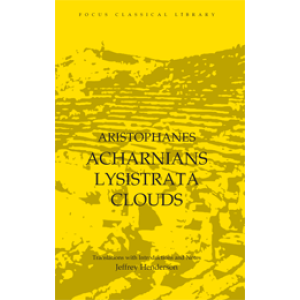
![]() Acharnians, Lysistrata, CloudsThis anthology offers English translations of three of Aristophanes' greatest comedies, Acharnians, Clouds, and Lysistrata, by Jeffrey Henderson, one of the most important scholars and translators of Greek comedy. Each comedy is also available in a single-play edition from Hackett Publishing's Focus imprint. Learn More
Acharnians, Lysistrata, CloudsThis anthology offers English translations of three of Aristophanes' greatest comedies, Acharnians, Clouds, and Lysistrata, by Jeffrey Henderson, one of the most important scholars and translators of Greek comedy. Each comedy is also available in a single-play edition from Hackett Publishing's Focus imprint. Learn More -
![]() Lysistrata (Henderson Edition)
Lysistrata (Henderson Edition)Henderson's English translation of Lysistrata, the most popular of Aristophanes' plays, appeals to the modern reader because of its lively and imaginative plot, strong and memorable heroine, good jokes, and appeal for peace and tolerance between nations and between the sexes. Jeffery Henderson, noted Greek scholar, puts the work in historical and cultural context in his comprehensive introduction. Suggestions for further reading, notes, and map are also included.
Learn More -
![]() Clouds (Meineck Edition)
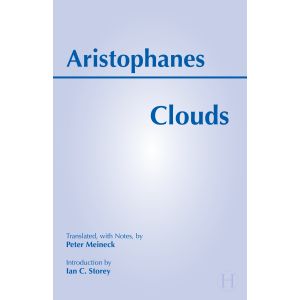
Clouds (Meineck Edition)"Since the appearance of Sommerstein’s very successful literal translation less than twenty years ago, there have been at least five further new published attempts at rendering the play into English. It is certainly a bold enterprise to introduce yet one more translation onto the scene, but Peter Meineck has risen well to the challenge. The translation is straightforward and idiomatic, as well as well-paced and funny. . . Ian Storey’s Introduction is perfect for undergraduates.” —Max Nelson, Bryn Mawr Classical Review
Learn More -
![]() Lysistrata (Ruden Edition)
Lysistrata (Ruden Edition)"Presents a readable, clear translation with the assistance students will need to understand this play and the society that produced it. . . . A worthy addition to Hackett's growing series of translations of classical literature in accessible editions."
Learn More
—Anne Mahoney, New England Classical Journal -
![]() Frogs (Henderson Edition)
Frogs (Henderson Edition)"Overall . . . I find this translation of the Frogs to be entertaining and very readable. Furthermore, Henderson's comprehensive introduction makes this translation quite useful for general readers or students at any level."
Learn More
—Erin K. Moodie, Bryn Mawr Classical Review -
![]() Forty-Six Stories in Classical Greek
Forty-Six Stories in Classical GreekThese forty-six Classical Greek readings provide entertaining and thought-provoking passages, in increasing difficulty, from the great authors of Classical Greece, from Plato and Xenophon to Aesop, Aristophanes, and Thucydides. Forth-Six Stories can be used for translation, reading, exploring Greek culture, and reviewing grammar and vocabulary. Course instructors: An electronic translation key (PDF) for Forty-Six Stories in Classical Greek (PDF only) is available for qualified adopters. If you have adopted the text, click here to request the translation key.
Learn More -
![]() Oresteia
Oresteia“Peter Meineck’s new rendition of the Oresteia is that rare and wonderful thing: a text accessible to the Greekless audience while still preserving the vocabulary of Aeschylus. Those of us who have seen Peter Meineck's performances have long marveled at his ability to turn Greek into clear English, how he does not do ‘versions’ of the plays, how he does not rewrite the ancients into modern jargon (even his comedies maintain more Aristophanic text than is usual). Here lines that students have always needed explicated stand clear. . . . Helene Foley has provided a fine introduction for this translation. Introduction and translation together provide an exciting text, one that should be widely read, widely used.” —Karelisa Hartigan, University of Florida, in The Classical Outlook
Learn More -
![]() Homeric Hymns (Ruden Edition)
Homeric Hymns (Ruden Edition)"Sarah Ruden's translation is clear, lean, intelligent, and delightfully readable. The notes provide guidance without encumbering the text. This will be marvelous for classroom use, for reading aloud, or simply for reading for pleasure."
Learn More
—Pamela Gordon, Department of Classics, University of Kansas -
![]() Symposium (Sharon Edition)
Symposium (Sharon Edition)"The Symposium challenges the translator who is also a poet in its range of styles which is unique among the Platonic dialogues. Not only does the translator have to mimic the distinct style of the narrator, Apollodoros, and the seven symposiasts . . . he has to mind and represent the action in this the most dramatic of the Platonic dialogues. Sharon's translation meets these challenges and is a brilliant recovery of the style and drama of the Symposium. I know of no other translation that is so appropriately various in the styles adopted by and for the speakers or which is so attentive to the drama of this dialogue which celebrates a tragic victory."
Learn More
—Diskin Clay, Duke University -
![]() Readings in Classical Political Thought
Readings in Classical Political Thought“A distinctive and superior collection of texts suitable for both graduate and undergraduate courses. There is nothing like it elsewhere. Steinberger’s commentary is succint, accurate, and very useful.”
Learn More
—Dr. Melvin Kulbicki, York College of Pennsylvania -
![]() Race and Ethnicity in the Classical World
Race and Ethnicity in the Classical World"This highly affordable, lively and wide-ranging anthology will be an invaluable study resource for courses on ancient identities and ideas about foreigners. . . . It will also appeal to the general reader interested in exploring what Greeks and Romans thought and wrote about peoples often styled 'barbarian,' not least because knowledge of such material was instrumental in the formation of the modern disciplines of anthropology, ethnography and geography. Both the high quality of the translation and the fact that it presents sizable chunks of text for students to ponder make it an ideal teaching text. Wild flights of fancy, tales of mythical monstrosity and cruel/bizarre stereotypes sit side-by-side. Dicaeopolis's response seems the most apt: 'Wowzers!'" —Journal of Classics Teaching
Learn More














Filter