The Hackett Signature Editions Collection Featuring Premium Hardcovers of Hackett Classics - Learn More Here.

Classical Studies



-
![]() Latin Prose Composition
Latin Prose CompositionThis classic text has been reset and reprinted based on the classic North and Hillard text. It includes all common words and constructions, special vocabularies, rules for the orders of words, list of synonyms and prepositional phrases, and more. Course Instructors: An electronic (PDF) answer key available to qualified course instructors who have adopted this text for their course, (not available for sale to students). If you have adopted this text, click here to request a copy of the answer key.
Learn More -
![]() Magic, Reason and Experience
Magic, Reason and ExperienceThis study of the origins and progress of Greek science focuses especially on the interaction between scientific and traditional patterns of thought from the sixth to the fourth century BC. It begins with an examination of how particular Greek authors deployed the category of "magic," sometimes attacking its beliefs and practices; these attacks are then related to their background in Greek medicine and philosophical thought. In his second chapter Lloyd outlines developments in the theory and practice of argument in Greek science and assesses their significance. He next discuses the progress of empirical research as a scientific tool from the Presocratics to Aristotle. Finally, he considers why the Greeks invented science, their contribution to its history, and the social, economic, ideological and political factors that had a bearing on its growth.
Learn More -
![]() Science, Folklore and Ideology
Science, Folklore and Ideology"[A] model of eclectic methodology, giving a fascinating picture of ancient views of animals, man, and medicine at the interface of popular belief and philosophy, of folklore and science, of ideology and criticism."
Learn More
—Helen King, Medical History -
![]() Plautus and Terence: Five Comedies
Plautus and Terence: Five Comedies"This is a book worthy of high praise. . . . All versions are exceedingly witty and versatile, in verse that ripples from one’s lips, pulling all the punches of Plautus, the knockabout king of farce, and proving that the more polished Terence can be just as funny. Accuracy to the original has been thoroughly respected, but look at the humour in rendering Diphilius’ play called Synapothnescontes as Three’s a Shroud. . . . Students in schools and colleges will benefit from short introductions to each play, to Roman stage conventions, to different types of Greek and Roman comedy, and there is a note on staging, with a diagram illustrating a typical Roman stage and further diagrams of the basic set for each play. The translators have paid more attention to stage directions than is usually given in translations, because they aim to show how these plays worked. This is a book to be used and enjoyed.”
Learn More
—Raymond J. Clark, The Classical Outlook -
![]() Statesman (Rowe Edition)
Statesman (Rowe Edition)“The original publication of Rowe’s translation in 1995 was a landmark event in the study of this fascinating but enigmatic dialogue. Based on a careful and convincing revised Greek text, the contemporary English of this unpretentious, clear, and—above all—accurate revised version make it by far the best available. In fact, Rowe’s translation is now and will surely remain the only acceptable choice.”
Learn More
—John Cooper, Princeton University -
![]() The Birds
The BirdsJeffrey Henderson's translation of Aristophanes' The Birds includes essays on Old Comedy and the Theater of Dionysus, suggestions for further reading, notes on production, and a general bibliography.
Learn More -
![]() Elementary Latin Exercises
Elementary Latin ExercisesDesigned as an introduction to North and Hillard's Latin Prose Composition. Presents the beginner with the simplest vocabulary and the most elementary forms of sentence construction. Includes both English-Latin and Latin-English exercises.
Learn More -
![]() Greek Prose Composition
Greek Prose CompositionFocus Edition of the classic British text, including original typesetting. Standard Greek, including all common words and constructions, special vocabularies, a general vocabulary, irregular verbs, a list of prepositional phrases, and more. Course Instructors: An electronic (PDF) answer key available to qualified course instructors who have adopted this text for their course, (not available for sale to students). If you have adopted this text, click here to request a copy of the answer key.
Learn More -
![]() Empire and the Ends of Politics
Empire and the Ends of PoliticsThis text brings together for the first time two complete key works from classical antiquity on the politics of Athens: Plato's Menexenus and Pericles' Funeral Oration (from Thucydides' history of the Peloponnesian War).
Learn More -
![]() Lingua Latina: Indices
Lingua Latina: IndicesIndices contains list of Roman consuls and their triumphs (Fasti consulares and Fasti triumphales), a name index (Index nominum) and a word index (Index vocabulorum) of all the words used in both parts of the course. An integral supplement to Roma Aeterna.
Learn More -
![]() Lingua Latina: Pars I: Latine Disco: Student's Manual (in English)
Lingua Latina: Pars I: Latine Disco: Student's Manual (in English)This student's manual, in English, for Familia Romana (Lingua Latina Pars I), includes a guide to pronunciation, instructions, and information on key points to be noted in each chapter. This book is especially valuable for students working on their own or in homeschooling, though also useful for school or university students. Pars 1: Latin Disco is also included in A Companion to Familia Romana (Second Edition).
The 2025 printing (this book) includes the same content as the previous printings (ISBN: 978-1-58510-050-7) with improved and enlarged text design and layout.
Learn More -
![]() Cratylus
Cratylus“It is. . . remarkable that Reeve’s is the first new English translation since Fowler’s Loeb edition of 1926. Fortunately, Reeve has done an excellent job. His version is not slavishly literal but is in general very accurate. It is also very clear and readable. Reeve is particularly to be congratulated for having produced versions of some of the more torturous passages, which are not only faithful to the text but also make good sense in English. The long and detailed introduction is worth reading in its own right.”
Learn More
—R. F. Stalley, The Classical Review -
![]() Bacchae (Woodruff Edition)
Bacchae (Woodruff Edition)"[Woodruff’s translation] is clear, fluent, and vigorous, well thought out, readable and forceful. The rhythms are right, ever-present but not too insistent or obvious. It can be spoken instead of read and so is viable as an acting version; and it keeps the lines of the plot well focused. The Introduction offers a good survey of critical approaches. The notes at the foot of the page are suitably brief and nonintrusive and give basic information for the non-specialist."
Learn More
—Charles Segal, Harvard University -
![]() Oresteia
Oresteia“Peter Meineck’s new rendition of the Oresteia is that rare and wonderful thing: a text accessible to the Greekless audience while still preserving the vocabulary of Aeschylus. Those of us who have seen Peter Meineck's performances have long marveled at his ability to turn Greek into clear English, how he does not do ‘versions’ of the plays, how he does not rewrite the ancients into modern jargon (even his comedies maintain more Aristophanic text than is usual). Here lines that students have always needed explicated stand clear. . . . Helene Foley has provided a fine introduction for this translation. Introduction and translation together provide an exciting text, one that should be widely read, widely used.” —Karelisa Hartigan, University of Florida, in The Classical Outlook
Learn More -
![]() Aristophanes 1: Clouds, Wasps, Birds
Aristophanes 1: Clouds, Wasps, BirdsOriginally adapted for the stage, Peter Meineck’s revised translations achieve a level of fidelity appropriate for classroom use while managing to preserve the wit and energy that led The New Yorker to judge his Clouds “The best Greek drama we’ve ever seen anywhere,” and The Times Literary Supplement to describe his Wasps as “Hugely enjoyable and very, very funny.” A general Introduction, introductions to the plays, and detailed notes on staging, history, religious practice and myth combine to make this a remarkably useful teaching text.
Learn More -
![]() Phaedo (Brann, Kalkavage, & Salem Edition)
Phaedo (Brann, Kalkavage, & Salem Edition)"This marvelously conceived new translation of Plato's most important dialogue will set the standard for classroom use for many years to come. . . . The authors' imaginative new interpretation will inspire students and generate scholarly controversy-and is thus certain to accomplish what it suggests is the true aim of Socratic inquiry: the weaving, unweaving, and perpetual re-weaving of the Logos."
Learn More
—Dr. George R. Lucas, Jr., Professor of Philosophy, US Naval Academy, Annapolis -
![]() The Law of Athens, Volume 1 of 2
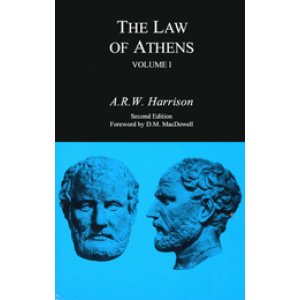
The Law of Athens, Volume 1 of 2Volume one of a two-volume set. It may be purchased separately or in conjunction with volume two. Volume I, completed in 1968, gives a systematic account of classical Athenian law concerning family and property. Volume II, on the law of obligations and of procedure, was unfinished at the time of the author’s death in 1969. The part which concerns procedure was virtually complete and, edited by D. M. MacDowell, appeared in 1971. MacDowell has provided a new Foreword for this edition as well as a select bibliography (from 1967 to the present), which appears in both volumes. Together these distinguished works form the most detailed study of Athenian law in the last half-century.
Learn More -
![]() The Law of Athens, Volume 2 of 2
The Law of Athens, Volume 2 of 2Volume two of a two-volume set. It may be purchased separately or in conjunction with volume one. Both volumes are available in a cloth edition when purchased together as a set. Volume I, completed in 1968, gives a systematic account of classical Athenian law concerning family and property. Volume II, on the law of obligations and of procedure, was unfinished at the time of the author’s death in 1969. The part which concerns procedure was virtually complete and, edited by D. M. MacDowell, appeared in 1971. MacDowell has provided a new Foreword for this edition as well as a select bibliography (from 1967 to the present), which appears in both volumes. Together these distinguished works form the most detailed study of Athenian law in the last half-century.
Learn More -
![]() The Law of Athens, 2 Volume Set
The Law of Athens, 2 Volume SetVolume I, completed in 1968, gives a systematic account of classical Athenian law concerning family and property. Volume II, on the law of obligations and of procedure, was unfinished at the time of the author’s death in 1969. The part which concerns procedure was virtually complete and, edited by D. M. MacDowell, appeared in 1971. MacDowell has provided a new Foreword for this edition as well as a select bibliography (from 1967 to the present), which appears in both volumes. Together these distinguished works form the most detailed study of Athenian law in the last half-century.
Learn More -
![]() The Peloponnesian War
The Peloponnesian WarThe first unabridged translation into American English, and the first to take into account the wealth of Thucydidean scholarship of the last half of the twentieth century, Steven Lattimore’s translation sets a new standard for accuracy and reliability. Notes provide information necessary for a fuller understanding of problematic passages, explore their implications as well as the problems they may pose, and shed light on Thucydides as a distinctive literary artist as well as a source for historians and political theorists.
"[Lattimore] gets closer to the Greek than either of his two available rivals, Richard Crawley and Rex Warner. . . . Lattimore’s uncompromising version now leads the field." —Peter Green, The Los Angeles Times Book Review
Learn More -
![]() Politics (Reeve Edition)
Politics (Reeve Edition)“The beautifully crafted English of Reeve’s translation is as crisp and lucid as Aristotle’s Greek. One is constantly impressed with Reeve’s instinct for the right word in rendering the rich vocabulary of Aristotle’s thoughts about politics and for his ability to capture the subtleties of Aristotelian syntax. Highly recommended.” —David Keyt, University of Washington
“This is an admirable translation, meticulous in its attention to Aristotle’s Greek and judicious in its phrasing and choice of terms. It should prove invaluable to beginning students and scholars alike.” —Richard Kraut, Northwestern University
Learn More -
![]() Meno (Anastaplo & Berns Edition)
Meno (Anastaplo & Berns Edition)"This new translation of the Meno by Anastaplo and Berns has several distinctive features that make it useful for teaching and studying the dialogue. Generally achieving a balance between clarity and faithfulness, it includes valuable annotation, two appendices . . . and an innovative division of the text through the provision of numbers for each of it's speeches. . . . The overall result is a text that would give a reader unschooled in Greek a fairly reliable sense of the flow of ideas in the original."
Learn More
—William A. Welton, Loyola College, in Review of Metaphysics -
![]() A Horace Reader
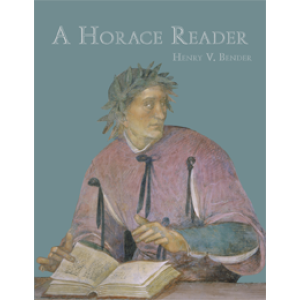
A Horace ReaderIntended for the Latin student with three years of Latin experience who is preparing for the Advanced Placement examination in Latin literature, this text offers a complete and thorough preparation, including an introduction to Horace's life and work, Latin text of 28 poems with facing notes, glossaries on meter and figures of speech, and a complete vocabulary. Each poem is introduced by a brief summary in English.
Learn More -
![]() Bacchae (Esposito Edition)
Bacchae (Esposito Edition)English translation, with introductory material, notes, glossary and essay by Stephen Esposito, of Euripides' tragedy based on the mythological story of King Pentheus of Thebes.
Learn More -
![]() Terence: Brothers
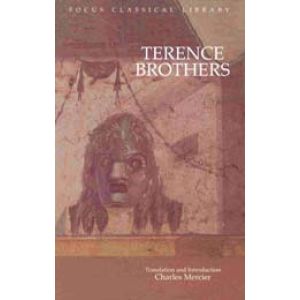
Terence: BrothersThis is an English translation of Terence's Roman comedy that deals with questions of perennial interest: "How best to raise children?" and "How to give self-disinterested moral advice?"
Learn More -
![]() Antigone (Blondell Edition)
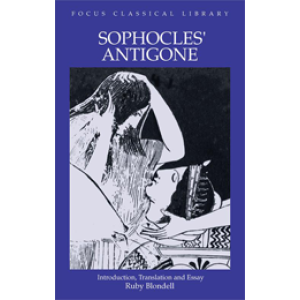
Antigone (Blondell Edition)"In her new translation of Antigone, Ruby Blondell demonstrates an unswerving sense of what the general reader needs to know in order not only to understand Sophocles, but to relish him as well… My own students have found that this edition not only makes the Antigone accessible, but also helps them understand why it continues to fascinate, to disturb, and to grip its readers century by century." —John T. Kirby, Comparative Literature, Purdue University
Learn More -
![]() Symposium (Sharon Edition)
Symposium (Sharon Edition)"The Symposium challenges the translator who is also a poet in its range of styles which is unique among the Platonic dialogues. Not only does the translator have to mimic the distinct style of the narrator, Apollodoros, and the seven symposiasts . . . he has to mind and represent the action in this the most dramatic of the Platonic dialogues. Sharon's translation meets these challenges and is a brilliant recovery of the style and drama of the Symposium. I know of no other translation that is so appropriately various in the styles adopted by and for the speakers or which is so attentive to the drama of this dialogue which celebrates a tragic victory."
Learn More
—Diskin Clay, Duke University -
![]() Hellenistic Philosophy (Second Edition)
Hellenistic Philosophy (Second Edition)This new edition of Hellenistic Philosophy—including nearly 100 pages of additional material—offers the first English translation of the account of Stoic ethics by Arius Didymus, substantial new sources on Epicureanism, Stoicism, and Scepticism, expanded representation of Plutarch and Cicero, and a fuller presentation of papyrological evidence. Inwood and Gerson maintain the standard of consistency and accuracy that distinguished their translations in the first edition, while regrouping some material into larger, more thematically connected passages. This edition is further enhanced by a new, more spacious page design.
Learn More -
![]() The Original Sceptics
The Original Sceptics"The Original Sceptics contains a wealth of analysis, argument and philological comment, and it undoubtedly succeeds in making the reader aware of the difficulties involved in discovering what the ancient sceptics really held.”
Learn More
—F. C. White, Australasian Journal of Philosophy -
![]() Plato's Cosmology
Plato's Cosmology“An indispensable storehouse of information and analysis—essential reading nowadays just as in 1935, when it first appeared. . . . Plato’s Cosmology continues to be the constant reference point of any serious study of the Timaeus.”
Learn More
—John M. Cooper, Princeton University -
![]() Plato: Complete Works
Plato: Complete Works"This is clearly the definitive edition in English of the Platonic writings. It replaces completely the Hamilton-Cairns collection. . . . The notes are at just the right level, and the index is very helpful. The translations are both readable and accurate." —Michael D. Rohr, Rutgers University
"The most important publishing event in Platonic translation is the Complete Works edited by Cooper and Hutchinson. . . . Hackett has lavished great care in the production of this volume: fine India paper, elegant typography, sewn binding, and cloth boards. . . . It should be in every library and on the shelves of all lovers of Plato." —Steven J. Willett, Syllecta Classica
Learn More -
![]() Iliad
Iliad"Gripping. . . . Lombardo's achievement is all the more striking when you consider the difficulties of his task. . . . [He] manages to be respectful of Homer's dire spirit while providing on nearly every page some wonderfully fresh refashioning of his Greek. The result is a vivid and disarmingly hardbitten reworking of a great classic." —Daniel Mendelsohn, The New York Times Book Review
"It is hard to overstate the attractions of this translation. In a rhythm sinewy and flexible, with language that is precise, lyrical and fresh, Lombardo's Iliad pulses with all the power and luminosity of the Greek. He shows extraordinary sensitivity to the images and aural effects of the ancient poem. There are brilliant touches on every page. . . . Altogether this is as good as Homer gets in English." —Richard P. Martin, Princeton University
Learn More -
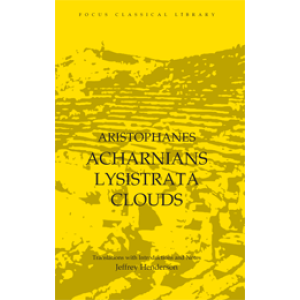
![]() Acharnians, Lysistrata, CloudsThis anthology offers English translations of three of Aristophanes' greatest comedies, Acharnians, Clouds, and Lysistrata, by Jeffrey Henderson, one of the most important scholars and translators of Greek comedy. Each comedy is also available in a single-play edition from Hackett Publishing's Focus imprint. Learn More
Acharnians, Lysistrata, CloudsThis anthology offers English translations of three of Aristophanes' greatest comedies, Acharnians, Clouds, and Lysistrata, by Jeffrey Henderson, one of the most important scholars and translators of Greek comedy. Each comedy is also available in a single-play edition from Hackett Publishing's Focus imprint. Learn More -
![]() Aristotle: Introductory Readings
Aristotle: Introductory ReadingsDrawn from the translations and editorial aids of Irwin and Fine's Aristotle, Selections (Hackett Publishing Co., 1995), this anthology will be most useful to instructors who must try to do justice to Aristotle in a semester-long ancient-philosophy survey, but it will also be appropriate for a variety of introductory-level courses. Introductory Readings provides accurate, readable, and integrated translations that allow the reader to follow Aristotle's use of crucial technical terms and to grasp the details of his argument. Included are adaptations of the glossary and notes that helped make its parent volume a singularly useful aid to the study of Aristotle.
Learn More -
![]() Parmenides (Gill & Ryan Edition)
Parmenides (Gill & Ryan Edition)“Gill’s and Ryan’s Parmenides is, simply, superb: the Introduction, more than a hundred pages long, is transparently clear, takes the reader meticulously through the arguments, avoids perverseness, and still manages to make sense of the dialogue as a whole; there is a fine selective bibliography; and those parts of the translation I have looked at in detail suggest that it too is very good indeed.”
Learn More
—Christopher Rowe, Phronesis -
![]() Greek Lyric
Greek Lyric“Miller is one of the ablest experts in the language of Greek poetry, and he has a razor-sharp sense for the nuances of the wording. A lastingly important sourcebook; I strongly recommend it.”
Learn More
—Gregory Nagy, Harvard University -
![]() Parmenides (Whitaker Edition)
Parmenides (Whitaker Edition)"Keith Whitaker's insightful introduction to this notoriously daunting text is valuable for its clarity and sobriety. The lucid interpretation will be of interest to those versed in the text and will be of great help to any who encounter the dialogue for the first time. The engaging translation humanizes the discourse without compromising its precision-a notable achievement that will earn the gratitude of readers."
Learn More
—Joseph Cropsey, University of Chicago -
![]() Sophist (Brann, Kalkavage, & Salem Edition)
Sophist (Brann, Kalkavage, & Salem Edition)This is an English translation of Plato presenting a new conception of the Theory of Forms. Socrates and others discuss the epistemological and metaphysical puzzles of the Parmenides, with aims to define the meaning of the Sophist. The glossary of key terms is a unique addition to Platonic literature by which concepts central to each dialogue are discussed and cross-referenced as to their occurrences throughout the work. In such a way students are encouraged to see beyond the words into concepts.
Learn More -
![]() The Presocratics
The PresocraticsThis comprehensive account of the history of ancient Greek thought circa 600 to 400 B.C. offers an accessible, nontechnical introduction to Presocratic philosophy. Translations of the surviving fragments of Presocratic writings serve as a foundation from which the discussion proceeds. Also included are maps, notes, and an index of names and terms. (Co-published in the U.K. by Gerald Duckworth and Company, Ltd. HPC holds rights in North America and U.S. Dependencies)
Learn More -
![]() Neoplatonism
Neoplatonism“An admirable account of a very difficult subject, remarkable for the erudition that clearly lies behind it as well as for its lucidity and good sense.”
Learn More
—Times Literary Supplement -
![]() Aristotle: Selections
Aristotle: SelectionsSelections seeks to provide an accurate and readable translation that will allow the reader to follow Aristotle's use of crucial technical terms and to grasp the details of his argument. Unlike anthologies that combine translations by many hands, this volume includes a fully integrated set of translations by a two-person team. The glossary—the most detailed in any edition—explains Aristotle's vocabulary and indicates the correspondences between Greek and English words. Brief notes supply alternative translations and elucidate difficult passages.
Learn More -
![]() The Greek and Roman Critics
The Greek and Roman Critics“An indispensable guide for anyone who wishes to study that . . . section of Greek and Latin literature which we should consider literary criticism.”
Learn More
—A. H. Armstrong -
![]() Phaedrus (Nehamas & Woodruff Edition)
Phaedrus (Nehamas & Woodruff Edition)"A superb translation that captures the rhetorical brilliance of the Greek. . . . The translation is faithful in the very best sense: it reflects both the meaning and the beauty of the Greek text. . . . The footnotes are always helpful, never obtrusive. A one-page outline is useful since there are no editorial additions to mark major divisions in the dialogue. An appendix containing fragments of early Greek love poetry helps the reader appreciate the rich, and perhaps elusive, meaning of eros. . . . The entire Introduction is crisply written, and the authors' erudition shines throughout, without a trace of pedantry. . . . this is an excellent book that deservedly should find wide circulation for many years to come."
Learn More
—Tim Mahoney, University of Texas at Arlington






















Filter