The Hackett Signature Editions Collection Featuring Premium Hardcovers of Hackett Classics - Learn More Here.

Browse All
-
![]() The History of Rome, Books 1-5
The History of Rome, Books 1-5"Dr. Warrior . . . wisely chose to be more literal than free, and she happily refrained from importing 'new and false metaphors'. . . . Her translation, accurate at every turn, is complemented with useful footnotes, especially in those parts of the work (e.g., the Preface) that need special elucidation. The scholarship that went into these footnotes, as well as into the appendix articles and Dr. Warrior's own Introduction, is current and of a very high quality. (I do not think I have ever read a better introduction to Livy.) A useful bibliography and several maps contribute to the excellence of a book, which, like Livy's own work, is not likely ever to be surpassed." —Blaise Nagy, College of the Holy Cross
Learn More -
![]() The Government of the Qin and Han Empires
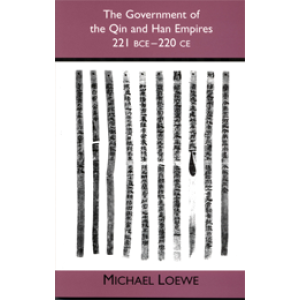
The Government of the Qin and Han EmpiresIn this concise volume, Michael Loewe provides an engaging overview of the government of the early empires of China. Topics discussed are: the seat of supreme authority; the structure of central government; provincial and local government; the armed forces; officials; government communications; laws of the empire; control of the people and the land; controversies; and problems and weaknesses of the imperial system. Enhanced by details from recently discovered manuscripts, relevant citations from official documents, maps, a chronology of relevant events, and suggestions for further reading keyed to each topic, this work is an ideal introduction to the ways in which China’s first emperors governed.
Learn More -
![]() Butterfly Mother
Butterfly Mother"Talk about 'persistent cultures'—this translation of the great epic, mythic tellings of the Miao/Hmong peoples is a window into a huge ancient soul of sustainable spirit and practice. Mark Bender's commentary provides context and details of places and singers that makes it even richer. This book provides new insights into how deeply oral recitation and performance can be embedded in a whole society, and some fresh, stunning stories."
Learn More
—Gary Snyder, author of Mountains and Rivers Without End -
![]() The Faerie Queene, Book Two
The Faerie Queene, Book Two"Teachers of Spenser will also welcome two more installments of the Hackett editions of separate books of The Faerie Queene under the general editorship of Abraham Stoll, this time on books 2 and on books 3 and 4. In my view, these are the most attractive, inexpensive, but also comprehensive editions to date, with far better (and easy to read) notes on mythology and name symbolism (matters increasingly foreign to our undergraduates) than almost all previous versions."
Learn More
—Catherine Gimelli Martin, Studies in English Literature 1500-1900 -
![]() Edgar Huntly; or, Memoirs of a Sleep-Walker
Edgar Huntly; or, Memoirs of a Sleep-Walker"This is now the edition of choice for those of us who teach Brown's fascinating Edgar Huntly. Barnard and Shapiro explore the relevant historical, cultural, and literary backgrounds in their illuminating Introduction; they skillfully annotate the text; they provide useful and up-to-date bibliographies; and they append a number of revealing primary texts for further cultural contextualization. This edition will help to stimulate new thinking about race, empire, and sexuality in Brown's prescient novel of the American frontier." —Robert S. Levine, University of Maryland
"The striking painting by a French artist on the cover of this American novel signals the editors' refreshing approach to Edgar Huntly through trans-Atlantic discourses of empire, radical-democratic social theory, sensibility, and sexuality. . . .This edition provides students with the tools to contextualize and analyze Edgar Huntly, including an extensive bibliography of relevant scholarship and footnotes that define unfamiliar words, give historical background, or refer the reader back to the introduction. Barnard and Shapiro's selection of related texts from works including William Godwin's Political Justice and Brown's essays gives students insight on Edgar Huntly's sources." —Yvette Piggush, Journal of the Early Republic
Learn More -
![]() Readings in Han Chinese Thought
Readings in Han Chinese Thought"A judicious selection from primary sources to illustrate the growth of ideas in early imperial times. Teachers and students will welcome these readable translations of passages drawn from Han writings that are not widely known and which add depth to existing views of Chinese ways of thought, religious practices, and means of government."
Learn More
—Michael Loewe, University of Cambridge -
![]() Quest for Harmony
Quest for Harmony"Finally I have found a book that combines many of the aspects I like to see included in readings for a course in Native American religions. . . . This publication combines historical overview and geographical diversity in its presentation of four Native American traditions. It includes the importance of the land, less well-known events and episodes in North American history, stereotyping, and contemporary problems and accomplishments."
Learn More
—Anine Singh-de Grood, Department of Religious Studies, Oklahoma State University -
![]() A Tale of Two Melons
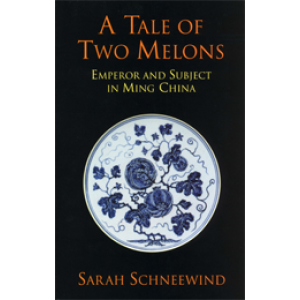
A Tale of Two Melons"Undergraduates will join specialists in enjoying this feast of melons. Schneewind's marvelous little book is at once a primer in some key aspects of China's traditional civilization and history, as well as a case study of an obscurely understood event that took place in 1372, in the reign of Taizu, founder of the Ming Dynasty (1368-1644). When two melons share a single stalk, and a local grower presents the anomaly to the emperor, the symbolism, the intentions of the giver, the reaction of the recipient, and the meaning of the whole act to observers and later commentators turn out to be anything but straightforward. Divergent interpretations began immediately, and continue to the present day."
Learn More
—John Dardess, University of Kansas -
![]() The Underdogs
The UnderdogsIn addition to a fresh translation of Los de Abajo, Azuela's classic novel of the Mexican Revolution, this volume offers both a general Introduction to the work and an extensive appendix setting the novel in its historical, literary, and political context. Related texts include contemporary reviews of Azuela's book, an excerpt from Anita Brenner's Idols Behind Altars (1929), and selections from John Reed's Insurgent Mexico (1914).
"Pellón's translation marks a clear improvement over the previous English versions of this seminal novel. Pellón captures the crisp, tense, and terse dialogue of Azuela's original, and I believe that his decision to leave some words in Spanish is a good one, given that most of the words involved are already well known to the non-Spanish speaking public. The retention of these Spanish words adds flavor to the translation without turning it into a 'Taco Bell' version of the novel. I am so enthusiastic about Pellón's translation that I believe it should become the standard edition of Los de Abajo read in America. . . In short, this new translation is worthy of the classic on which it is based. I will certainly use it in my courses, but more to the point, I will recommend it to my colleagues teaching courses on English literature, Comparative literature, and American studies." —Roberto González Echevarría, Sterling Professor of Hispanic and Comparative Literatures, Yale University
Learn More -
![]() Confessions (Sheed, Second Edition)
Confessions (Sheed, Second Edition)"This translation is already a classic. It is the translation that has guided three generations of students and readers into a renewed appreciation of the beauty and urgency of a masterpiece of Christian autobiography. This is largely because the translator has caught not only the meaning of Augustine’s Confessions, but a large measure of its poetry. It makes the Latin sing in English as it did when it came from the pen of Augustine, some sixteen hundred years ago. Deeply rooted in the tradition of which Augustine was himself a principal founder, this translation is not only modern: it is a faithful echo, in a language that has carried throughout the ages, of its author’s original passion and disquiet." —Peter Brown
"To my ears, Sheed’s translation is the most beautiful English translation available. The same electric current that runs through Augustine’s original can be felt in this translation, which combines a slightly elevated style (more elevated in direct prayers) combined with the immediacy and transparency of a street preacher (not that different from Augustine’s own style). The latest edition includes an introduction by Peter Brown, the best biographer of Augustine, and notes and commentary by Michael Foley, a truly excellent reader of Augustine." —Jared Ortiz, Hope College, in Catholic World Report
Learn More -
![]() Poetics (Sachs Edition)
Poetics (Sachs Edition)"I find the Introduction extremely convincing, lucid, learned, fair to past scholarship, and truly illuminating about the meaning of tragedy in general and about the very specific acceptions of hamartia, katharsis, ekplêxis, and thauma, in the context of an appropriate understanding of the Poetics. Another remarkable feature is the dexterity and ease with which it draws on all the relevant parts of the Aristotelian corpus to shed light on troublesome textual passages in the Poetics. Finally, the style of the Introduction is straightforward, free of unnecessary jargon, direct, and economical, the best interpretation of the Poetics I ever read." —Sabetai Unguru, Tel Aviv University
Learn More -
![]() Survey of French Literature, Volume IV: The 19th Century (Third Edition)
Survey of French Literature, Volume IV: The 19th Century (Third Edition)A new edition of a classic anthology, published in five convenient and inexpensive volumes, updated for the modern student. Selections in French, with introductory material and notes in English. Includes time lines, introductions to each period and its culture, and short biographies of the authors.
Learn More -
![]() Plato on Love
Plato on LoveThis collection features Plato's writings on sex and love in the preeminent translations of Stanley Lombardo, Paul Woodruff and Alexander Nehamas, D. S. Hutchinson, and C. D. C. Reeve. Reeve's Introduction provides a wealth of historical information about Plato and Socrates, and the sexual norms of classical Athens. His introductory essay looks closely at the dialogues themselves and includes the following sections: Socrates and the Art of Love; Socrates and Athenian Paiderastia; Loving Socrates; Love and the Ascent to the Beautiful; The Art and Psychology of Love Explained; and Writing about Love.
Learn More -
![]() Selected Writings of James Madison
Selected Writings of James Madison"This valuable anthology of the framer's essential writings allows readers to experience the panoramic depth of Madison's mind. For those just beginning their study, Ketcham's choices offer a meaningful introduction to Madison's complex view of the whole. . . . Of special note is the final section, in which Ketcham provides a selection of Madison's treatises on issues that cut the Union asunder in the decade prior to the Civil War. In this reviewer's mind, the editor is to be praised for his efforts in assembling such a comprehensive, cohesive, and concise collection. Summing Up: Essential."
Learn More
—M. J. C, Taylor, CHOICE -
![]() Arbeitsbuch zu German Culture through Film
Arbeitsbuch zu German Culture through FilmThe second book in a two book series on German film study, Arbeitsbuch zu German Culture through Film covers 14 of the 31 films covered in the first book in the series in German with an emphasis on German language skills. The first book in the series, German Culture Through Film: An Introduction to German Cinema, covers 31 German films in English.
For additional film resources visit Reinhard Zachau's German film website.
Learn More -
![]() Engaging Philosophy
Engaging Philosophy"Provides a wonderful and unique introduction to philosophy—not just to its central questions and the creative answers (some classic and enduring, some cutting-edge) that philosophers have given, but also to the shared techniques, style, and wonderment that makes philosophy so, well, engaging. The book can clearly be used on its own, or along with a selection of the philosophical texts it discusses. Particularly useful in this regard are the study questions and further reading suggestions that come at the end of each chapter."
Learn More
—Joseph G. Moore, Amherst College -
![]() Gorgias (Arieti & Barrus Edition)
Gorgias (Arieti & Barrus Edition)"Arieti and Barrus have provided us with a fine contribution to the literature on Plato's Gorgias. This text includes a literal translation of the Gorgias with a helpful introductory essay, and copious notes. It includes a priceless appendix of the only literal translations available today of several key speeches from Thucydides, as well as a valuable glossary and appendices on the rules of dialectic that may be derived from the arguments of the Gorgias, and on Plato's use of the terms mythos and logos, with which not all scholars may agree, but which I think all should find of interest."
Learn More
—Michael Palmer, University of Maine -
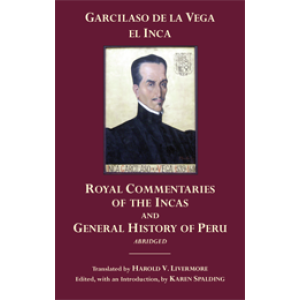
![]() The Royal Commentaries of the Incas and General History of Peru, Abridged
The Royal Commentaries of the Incas and General History of Peru, Abridged"Karen Spalding's abridgment of Livermore's translation is an excellent example of what a sourcebook for classroom use should be. It has a wonderfully enlightening Introduction and the texts are well selected, allowing students to grasp the breath, complexity, and importance of Garcilaso's work. This book enables teachers and professors to expose their students to a unique literary, historical, and artistic production by a mestizo who reflects on both conquest and miscegenation in early colonial Peru." —Tamar Herzog, Stanford University
"Abridging fifteen hundred pages to a concise two-hundred-page book, Karen Spalding has provided educators with a text that makes this important author accessible to undergraduates. . . . By publishing both parts of his history together . . . Spalding encourages students to compare the rational Inca state with the corruption anad deception of Spanish administrators—exactly as Garcilaso had intended. . . . Spalding's abridgment of Garcilaso carefully includes excerpts from the major issues detailed in Garcilaso's rich history." —R. Jovita Baber, (University of Illinois-Champaign), in The Sixteenth Century Journal
Learn More -
![]() The Treatise on the Divine Nature
The Treatise on the Divine Nature"Fr Shanley's translation is clear, idiomatic, and accurate. A particular virtue of the translation is that it frequently indicates along the way which Latin terms are being rendered into English as Fr Shanley renders them. This kind of flagging will help readers to get a better sense of what Aquinas is saying than they might otherwise do. . . . [The] commentary is lucid, well informed, clearly written, and, given its word count, very comprehensive. Fr Shanley homes in on just what one would look for in a volume like the present. Hence we find him explaining Aquinas's technical terms and showing how bits of Summa Theologiae I, 1-13 connect with each other. He also relates Aquinas to previous and contemporary thinkers with whom Aquinas is engaging. The end product is something that can be warmly recommended to anyone looking for what Fr Shanley has tried to provide."
Learn More
–Brian Davies, Notre Dame Philosophical Reviews -
![]() A Sentimental Journey Through France and Italy and Continuation of the Bramine's Journal
A Sentimental Journey Through France and Italy and Continuation of the Bramine's Journal"Melvyn New's and W. G. Day's edition of Sterne's Sentimental Journey is the single best scholarly edition of that quirky but essential text available for student use. The notes are meticulous and hugely informative. The Introduction is lucid and useful, and the supplementary materials, including excerpts from Tristram Shandy and some of Sterne's sermons, provide essential background."
Learn More
—John Richetti, Department of English, University of Pennsylvania -
![]() The Essential Aeneid
The Essential AeneidStanley Lombardo's deft abridgment of his 2005 translation of the Aeneid preserves the arc and weight of Virgil's epic by presenting major books in their entirety and abridged books in extended passages seamlessly fitted together with narrative bridges. W. R. Johnson's Introduction, a shortened version of his masterly Introduction to that translation, will be welcomed by both beginning and seasoned students of the Aeneid, and by students of Roman history, classical mythology, and Western civilization.
Learn More -
![]() Philosopher-Kings
Philosopher-Kings"Philosopher-Kings broke new ground on its first appearance by delivering to an audience accustomed to looking for flaws in Plato's thinking an interpretation of the Republic that celebrates the coherence of Plato's argument as it ramifies through every cranny of that controversial work. Reeve's book swiftly became a classic of Platonic scholarship and has never lost its grip. Its reissue by Hackett is a very welcome event."
Learn More
—G.R.F. Ferrari, University of California, Berkeley -
![]() The Essential Spinoza
The Essential Spinoza"Absolutely magnificent edition! I will be using it in all my introductory courses. . . . I also will use it in my 16th and 17th-century History of Philosophy course. . . . Just a wonderful collection, great translations, good editorial additions as well. Terrific selection!"
Learn More
—Abba Lessing, Professor of Philosophy, Lake Forest College -
![]() Early Buddhist Discourses
Early Buddhist DiscoursesTwenty discourses from the Pali Canon—including those most essential to the study and teaching of early Buddhism—are provided in fresh translations, accompanied by introductions that highlight the main themes and set the ideas presented in the context of wider philosophical and religious issues. Taken together, these fascinating works give an account of Buddhist teachings directly from the earliest primary sources.
Learn More -
![]() The Practice of Virtue
The Practice of VirtueThis collection provides readings from five classic thinkers with importantly distinct approaches to virtue theory, along with five new essays from contemporary thinkers that apply virtue theories to the resolution of practical moral problems. Jennifer Welchman's Introduction discusses the history of virtue theory. A short introduction to each reading highlights the distinctive aspects of the view expressed.
Learn More -
![]() Six Myths about the Good Life
Six Myths about the Good Life"This is the best introduction to philosophical accounts of the good life available. An excellent choice for any student of philosophy, this original and revealing study will inform, stimulate, and challenge even the most sophisticated reader. Kupperman combines the distinctive care, precision, and analytic power of philosophy with the best insights of contemporary psychology and a sophisticated, sensitive, and wise appreciation of the Indian, Chinese, and Western philosophical traditions. The result is a modern classic."
Learn More
—Philip J. Ivanhoe, City University of Hong Kong -
![]() The Spanish Inquisition, 1478-1614
The Spanish Inquisition, 1478-1614"With very few exceptions the rich inquisitorial sources collected here have, until now, been available only to specialists with a knowledge of early modern Spanish. The Spanish Inquisition, 1478–1614: An Anthology of Sources fills a gaping hole in the English-language literature, making these previously inaccessible documents available to a much wider reading public. . . . With a strong Introduction and supporting material for each document, this source reader provides a wealth of material for classes on late medieval or modern Europe; Spain and Latin America; Western civilization; or the history of Western religions. This reader will also be valuable to seminars on subjects such as witchcraft, early modern legal history, and women's history."
Learn More
—Benjamin Ehlers, University of Georgia -
![]() Agricola, Germany, and Dialogue on Orators
Agricola, Germany, and Dialogue on OratorsThis volume provides three short works of Tacitus: Agricola—the fullest ancient account of Rome's conquest of Britain and of the public career of a senator in the service of a Roman emperor—Germany, a valuable source on the ancient land and its people, and Dialogue on Orators, an examination in the tradition of Cicero's rhetorical essays of the decline of oratory in Rome's early empire. Together, these works illuminate an important phase in Tacitus' development as Rome's foremost historian.
Learn More -
![]() The Essential Analects
The Essential AnalectsThe Essential Analects offers a representative selection from Edward Slingerland's acclaimed translation of the full work, including passages covering all major themes. An appendix of selected traditional commentaries keyed to each passage provides access to the text and to its reception and interpretation. Also included are a glossary of terms and short biographies of the disciples of Confucius and the traditional commentators cited.
Learn More -
![]() The Essential Jefferson
The Essential Jefferson"The publication of The Essential Jefferson is a welcome addition to the fine American Heritage Series published by Hackett Publishing. . . . Yarbrough's judicious selection of key Jefferson documents and its economical price make [this book] ideal for the classroom. . . . In the post-September 11 era, an understanding of the thought of America's first philosopher of democracy is more essential now than at any time in America's history—including its founding era. Anyone interested in understanding democracy would be wise to read The Essential Jefferson."
Learn More
—Jeffrey D. Hilmer, Perspectives on Political Science -
![]() The Social and Political Thought of American Progressivism
The Social and Political Thought of American Progressivism"Eldon Eisenach, one of the most perceptive scholars of American progressivism, has brought together in this fine collection both standard and unfamiliar sources that will give historians, political scientists, and their undergraduate and graduate students access to a wide range of voices from—and reliable guidance to the voluminous secondary sources on—the era of progressive reform."
Learn More
—James Kloppenberg, Harvard University -
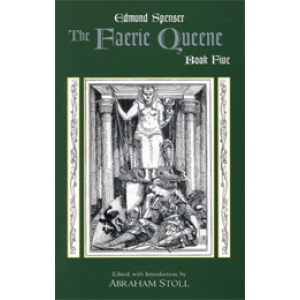
![]() The Faerie Queene, Book Five
The Faerie Queene, Book Five"This edition of book 5 of The Faerie Queene is a welcome contribution. Stoll presents a text that will be very useful in the classroom. The decision to make available individual (or in two cases, paired) books of the romance will make it possible for instructors to teach their preferred books of the romance; Stoll's edition of book 5 will certainly increase the likelihood that the Legend of Justice will reappear in undergraduate classrooms, introducing students to a text in which Spenser scholars are increasingly interested. We will all benefit from that."
Learn More
—Andrew Fleck, Sixteenth Century Journal -
![]() L'École des femmes
L'École des femmesMolière's 1662 comedy L'École des femmes is considered by critics to be among his finest work. The story of a man who is so obsessed by feminine unfaithfulness that he plans to marry his young, naïve ward, whom he has groomed to be the perfect wife, is a classic example of Moliere's bold comedic style. This edition features the French text of Molière's play with vocabulary and notes suitable for students studying for the AP exam in French Literature.
Learn More -
![]() The First New Chronicle and Good Government, Abridged
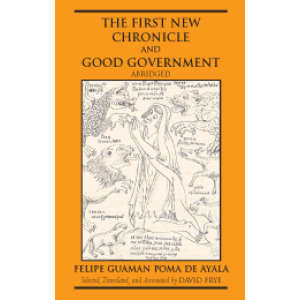
The First New Chronicle and Good Government, AbridgedDavid Frye's skillful translation and abridgment of Felipe Guaman Poma de Ayala's monumental First New Chronicle and Good Government (composed between 1600-1616) offers an unprecedented glimpse into pre-colonial Inca society and culture, the Spanish conquest of Peru (1532-1572), and life under the corrupt Spanish colonial administration. An Introduction provides essential historical and cultural background and discusses the author's literary and linguistic innovations. Maps, a glossary of terms, and seventy-five of Guaman Poma's ink drawings are also included.
Learn More -
![]() Introducción a la literatura Española
Introducción a la literatura EspañolaThis text is part of a Focus series of student editions in Spanish designed for students of Spanish and general readers who are not native speakers. Each book carries the full text, notes, introduction and questions in the manner of Advanced Literature Placement examination questions. All are in Spanish and are designed to help the reader approach the materials with both linguistic, literary and cultural issues.
Learn More -
![]() On Academic Scepticism
On Academic Scepticism"Brittain's On Academic Scepticism is more than a translation. It is a thorough introduction to the study of one of Cicero's most important philosophical dialogues, a work which is the key to understanding Hellenistic scepticism and a great deal of the Latin philosophical tradition shaped by Cicero. The translation is sharp and philosophically sensitive without betraying Cicero's elegant style; the Introduction (historical, philosophical, and philological) is compact, lucid, and authoritative. At last this important work is accessible to those who do not read Latin; even those who do will turn to Brittain's book as a fundamental resource for years to come."
Learn More
—Brad Inwood, Canada Research Chair in Ancient Philosophy, University of Toronto -
![]() Cinema for Russian Conversation, Volume 2
Cinema for Russian Conversation, Volume 2This is the second in a two-volume series of books designed to facilitate discussion in Russian of Russian language films. Each chapter concentrates on one film and includes assignments for students training from Intermediate to Advanced Plus proficiency according to the ACTFL guidelines. The book has a modular structure that allows instructors to select the films according to the students' interests and goals of the class. The book can be used on its own as a textbook or as a supplemental material for classes at various levels. While the book's main purpose is the development of students' conversation skills, each chapter includes texts for reading comprehension and exercises that focus on the acquisition of written skills and grammatical accuracy.
Learn More -
![]() Transition to Attic Greek
Transition to Attic GreekTransition to Attic Greek is a reference for students who need a bridge from Homeric Greek to Attic Greek - a handy reference for aspects of the language that will be unfamiliar to those who have taken an approach to Greek through Homer.
Learn More -
![]() Latin Letters
Latin LettersA compilation of over thirty Latin letters with introduction, commentary and grammar review. The letters are focused on Cicero and Pliny, but include numerous other authors and a wide range of fascinating topics. Authors represented are Cicero, Seneca, Pliny, Augustus, Cornelia, Claudia Severa, Vergil, Sidonius, and Ausonius. Designed for use in the first or second-year Latin college level course.
Learn More -
![]() Apologies
Apologies"Kremer's is an attractive text because of its combination of simplicity and strong delivery, and this is true regarding his translation and his interpretive essay alike. He has striven for a scrupulous accuracy in his translation, and he has achieved this without sacrificing readability or neglecting the distinctive tone of Plato and Xenophon."
Learn More
—Norma Thompson, Yale University -
![]() Hecuba
HecubaEuripides Hecuba is one of the few tragedies that evoke a sense of utter desolation and destruction in the audience. The drama focuses on the status of women, those who are out of power and at the margins of society, by enacting the sufferings of Hecuba. With the city of Troy fallen, Hecuba and Polyxena, her daughter, are enslaved to Agamemnon. Hecuba is despondent with the news that Polyxena is chosen to be sacrificed at the tomb of Achilles. After the sacrifice, the body of her son Polydorus, already a ghost at the start of the drama, is discovered. Polymestor, a king in Thrace who Hecuba sent Polydorus to for safety reasons, murdered Polydorus for his gold. With the tacit complicity of Agamemnon, Hecuba plots her revenge against Polymestor. What transpires next has lasting implications for all involved, including a dramatic trial scene and Hecubas ultimate metamorphosis.
Learn More -
![]() Reading Course in Homeric Greek, Book 1 (Third Edition)
Reading Course in Homeric Greek, Book 1 (Third Edition)A Reading Course in Homeric Greek, Book 1 of the revised Edward's editions by Focus Publishing. This text was originally published by the well respected Frs. Schoder and Horrigan. A Reading Course in Homeric Greek, Book I, provides an introduction to Greek language as found in the Greek of Homer. Covering 120 lessons, readings from Homer begin after the first 10 lessons in the book. Honor work, appendices, and vocabularies are included, along with review exercises for each chapter which have answers.
Learn More -
![]() Readings and Exercises in Latin Prose Composition
Readings and Exercises in Latin Prose CompositionReadings and Exercises in Latin Prose Composition provides a refreshing approach for the standard Latin composition course offered at the college level. This text encourages the student to think in Latin through the process of reading unedited Latin selections and then composing in Latin, as opposed to the process of translating back and forth into English. The book offers a number of highly structured composition exercises that introduce students to a deeper understanding of Latin grammar and prose as well as to greater facility in reading and understanding it. Course Instructors: An electronic answer key (PDF only) is available for qualified instructors who have adopted this text for their course. If you have adopted this text for your course click here to request a copy of the answer key.
Learn More -
![]() Breathe and Speak
Breathe and SpeakThis book is a collection of fifty-five "open scenes" for actors in nine categories such as male/male scenes, three person scenes, and non-gender specific monologues. The scenes contain little to no stage directions or indications regarding specific emotions. The actor learns to say, "I don't know" to many details of the scene, and in doing so, must trust both the text and him or herself, his or her partner, and the moment.
Learn More -
![]() The Mangy Parrot, Abridged
The Mangy Parrot, AbridgedDavid Frye’s abridgment of his 2003 translation of The Mangy Parrot captures all of the narrative drive, literary innovation, and biting social commentary that established Lizardi’s comic masterpiece as the Don Quixote of Latin America.
Learn More -
![]() Paradise Lost (Kastan Edition)
Paradise Lost (Kastan Edition)"Kastan is an exemplary editor, attuned to emerging critical currents, yet steeped in the scholarship of an earlier tradition, aware of the text's provenance and reception, alert to its topicality. His introduction, a model of theoretically informed, politically committed, historically grounded criticism, makes this edition of Paradise Lost all you would expect from one of the most erudite and perceptive figures in the field." —Willy Maley, Modern Language Review
"This is a superb edition, a model of careful editing and judicious annotation." —Leslie Brisman, Department of English, Yale University
"Thank you for sending this impressive edition. . . . Having edited Paradise Lost myself (Norton, 2005), I was curious and keen to see Professor Kastan's. I agree wholeheartedly with the claim (more diplomatically put) that the punctuation of the 17th century editions has no authority and that its proponents are avoiding the problem of syntax. The notes are learned and informative, without excess, and it's good to have the text of Edward Phillips' Life." —Gordon Teskey, Harvard University
Learn More -
![]() The Cardinal Virtues
The Cardinal Virtues"Thomas Aquinas is still known in ethics primarily as the quintessential theorist of natural law—this despite the fact that his writings on that subject are quite meager in comparison to his exhaustive and masterly treatments of the virtues. The result of Richard Regan's labors is an introduction to Thomas' moral philosophy that is much more indicative of Thomas' rich reflections on the moral life than is available from the study of his natural law writings alone, making accessible Thomas' insights into the cardinal virtues of justice, prudence, courage, and temperance."
Learn More
—Douglas Kries, Associate Professor of Philosophy, Gonzaga University -
![]() Homeric Hymns (Ruden Edition)
Homeric Hymns (Ruden Edition)"Sarah Ruden's translation is clear, lean, intelligent, and delightfully readable. The notes provide guidance without encumbering the text. This will be marvelous for classroom use, for reading aloud, or simply for reading for pleasure."
Learn More
—Pamela Gordon, Department of Classics, University of Kansas -
![]() Lingua Latina: Teacher's Materials and Answer Keys
Lingua Latina: Teacher's Materials and Answer KeysThis book contains teacher's materials (advice for the instructor and all the exercises [Pensa] from Familia Romana and Roma Aeterna, on separate sheets for photocopying and distribution) and an answer key (Pensa Soluta) for Familia Romana (the main book of Lingua Latina Pars I) and Roma Aeterna (the main book of Lingua Latina Pars II), as well as for Exercitia Latina I and II. If you have purchased the CD-Rom's, or are using the courseware, you do not necessarily need the answer key, as the answers are provided on the CD-Roms and in the courseware after three attempts.
Learn More