The Hackett Signature Editions Collection Featuring Premium Hardcovers of Hackett Classics - Learn More Here.

Browse All
-
![]() Lingua Latina: Pars I: Latine Disco: Student's Manual (in English)
Lingua Latina: Pars I: Latine Disco: Student's Manual (in English)This student's manual, in English, for Familia Romana (Lingua Latina Pars I), includes a guide to pronunciation, instructions, and information on key points to be noted in each chapter. This book is especially valuable for students working on their own or in homeschooling, though also useful for school or university students. Pars 1: Latin Disco is also included in A Companion to Familia Romana (Second Edition).
The 2025 printing (this book) includes the same content as the previous printings (ISBN: 978-1-58510-050-7) with improved and enlarged text design and layout.
Learn More -
![]() Lingua Latina: Pars I: Vocabulario Latino-Español
Lingua Latina: Pars I: Vocabulario Latino-EspañolVocabulario Latino-Español is a Latin-Spanish vocabulary of words used in Familia Romana for native Spanish speakers learning Latin.
Learn More -
![]() Liberty, Equality & Modern Constitutionalism, Volume OneVolume 1 of two readers containing essential important works on constitutional liberty and the foundations of modern western political theory. This first volume contains the complete Apology of Socrates. Learn More
Liberty, Equality & Modern Constitutionalism, Volume OneVolume 1 of two readers containing essential important works on constitutional liberty and the foundations of modern western political theory. This first volume contains the complete Apology of Socrates. Learn More -
![]() Liberty, Equality & Modern Constitutionalism, Volume Two
Liberty, Equality & Modern Constitutionalism, Volume TwoVolume 2 of two readers containing essential important works on constitutional liberty and the foundations of modern western political theory.
Learn More -
![]() The Birds
The BirdsJeffrey Henderson's translation of Aristophanes' The Birds includes essays on Old Comedy and the Theater of Dionysus, suggestions for further reading, notes on production, and a general bibliography.
Learn More -
![]() Four Island Utopias
Four Island UtopiasIncludes Plato's Atlantis, Euhemeros of Messene's Sacred Inscription, Iamboulos's Island of the Sun, and Bacon's New Atlantis, with a supplement of Utopian Prototypes, Developments and Variations.
Learn More -
![]() Elementary Latin Exercises
Elementary Latin ExercisesDesigned as an introduction to North and Hillard's Latin Prose Composition. Presents the beginner with the simplest vocabulary and the most elementary forms of sentence construction. Includes both English-Latin and Latin-English exercises.
Learn More -
![]() Public Administration in the United States
Public Administration in the United StatesAn extensive reader including many seminal documents covering all aspects of public administration policy and practice in Twentieth Century United States.
Learn More -
![]() Greek Prose Composition
Greek Prose CompositionFocus Edition of the classic British text, including original typesetting. Standard Greek, including all common words and constructions, special vocabularies, a general vocabulary, irregular verbs, a list of prepositional phrases, and more. Course Instructors: An electronic (PDF) answer key available to qualified course instructors who have adopted this text for their course, (not available for sale to students). If you have adopted this text, click here to request a copy of the answer key.
Learn More -
![]() From Russian Into English (Second Edition)
From Russian Into English (Second Edition)"This is the only text that actually teaches the student how to cope with practical Russian-English interpretation and translation problems which are becoming ever more important in today's global village. All those to whom I have recommended the first edition have found it a highly useful if not indispensable tool, and this revised and expanded version will be welcomed by advanced students of Russian as well as future interpreters and translators. Dr. Visson is to be commended for her emphasis on the importance of using correct and appropriate English equivalents for a broad range of Russian formal and informal colloquial expressions."
Learn More
—Frank J. Miller, Russian Language Coordinator, Columbia University -
![]() Empire and the Ends of Politics
Empire and the Ends of PoliticsThis text brings together for the first time two complete key works from classical antiquity on the politics of Athens: Plato's Menexenus and Pericles' Funeral Oration (from Thucydides' history of the Peloponnesian War).
Learn More -
![]() Bacchae (Woodruff Edition)
Bacchae (Woodruff Edition)"[Woodruff’s translation] is clear, fluent, and vigorous, well thought out, readable and forceful. The rhythms are right, ever-present but not too insistent or obvious. It can be spoken instead of read and so is viable as an acting version; and it keeps the lines of the plot well focused. The Introduction offers a good survey of critical approaches. The notes at the foot of the page are suitably brief and nonintrusive and give basic information for the non-specialist."
Learn More
—Charles Segal, Harvard University -
![]() Oresteia
Oresteia“Peter Meineck’s new rendition of the Oresteia is that rare and wonderful thing: a text accessible to the Greekless audience while still preserving the vocabulary of Aeschylus. Those of us who have seen Peter Meineck's performances have long marveled at his ability to turn Greek into clear English, how he does not do ‘versions’ of the plays, how he does not rewrite the ancients into modern jargon (even his comedies maintain more Aristophanic text than is usual). Here lines that students have always needed explicated stand clear. . . . Helene Foley has provided a fine introduction for this translation. Introduction and translation together provide an exciting text, one that should be widely read, widely used.” —Karelisa Hartigan, University of Florida, in The Classical Outlook
Learn More -
![]() Aristophanes 1: Clouds, Wasps, Birds
Aristophanes 1: Clouds, Wasps, BirdsOriginally adapted for the stage, Peter Meineck’s revised translations achieve a level of fidelity appropriate for classroom use while managing to preserve the wit and energy that led The New Yorker to judge his Clouds “The best Greek drama we’ve ever seen anywhere,” and The Times Literary Supplement to describe his Wasps as “Hugely enjoyable and very, very funny.” A general Introduction, introductions to the plays, and detailed notes on staging, history, religious practice and myth combine to make this a remarkably useful teaching text.
Learn More -
![]() Thinking Clearly about Death (Second Edition)
Thinking Clearly about Death (Second Edition)Jay Rosenberg’s penetrating and persuasively argued analysis of the central metaphysical and moral questions pertaining to death has been updated and revised to expand and deepen several of its key arguments and to address conceptual developments of the past fifteen years. Among the topics discussed are: Life After Death; The Limits of Theorizing; The Limits of Imagination; Death and Personhood; Values and Rights; “Mercy Killing”; Prolonging Life; “Rational Suicide”; and One’s Own Death. Rosenberg’s prose is lucid, lively, thoroughly absorbing, and accessible to introductory-level readers. Essential reading for anyone interested in reflecting on this engaging topic.
Learn More -
![]() The Province of Jurisprudence Determined and The Uses of the Study of Jurisprudence
The Province of Jurisprudence Determined and The Uses of the Study of JurisprudenceThis edition comprises the full text of The Province of Jurisprudence Determined, a classic work of moral, political, and legal philosophy, including the chapter on Utilitarianism and the detailed discussion of social contract theory, which have been excluded from previous editions. Also included is the essay on The Uses of the Study of Jurisprudence, which gives an important assessment of Austin’s conception of analytical jurisprudence.
Learn More -
![]() Cratylus
Cratylus“It is. . . remarkable that Reeve’s is the first new English translation since Fowler’s Loeb edition of 1926. Fortunately, Reeve has done an excellent job. His version is not slavishly literal but is in general very accurate. It is also very clear and readable. Reeve is particularly to be congratulated for having produced versions of some of the more torturous passages, which are not only faithful to the text but also make good sense in English. The long and detailed introduction is worth reading in its own right.”
Learn More
—R. F. Stalley, The Classical Review -
![]() Discourse on Method (Cress, Third Edition)
Discourse on Method (Cress, Third Edition)By far the most widely used translation in North American college classrooms, Donald A. Cress's translation from the French of the Adam and Tannery critical edition is prized for its accuracy, elegance, and economy. The translation featured in the Third Edition has been thoroughly revised from the 1979 First Edition and includes page references to the critical edition for ease of comparison.
Learn More -
![]() On the Inner Life of the Mind
On the Inner Life of the MindBoth an anthology of Augustine’s writings and a commentary on them, this work features substantial selections from On the Trinity, Confessions, The City of God, and On Freedom of the Will, as well as selections from lesser known works—all brilliantly knit together and illuminated by philosopher Robert Meagher.
Learn More -
![]() Phaedo (Brann, Kalkavage, & Salem Edition)
Phaedo (Brann, Kalkavage, & Salem Edition)"This marvelously conceived new translation of Plato's most important dialogue will set the standard for classroom use for many years to come. . . . The authors' imaginative new interpretation will inspire students and generate scholarly controversy-and is thus certain to accomplish what it suggests is the true aim of Socratic inquiry: the weaving, unweaving, and perpetual re-weaving of the Logos."
Learn More
—Dr. George R. Lucas, Jr., Professor of Philosophy, US Naval Academy, Annapolis -
![]() The Peloponnesian War
The Peloponnesian WarThe first unabridged translation into American English, and the first to take into account the wealth of Thucydidean scholarship of the last half of the twentieth century, Steven Lattimore’s translation sets a new standard for accuracy and reliability. Notes provide information necessary for a fuller understanding of problematic passages, explore their implications as well as the problems they may pose, and shed light on Thucydides as a distinctive literary artist as well as a source for historians and political theorists.
"[Lattimore] gets closer to the Greek than either of his two available rivals, Richard Crawley and Rex Warner. . . . Lattimore’s uncompromising version now leads the field." —Peter Green, The Los Angeles Times Book Review
Learn More -
![]() Franz Rosenzweig
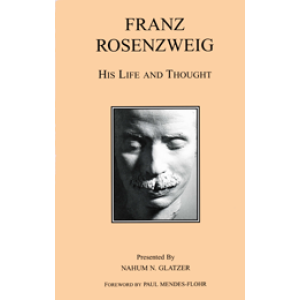
Franz Rosenzweig“Rosenzweig’s life combined a fabulous spiritual search, a profound engagement with philosophy as well as with Judaism, and enormous accomplishment in the face of overwhelming physical handicaps. His thought is both illuminated by and realized in his amazing life. Nahum Glatzer has brought both the life and the thought together in this marvelous collection. There is no better introduction to this seminal Jewish thinker.”
Learn More
—Hilary Putnam, Harvard University -
![]() The Law of Athens, Volume 1 of 2
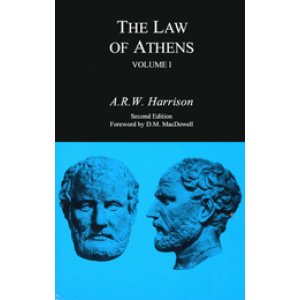
The Law of Athens, Volume 1 of 2Volume one of a two-volume set. It may be purchased separately or in conjunction with volume two. Volume I, completed in 1968, gives a systematic account of classical Athenian law concerning family and property. Volume II, on the law of obligations and of procedure, was unfinished at the time of the author’s death in 1969. The part which concerns procedure was virtually complete and, edited by D. M. MacDowell, appeared in 1971. MacDowell has provided a new Foreword for this edition as well as a select bibliography (from 1967 to the present), which appears in both volumes. Together these distinguished works form the most detailed study of Athenian law in the last half-century.
Learn More -
![]() The Law of Athens, Volume 2 of 2
The Law of Athens, Volume 2 of 2Volume two of a two-volume set. It may be purchased separately or in conjunction with volume one. Both volumes are available in a cloth edition when purchased together as a set. Volume I, completed in 1968, gives a systematic account of classical Athenian law concerning family and property. Volume II, on the law of obligations and of procedure, was unfinished at the time of the author’s death in 1969. The part which concerns procedure was virtually complete and, edited by D. M. MacDowell, appeared in 1971. MacDowell has provided a new Foreword for this edition as well as a select bibliography (from 1967 to the present), which appears in both volumes. Together these distinguished works form the most detailed study of Athenian law in the last half-century.
Learn More -
![]() The Law of Athens, 2 Volume Set
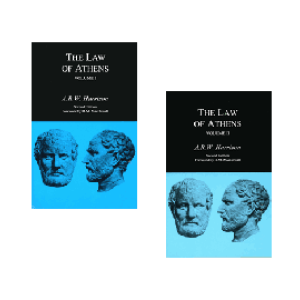
The Law of Athens, 2 Volume SetVolume I, completed in 1968, gives a systematic account of classical Athenian law concerning family and property. Volume II, on the law of obligations and of procedure, was unfinished at the time of the author’s death in 1969. The part which concerns procedure was virtually complete and, edited by D. M. MacDowell, appeared in 1971. MacDowell has provided a new Foreword for this edition as well as a select bibliography (from 1967 to the present), which appears in both volumes. Together these distinguished works form the most detailed study of Athenian law in the last half-century.
Learn More -
![]() Politics (Reeve Edition)
Politics (Reeve Edition)“The beautifully crafted English of Reeve’s translation is as crisp and lucid as Aristotle’s Greek. One is constantly impressed with Reeve’s instinct for the right word in rendering the rich vocabulary of Aristotle’s thoughts about politics and for his ability to capture the subtleties of Aristotelian syntax. Highly recommended.” —David Keyt, University of Washington
“This is an admirable translation, meticulous in its attention to Aristotle’s Greek and judicious in its phrasing and choice of terms. It should prove invaluable to beginning students and scholars alike.” —Richard Kraut, Northwestern University
Learn More -
![]() Dialogues Concerning Natural Religion (Second Edition)
Dialogues Concerning Natural Religion (Second Edition)Hume's brilliant and dispassionate essay "Of Miracles" has been added in this expanded edition of his Dialogues Concerning Natural Religion, which also includes "Of the Immortality of the Soul," "Of Suicide," and Richard Popkin's illuminating Introduction.
Learn More -
![]() Principles of Cartesian Philosophy
Principles of Cartesian PhilosophyWith meticulous scholarship and an accurate, highly readable translation, this volume sheds light not only on Spinoza’s debt to Descartes but also on the development of Spinoza’s own thought. Appearing for the first time in English translation, Lodewijk Meyer’s inaugural dissertation on matter (1683)—relevant for its comments on Descartes, Spinoza, and other thinkers of the time—is appended with notes and a short commentary. Cross-references to Descartes’s Principles of Philosophy are provided in an index, and there is an extensive bibliography.
Learn More -
![]() The Breakdown of Cartesian Metaphysics
The Breakdown of Cartesian Metaphysics“Original and stimulating. . . . The four new chapters deserve close attention. . . . Readers will await further studies by Richard A. Watson all the more impatiently.”
Learn More
—Jean-Luc Marion, Archives de Philosophie -
![]() On the Dignity of Man
On the Dignity of ManReflecting the broad range of interests of a major Renaissance philosopher and his distinctive brand of syncretism, this anthology offers in their entirety three central works of Pico’s. On the Dignity of Man, the quintessential expression of Renaissance humanism, appears in the context of two lesser known but equally representative mature works: On Being and the One, a treatise defending what Pico held to be the agreement between Aristotle and Plato on the relation between unity and being, and Heptaplus, an interpretation, influenced by a blend of cabalism and Christian doctrine, of the first verses of Genesis. New Selected Bibliography.
Learn More -
![]() Meno (Anastaplo & Berns Edition)
Meno (Anastaplo & Berns Edition)"This new translation of the Meno by Anastaplo and Berns has several distinctive features that make it useful for teaching and studying the dialogue. Generally achieving a balance between clarity and faithfulness, it includes valuable annotation, two appendices . . . and an innovative division of the text through the provision of numbers for each of it's speeches. . . . The overall result is a text that would give a reader unschooled in Greek a fairly reliable sense of the flow of ideas in the original."
Learn More
—William A. Welton, Loyola College, in Review of Metaphysics -
![]() A Horace Reader
A Horace ReaderIntended for the Latin student with three years of Latin experience who is preparing for the Advanced Placement examination in Latin literature, this text offers a complete and thorough preparation, including an introduction to Horace's life and work, Latin text of 28 poems with facing notes, glossaries on meter and figures of speech, and a complete vocabulary. Each poem is introduced by a brief summary in English.
Learn More -
![]() Bacchae (Esposito Edition)
Bacchae (Esposito Edition)English translation, with introductory material, notes, glossary and essay by Stephen Esposito, of Euripides' tragedy based on the mythological story of King Pentheus of Thebes.
Learn More -
![]() Terence: Brothers
Terence: BrothersThis is an English translation of Terence's Roman comedy that deals with questions of perennial interest: "How best to raise children?" and "How to give self-disinterested moral advice?"
Learn More -
![]() Symposium (Sharon Edition)
Symposium (Sharon Edition)"The Symposium challenges the translator who is also a poet in its range of styles which is unique among the Platonic dialogues. Not only does the translator have to mimic the distinct style of the narrator, Apollodoros, and the seven symposiasts . . . he has to mind and represent the action in this the most dramatic of the Platonic dialogues. Sharon's translation meets these challenges and is a brilliant recovery of the style and drama of the Symposium. I know of no other translation that is so appropriately various in the styles adopted by and for the speakers or which is so attentive to the drama of this dialogue which celebrates a tragic victory."
Learn More
—Diskin Clay, Duke University -
![]() Hellenistic Philosophy (Second Edition)
Hellenistic Philosophy (Second Edition)This new edition of Hellenistic Philosophy—including nearly 100 pages of additional material—offers the first English translation of the account of Stoic ethics by Arius Didymus, substantial new sources on Epicureanism, Stoicism, and Scepticism, expanded representation of Plutarch and Cicero, and a fuller presentation of papyrological evidence. Inwood and Gerson maintain the standard of consistency and accuracy that distinguished their translations in the first edition, while regrouping some material into larger, more thematically connected passages. This edition is further enhanced by a new, more spacious page design.
Learn More -
![]() The Fable of the Bees and Other Writings
The Fable of the Bees and Other Writings“Hundert is especially good at demonstrating how vital Mandeville’s ideas are as a major foundation for more famous Enlightenment thinkers such as Rousseau, Diderot, Voltaire and others. . . . The additions of Nicole and Bayle will be useful in courses on 18th century ethics and morals, and in general surveys of Enlightenment thought. This is probably the best one-volume edition of the main works of Mandeville now available.”
Learn More
—Irwin Primer, Rutgers University -
![]() The Original Sceptics
The Original Sceptics"The Original Sceptics contains a wealth of analysis, argument and philological comment, and it undoubtedly succeeds in making the reader aware of the difficulties involved in discovering what the ancient sceptics really held.”
Learn More
—F. C. White, Australasian Journal of Philosophy -
![]() Abortion: A Dialogue
Abortion: A DialogueVigorously demonstrating the relevance of reasoning to important moral problems, the participants in this dialogue resist the temptations of strident emotional appeal in an effort to present the most honorable and intellectually sophisticated sides of their arguments. This effort leads them to consideration of ante-bellum slavery, to a comparison of the notions of absolute truth in ethics versus mathematics, and to constructive discussions of genetics, artificial intelligence, euthanasia, personal identity, human sexuality, and Roe v. Wade.
Learn More -
![]() Plato's Cosmology
Plato's Cosmology“An indispensable storehouse of information and analysis—essential reading nowadays just as in 1935, when it first appeared. . . . Plato’s Cosmology continues to be the constant reference point of any serious study of the Timaeus.”
Learn More
—John M. Cooper, Princeton University -
![]() Anselm: Basic Writings
Anselm: Basic WritingsRanging from his early treatises, the Monologion (a work written to show his monks how to meditate on the divine essence) and the Proslogion (best known for its advancement of the so-called ontological argument for the existence of God), to his three philosophical dialogues on metaphysical topics such as the relationship between freedom and sin, and late treatises on the Incarnation and salvation, this collection of Anselm's essential writings will be a boon to students of the history of philosophy and theology as well as to anyone interested in examining what Anselm calls "the reason of faith."
Learn More -
![]() Basic Writings of St. Thomas Aquinas, Volume 1 of 2
Basic Writings of St. Thomas Aquinas, Volume 1 of 2Includes the whole of the First Part of the Summa Theologica. Pegis’s revision and correction of the English Dominican Translation renders Aquinas’ technical terminology consistently as it conveys the directness and simplicity of Aquinas’ writing; the Introduction, notes, and index aim at giving the text its proper historical setting, and the reader the means of studying St. Thomas within that setting.
Learn More -
![]() Basic Writings of St. Thomas Aquinas, Volume 2 of 2
Basic Writings of St. Thomas Aquinas, Volume 2 of 2Includes substantial selections from the Second Part of the Summa Theologica and the Summa Contra Gentiles. Pegis’s revision and correction of the English Dominican Translation renders Aquinas’ technical terminology consistently as it conveys the directness and simplicity of Aquinas’ writing; the Introduction, notes, and index aim at giving the text its proper historical setting, and the reader the means of studying St. Thomas within that setting.
Learn More -
![]() Basic Writings of St. Thomas Aquinas, 2 Volume Set
Basic Writings of St. Thomas Aquinas, 2 Volume SetIncludes the whole of the First Part of the Summa Theologica and substantial selections from the Second Part and the Summa Contra Gentiles. Pegis’s revision and correction of the English Dominican Translation renders Aquinas’ technical terminology consistently as it conveys the directness and simplicity of Aquinas’ writing; the Introduction, notes, and index aim at giving the text its proper historical setting, and the reader the means of studying St. Thomas within that setting.
Learn More -
![]() Freedom: A Dialogue
Freedom: A DialogueTranslated by Bencivenga from the original Italian of his philosophical best-seller, this dialogue provides a comprehensive statement on the role of freedom in the realms of morality, psychology, metaphysics, and aesthetics. Bencivenga lets his four characters embrace a wide range of topics in their eclectic discussion, including considerations of quantum physics and deconstruction, the Gothic novel and detective stories, the structure of desire and the mathematics of infinity, penetrating comments on Freud, Raymond Chandler, and Wertverlufe, and a reasonable explanation of why Kants first Critique is longer than both the second and the third. What results is less a systematic account than a composite picture for the student of philosophy to piece together.
Learn More -
![]() Writings of the Young Marx on Philosophy and Society
Writings of the Young Marx on Philosophy and Society“Lucid translations into idiomatic English. They are clearer than the original German version! Our students struggle with Marx and they will appreciate a more ‘user - friendly’ translation.”
Learn More
—John Brunn, Chabot College -
![]() On Art, Religion, and the History of Philosophy
On Art, Religion, and the History of PhilosophyThe famous introductory lectures collected in this volume represent the distillation of Hegel’s mature views on the three most important activities of spirit, and have the further advantage, shared by his lectures in general, of being more comprehensible than those works of his published during his lifetime. A new Introduction, Select Bibliography, Analytical Table of Contents, and the restoration in the section headings of the outline of Hegel’s lectures make this new edition particularly useful and welcome.
Learn More -
![]() Twilight of the Idols
Twilight of the IdolsTwilight of the Idols presents a vivid, compressed overview of many of Nietzsche’s mature ideas, including his attack on Plato’s Socrates and on the Platonic legacy in Western philosophy and culture. Polt provides a trustworthy rendering of Nietzsche’s text in contemporary American English, complete with notes prepared by the translator and Tracy Strong. An authoritative Introduction by Strong makes this an outstanding edition. Select Bibliography and Index.
Learn More -
![]() Plato: Complete Works
Plato: Complete Works"This is clearly the definitive edition in English of the Platonic writings. It replaces completely the Hamilton-Cairns collection. . . . The notes are at just the right level, and the index is very helpful. The translations are both readable and accurate." —Michael D. Rohr, Rutgers University
"The most important publishing event in Platonic translation is the Complete Works edited by Cooper and Hutchinson. . . . Hackett has lavished great care in the production of this volume: fine India paper, elegant typography, sewn binding, and cloth boards. . . . It should be in every library and on the shelves of all lovers of Plato." —Steven J. Willett, Syllecta Classica
Learn More