The Hackett Signature Editions Collection Featuring Premium Hardcovers of Hackett Classics - Learn More Here.

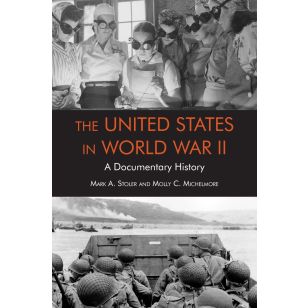
The United States in World War II
"Outstanding . . . the best short history I have read of America's role in World War II. Stoler and Michelmore draw on a judicious selection of historical documents to provide a concise, readable history. The historiography of the war is well covered and explained. It is no small task to delineate the many, sometimes, heated debates over the conduct of the war, and in this volume the many sides of the historical debate are fairly and evenly treated. For a single-volume study, the book is remarkably comprehensive. It addresses major events and decisions; yet it also covers the political and policy-driven, strategic and operational, and social and cultural aspects of the War. The development of key technologies (such as the atomic bomb) and intelligence capabilities are explained. Finally, this book also covers topics that are often neglected in histories of the War, including racism in America, the American response to the Holocaust, and the evolving role of women in the workforce." —Adrian Lewis, The University of Kansas
"A superbly researched resource, packed with fascinating primary sources, and full of cutting edge judgments and explanations. Stoler and Michelmore take us into nearly every corner of the American experience in World War II, from the White House to race riots to combat operations, and much more." —John C. McManus, Missouri University of Science and Technology
SKU
28086g
Reviews:
"Outstanding . . . the best short history I have read of America’s role in World War II. Stoler and Michelmore draw on a judicious selection of historical documents to provide a concise, readable history.
"The historiography of the war is well covered and explained. It is no small task to delineate the many, sometimes, heated debates over the conduct of the war, and in this volume the many sides of the historical debate are fairly and evenly treated.
"For a single-volume study, the book is remarkably comprehensive. It addresses major events and decisions; yet it also covers the political and policy-driven, strategic and operational, and social and cultural aspects of the War. The development of key technologies (such as the atomic bomb) and intelligence capabilities are explained. Finally, this book also covers topics that are often neglected in histories of the War, including racism in America, the American response to the Holocaust, and the evolving role of women in the workforce."
—Adrian Lewis, The University of Kansas, author of The American Culture of War: The History of U.S. Military Forces from World War II to Operation Enduring Freedom (Routledge, 2nd ed. 2012)
"A superbly researched resource, packed with fascinating primary sources, and full of cutting edge judgments and explanations. Stoler and Michelmore take us into nearly every corner of the American experience in World War II, from the White House to race riots to combat operations, and much more."
—John C. McManus, Ph.D., Curators' Distinguished Professor of U.S. Military History, Missouri University of Science and Technology, author of Hell Before Their Very Eyes: American Soldiers Liberate Concentration Camps in Germany, April 1945 (Johns Hopkins University Press, 2015)
Contents
Preface, Introduction
Chapter 1: The Yanks Are Coming . . . Again: U.S. Entry into World War II
Chapter 2: Over Here: Mobilizing the American People for War
Chapter 3: Creating a Global Allied Strategy to Defeat the Axis Powers
Chapter 4: Fighting and Defeating Nazi Germany
Chapter 5: The War against Japan—and the Japanese
Chapter 6: For the Duration: Life and Society on the American Home Front
Chapter 7: The Manhattan Project and Beyond: The Role of Science, Medicine, and Technology in the American War Effort
Chapter 8: The Intelligence War: Code Breaking, Cryptography, Intelligence Gathering, and Allied Victory
Chapter 9: The United States and the Holocaust
Chapter 10: Planning and Preparing for the Peace at Home
Chapter 11: President Franklin D. Roosevelt and Allied Diplomacy for War and Peace
Chapter 12: The Atomic Bomb and the End of World War II
General Bibliography
About the Authors:
Mark A. Stoler is Professor Emeritus of History, The University of Vermont.
Molly C. Michelmore is Associate Professor of History, Washington and Lee University.