The Hackett Signature Editions Collection Featuring Premium Hardcovers of Hackett Classics - Learn More Here.

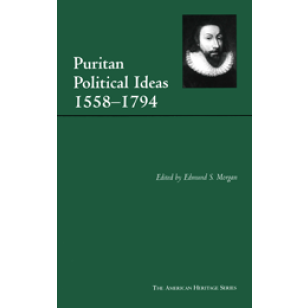
Puritan Political Ideas
In this unique collection, noted historian Edmund Morgan focuses upon three ideas that lay at the root of Puritan political theory and have had a continuing significance in our history: calling, covenant, and the separate spheres of church and state. The selections show the origin of these ideas in the writings of the early English Puritans before the colonization of America, in seventeenth century New England, and finally in new contexts in the eighteenth century. One may read these documents as primary sources of Puritan thought per se, as sources of American intellectual history, or as sources of a political theory that flowered in the early years of the new constitutional republic.
—from the Foreword
SKU
26289g
A reprint of the 1965 Bobbs-Merrill edition.
In this unique collection, noted historian Edmund Morgan focuses upon three ideas that lay at the root of Puritan political theory and have had a continuing significance in our history: calling, covenant, and the separate spheres of church and state. The selections show the origin of these ideas in the writings of the early English Puritans before the colonization of America, in seventeenth century New England, and finally in new contexts in the eighteenth century. One may read these documents as primary sources of Puritan thought per se, as sources of American intellectual history, or as sources of a political theory that flowered in the early years of the new constitutional republic.
—from the Foreword
Contents:
Introduction. Collateral Reading. Editor’s Note.
PART ONE: The English Background
- 1. Christopher Goodman on Resistance to Tyrants (1558)
- 2. Henry Bullinger on the Duties of Rulers and Subjects (1587)
- 3. William Perkins on Callings (1603)
- 4. William Perkins on Christian Equity (1604)
PART TWO: The New England Puritans
- 5. A Model of Christian Charity by John Winthrop (1630)
- 6. The Journal of John Winthrop (1603-1645)
- 7. John Winthrop on Restriction of Immigration (1637)
- 8. John Winthrop on Arbitrary Government (1644)
- 9. John Cotton on Church and State (1636)
- 10. John Cotton on Limitation of Government (1655)
- 11. The Massachusetts Body of Liberties (1641)
- 12. The Bloudy Tenent of Persecution by Roger Williams (1644)
- 13. The Bloody Tenent Yet More Bloody (1652)
- 14. Letters of Roger Williams (1636-1681)
- 15. Provoking Evils (1675)
- 16. The People of God (1690)
PART THREE: Eighteenth-century Transformations
- 17. John Wise on the Principles of Government (1717)
- 18. The Inalienable Rights of Conscience (1744)
- 19. Jonathan Mayhew on the Right of Revolution (1750)
- 20. From the Social Ladder to the Separation of Powers (1762)
- 21. Government Corrupted by Vice (1775)
- 22. Ezra Stiles on the Rights of the People (1794)
About the Author:
Edmund S. Morgan is Sterling Professor Emeritus of History, Yale University.