The Hackett Signature Editions Collection Featuring Premium Hardcovers of Hackett Classics - Learn More Here.

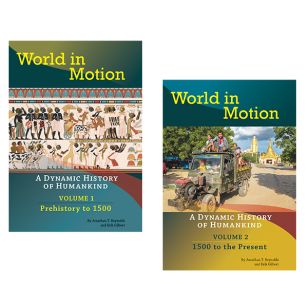
World in Motion: A Dynamic History of Humankind (Volumes 1 & 2)
"Packed with features and written in Reynold's and Gilbert’s signature accessible style, World in Motion delivers on the vision of a world history that recognizes the never-ending movement of people, things, identities, and even our understanding of history. It is a startling achievement, many years in the making, and one that will speak to this generation of students."
—Trevor Getz, San Francisco State University
SKU
World in Motion-2
"Packed with features and written in Reynold's and Gilbert’s signature accessible style, World in Motion delivers on the vision of a world history that recognizes the never-ending movement of people, things, identities, and even our understanding of history. It is a startling achievement, many years in the making, and one that will speak to this generation of students."
—Trevor Getz, San Francisco State University
The theme of motion is an organizing principle for this text, as a way to complicate our understanding of World History and blur our constructed historical borders. Embracing motion as a key organizing principle helps World in Motion present an engaging and coherent perspective on world history, while simultaneously challenging the silences and complicating the borders once created by the field.
The idea of motion offers a new and thought-provoking vision of world history through a focus on movement and change across various facets of human experience, including migration, trade, culture, identity, biology, and the environment. World in Motion re-conceptualizes the presentation of world history through the perspective of three key themes:
- Everything moves. From people, to goods, to ideas, and even the environment – nothing stays still.
- Identities are in motion. People don’t only move physically and genetically, their constructions of culture and self are also in constant motion.
- History itself is in motion. Our ability to research and reconstruct the past has improved, and so our understanding of the past is in a state of constant change.
Features in every chapter of World in Motion serve to enhance and extend the text’s themes. Free online supplemental materials (available in late summer 2026)—including primary source excerpts, supplementary readings, videos, and more—create in-depth opportunities for students to explore the book’s organizing idea of motion. World in Motion is organized into two volumes, six parts, and twenty-six chapters. Each volume and part is preceded by an introduction that makes a case for the organization of the text at each level.
Tables of Contents
Click on the links below to open PDFs of each volume's table of contents:
About the Authors
Erik Gilbert received his BA in Classical Greek at the College of William and Mary. He got his MA in History at the University of Vermont and completed his PhD in 1996. His current research involves using plant genetics to study the movement of food crops from Asia to Africa in the early history of the Indian Ocean. He is currently a Professor of History at Arkansas State University.
Jonathan T. Reynolds received his BA from the University of Tennessee, Knoxville, with majors in Honors History, Anthropology, and Ancient Mediterranean Civilizations. He completed his PhD in African History at Boston University in 1995. He is currently a Regents Professor of History at Northern Kentucky University, where he teaches courses on African, World, Imperialism, Technology, Distance, and Food History, as well as on Historical Methodology. He is the current President of the World History Association.