The Hackett Signature Editions Collection Featuring Premium Hardcovers of Hackett Classics - Learn More Here.

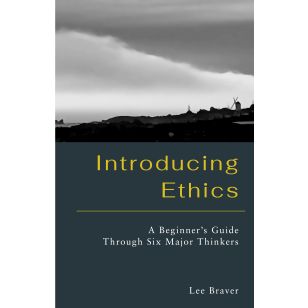
Introducing Ethics: A Beginner’s Guide Through Six Major Thinkers
Lee Braver
About the Book
Introducing Ethics takes us through the history of Western ethics, beginning with Socrates’s attempt to apply reason to questions about what it is to be a good person and what we ought to do. We then examine three leading moral theories—John Stuart Mill’s utilitarianism, Immanuel Kant’s deontology, and Aristotle’s character ethics—as if they were a large-scale Socratic dialogue, where each raises objections to and builds on the others. We end with two twentieth-century challenges to Socrates’s enterprise in Carol Gilligan’s feminism and JeanPaul Sartre’s existentialism.
Instructor Resources:
- Table of Contents & Introduction Preview: (PDF download)
- Sample Course Syllabus: (Word File download)
- Guide to teaching with the Introducing Ethics textbook and additional reading assignments and test banks by author Lee Braver: Read below or download a PDF here.
- Reading Assignments and Test Bank: Request PDFs of reading assignments with reading questions and a test bank with answer keys using the instructor request form below.
Return to the Introducing Ethics title page.
Lee Braver's guide to teaching ethics with the Introducing Ethics textbook and additional resources:
I have taught Introduction to Ethics at various colleges for many years. I taught it to classes of 15 students at a liberal arts college with a total enrollment of fewer than 900 students, and at a public state university where the class itself enrolled 300 students. I used what I learned each time, often from painful mistakes, to revise and refine the course over the years, the results of which form the basis of this book.
Its chapters are adaptations of lectures, while other components can be found here in this online resource. Here you can find the basic framework of my syllabus as well as various assignments. I have left it open-ended to make it easier to adapt to different purposes and circumstances. I see three main uses for the materials provided here, though obviously you are free to use them however you see best.
First, they can be used by readers not enrolled in an ethics course, but who would like a structured way to learn about the subject. Twenty-five centuries of philosophical writings can be overwhelming but along with Introducing Ethics: A Beginner’s Guide Through Six Major Thinkers, this resource can help you engage with ethics in a rigorous, systematic way. You can simply follow the syllabus below (at your own pace—the time schedule is just a suggestion) and read the assigned pages of the primary texts (Socrates, Mill, Kant, Aristotle, Gilligan, and Sartre) in that order. The syllabus points you toward some of the passages that are most important for a first-time learner, and gives you an organized way to read them. When you finish each individual author, or if you run into trouble understanding what they’re saying (which will happen), you can turn to the chapter about that philosopher in Introducing Ethics for help. I have tried there to open up these readings by making them understandable and relatable to people who have no knowledge of or experience with philosophy.
I strongly recommend that you read the primary texts before the corresponding chapter, and then go back and reread them. So, for instance, you should read Plato’s Euthyphro first, then Introducing Ethics Chapter 1 which explains what’s going on in it, and then the Euthyphro again after getting my explanation. I believe you will find that the primary text reads very differently the second time. When you know what to look for, you will see where Socrates makes the important moves and why he says what he does. The second time through you will see far more than you did the first time, and it should be smoother and easier in general.
If you do this consistently throughout the course—read the primary text, then my chapter, then the primary text again—I promise you that by the end, your ability to read philosophy, and really anything, will have greatly increased. You will be amazed at how much easier (not easy, but easier!) it is to grasp what these philosophers or any writer is saying than when you first started. This feels amazing; I hope you get to experience it yourself, and the only way to have that experience is by going through the process. It’s a high-intensity workout regimen for your intellect, CrossFit training for the mind. If you’ve ever seen those really fit people who flip giant tractor tires across the floor and make waves in thick rope and wished you could be like that—well, the process I just described can do this for your mind.
The final phase of this self-administered course on ethics would be to give the reading questions, quizzes, and tests to yourself. This would not be to punish yourself or to prove anything. A well-made assignment helps you put ideas together in a way that reading alone might not. This is the least necessary part of the course for this kind of reader, but at least glancing through and reflecting on these questions along with the Review Questions at the end of each book chapter would be worthwhile.
The second use I imagine the book serving is as an aid to students who are taking a class, presumably Introduction to Ethics or a more advanced ethics course that uses a historical approach like I do. These are challenging ideas and texts that can be quite disorienting, especially for someone who has never read or thought in this way before, and professors only have so much time—both in class and out. Reading Chapter 3, for example, could help make class lectures or discussions of Kant’s ethics much more comprehensible. The test and quiz questions provided here, along with the Review Questions at the end of each book chapter, can serve as study guides and practice tests. Of course, there is no guarantee that your professor will ask about these specific topics, nor that they will be looking for the exact answers phrased precisely the way they are here. There are often at least some minor variations in how different scholars read these works and/or the terms they use. I have tried to make my interpretations neutral enough that I think few professors will find fault with them though, when in doubt, defer to your professor.
The third use is for the teachers themselves. Introduction to Ethics is one of the courses most commonly offered by philosophy departments, creating a high demand for faculty who can teach it. Not everyone has been trained in the subject nor in how to teach it, however. Indeed, few departments give their graduate students any training in how to teach at all, unfortunately. Advanced graduate students and new professors often get thrown into the deep end without ever having designed a syllabus, written a test, or given a lecture.
If you are in this or a similar situation, you can use the materials provided here as the basis for a class, employing them as a framework around which you can build your own course. You can use the outline of the syllabus, take up whichever assignments you consider worthwhile, and put together quizzes and tests adapted from the ones I have included here. This can smooth your transition into teaching. With experience, you will diverge more and more from my structure as you figure out what does and doesn’t work for you, but this can help you get the experience you need to find that out. As Aristotle says, there are many things that we learn by doing which require us to do them before we fully know how (remember what I said above about making lots of mistakes). The materials contained here can ease that initial entrance into the activity. In addition to these assignments, the chapters in the book could help you think about how to explain the philosophers’ ideas and suggest useful examples, phrases, and approaches.
I wouldn’t worry that your students have access to potential quiz and/or test questions; if they’re able to answer them well, then they’ve learned the material and you have achieved the goal of the class. Nor should you feel self-conscious about using someone else’s teaching materials. I’ve taken anything I have found useful from wherever I have found it, obeying this general rule: if it helps students learn, use it.
Instructor's Test Bank with Answer Keys and Reading Assignments with Reading Questions PDF Request form:
Please submit the form below to request the reading assignments/questions and test bank with answer keys PDFs for Introducing Ethics. Requested files will be sent to verified instructors as email attachments to the email address provided. Requests submitted outside of regular business hours will be processed on the next business day.