The Hackett Signature Editions Collection Featuring Premium Hardcovers of Hackett Classics - Learn More Here.

Latin American History
-
![]() The Essential Sarmiento: Civilization, Barbarism, and Progress
The Essential Sarmiento: Civilization, Barbarism, and Progress"Domingo Sarmiento is a rhetorical and political giant whose garrulous, colorful, and troubling ideas about race, violence, politics, and literature have fascinated Spanish-language readers for over a hundred and fifty years. Thanks to William Acree's brilliant selection of writings and annotations, the sparkling translations of John Charles Chasteen, and Oscar Chamosa's excellent critical Introduction, readers of English can finally encounter this larger-than-life writer who was deeply committed to documenting his historical moment and assessing social and political ills. This book is a major—and long overdue—contribution to Latin American Studies."
Learn More
—Christopher B. Conway, The University of Texas at Arlington -
![]() Mexico, Slavery, Freedom
Mexico, Slavery, FreedomWinner of the American Historical Association's 2025 J. Franklin Jameson Award for outstanding achievement in the editing of historical sources.
"A welcome tome for the study of slavery and freedom in the African Diaspora. An extensive, and often difficult to access repository of documents has been made available in a bilingual edition that will richly benefit scholars and students alike to better understand the complexities of the Black experience in colonial and early national Mexico. Bridging normal historical chronologies, and featuring sweeping sets of documents ranging from politics, religion, economics, and social life, there is little ground left uncovered for providing windows and glimpses of the evolution of blackness in Mexico. Expertly curated, marvelously framed, and diligently translated, this is a jewel of a book for historians."
Learn More
—Ben Vinson III, Distinguished Historian of Latin America and former President of Howard University -
![]() The Suriname Writings of John Gabriel Stedman
The Suriname Writings of John Gabriel Stedman“Jared Ross Hardesty's new critical edition, The Suriname Writings of John Gabriel Stedman, makes an important and necessary intervention into the study of eighteenth-century Caribbean travel writing and natural history by foregrounding the previously unpublished diary entries Stedman authored in Suriname, rather than focusing solely on his writings printed in the metropoles of Europe. Hardesty's edition is especially useful because it includes both a transcription of Stedman's Suriname diary and a detailed appendix tracking key discrepancies between the diary and Stedman's heavily revised printed natural history. This focus on genre and the editorial process in the production of Anglophone transatlantic writing is an excellent resource for students and scholars of the eighteenth-century Caribbean and the Atlantic World. I can see this being a helpful resource in an early American or eighteenth-century history or literature course, as it would enable students to easily compare differing editions of Stedman's Suriname writings. What Hardesty's edition of The Suriname Writings of John Gabriel Stedman offers is a more accessible study of how eighteenth-century writing on maroonage, slavery, science, and abolition was heavily mediated in the print and production process, as this compiled edition offers critical insight into the gendered and racial politics of life in the colonial Caribbean as well as how printers in the metropole attempted to alter the writing of colonizing authors like Stedman.”
—Elizabeth Polcha, Drexel University
Learn More -
![]() The Mexican Revolution
The Mexican RevolutionSelected as one of the best historical materials of 2023 by the Reference and User Services Association, a division of The American Library Association.
"Henderson and Buchenau have done an excellent and thoughtful job of collecting a wide range of voices for students to learn about the Mexican Revolution and its causes, both from ‘above’ and from ‘below’. I’m particularly appreciative of the authors’ inclusion of women’s voices and women’s issues of the era, including the point of view of the first woman elected to public office in Mexico. They deserve praise for including documents that complicate widely accepted, heroic revolutionary narratives of the period for students—such as the experience of soldaderas and the massacre of Chinese people in Torreón. It is also worth mentioning that the editors have done an admirable job in choosing documents from across Mexico’s many diverse and heterogenous regions. The general Introduction is excellent; it is both accurate and highly readable for students. It is no easy feat to succinctly describe both the events and the significance of this period in Mexican history as the authors have done here." —Sarah Osten, The University of Vermont
Learn More -
![]() Women in Colonial Latin America, 1526 to 1806
Women in Colonial Latin America, 1526 to 1806"This outstanding collection makes available for the first time a remarkable range of primary sources that will enrich courses on women as well as Latin American history more broadly. Within these pages are captivating stories of enslaved African and indigenous women who protest abuse; of women who defend themselves from charges of witchcraft, cross-dressing, and infanticide; of women who travel throughout the empire or are left behind by the men in their lives; and of women’s strategies for making a living in a world of cross-cultural exchanges. Jaffary and Mangan's excellent Introduction and annotations provide context and guide readers to think critically about crucial issues related to the intersections of gender with conquest, religion, work, family, and the law." —Sarah Chambers, University of Minnesota
"Mangan and Jaffary's volume offers an impressive collection of primary sources for Latin American women’s history. It includes texts covering a diversity of women, times, and places across this broad region; shows that women were agents of survival and change for themselves and others; and humanizes the experience of colonial life for specific individuals and families across a long period. This book will be very usable in courses on Latin American, gender, social, and cultural history. I highly recommend it." —Susan Kellogg, University of Houston
Learn More -
![]() Afro-Latino Voices, Shorter Edition
Afro-Latino Voices, Shorter EditionIdeally suited for use in broad, swift-moving surveys of Latin American and Caribbean history, this abridgment of McKnight and Garofalo's Afro-Latino Voices: Narratives from the Early Modern Ibero-Atlantic World, 1550-1812 (2009) includes all of the English translations, introductions, and annotation created for that volume.
Learn More -
![]() The Haitian Revolution
The Haitian Revolution"A landmark collection of documents by the field's leading scholar. This reader includes beautifully written introductions and a fascinating array of never-before-published primary documents. These treasures from the archives offer a new picture of colonial Saint-Domingue and the Haitian Revolution. The translations are lively and colorful." —Alyssa Sepinwall, California State University San Marcos
"Extraordinary . . . offers a fascinating window into the slave uprising that began in Saint-Dominique in 1791 and culminated with the emergence of an independent black Haiti in 1803. . . . [Geggus] offers more detailed coverage than Laurent Dubois and John D. Garrigus's Slave Revolution in the Caribbean, 1789-1804: A brief History with Documents (Bedford/St. Martin's, 2006) by providing twice the number of primary documents. . . . The introduction is crisp and concise. . . . Summing up: Essential."
Learn More
—B.N. Newman, Virginia Commonwealth University, in CHOICE -
![]() The Essential Díaz
The Essential DíazIdeally suited for use in swift-moving surveys of World, Atlantic, and Latin American history, this abridgment of Ted Humphrey and Janet Burke’s 2012 translation of the True History provides key excerpts from Diaz’s text and concise summaries of omitted passages. Included in this edition is a new preface outlining the social, economic, and political forces that motivated the European “discovery” of the New World.
Learn More -
![]() The True History of The Conquest of New Spain
The True History of The Conquest of New Spain"Bernal Díaz’s True History of the Conquest of New Spain, the chronicle of an ‘ordinary’ soldier in Hernando Cortés’s army, is the only complete account (other than Cortés’s own) that we have of the Spanish conquest of ancient Mexico. Although it is neither so ‘true’ nor so unassumingly direct as its author would have us believe, it is unmistakably the voice of the often unruly, undisciplined body of untrained freebooters who, in less than three years, succeeded against all apparent odds, in bringing down the once mighty ‘Aztec Empire.’ It makes for consistently fascinating reading, and Ted Humphrey and Janet Burke have provided the best, and the most engaging, translation ever to have appeared in English."
Learn More
—Anthony Pagden, UCLA -
![]() A True and Exact History of the Island of Barbados
A True and Exact History of the Island of Barbados“Ligon’s True and Exact History of the Island of Barbados is the most significant book-length English text written about the Caribbean in the seventeenth century. [It] allows one to see the contested process behind the making of the Caribbean sugar/African slavery complex. Kupperman is one of the leading scholars of the early modern Atlantic world. . . . I cannot think of any scholar better prepared to write an Introduction that places Ligon, his text, and Barbados in an Atlantic historical context. The Introduction is quite thorough, readable, and accurate; the notes [are] exemplary!”
Learn More
—Susan Parrish, University of Michigan -
![]() Latin American Independence
Latin American Independence"Rarely has the story of Latin American independence been told so richly and with such a plurality of voices. Chambers and Chasteen have expertly woven a comprehensive yet accessible historical tapestry of primary sources to tell the story of the Wars for Independence. The editors recover fascinating, lesser-known voices—many of which appear in English for the first time here—and situate them alongside canonical sources in rewarding and surprising ways. This is an indispensable resource for students and scholars alike, and an invitation to critically rethink the multiple meanings and resonance of Latin American independence."
Learn More
—Christopher Conway, The University of Texas at Arlington -
![]() The U.S.-Mexican War
The U.S.-Mexican War"Conway's judicious selection of primary sources—some fundamental, others lesser-known—affords readers valuable insight into a conflict that does not hold a prominent place in the United States' collective imagination. Especially noteworthy are Conway's efforts to fully portray the Mexican experience in the war through an examination of military operations, political affairs, daily life, gender, and popular culture." —Pedro Santoni, California State University, San Bernardino
"What makes this edited collection truly distinctive is the large amount of material from the Mexican side. . . . There is really nothing like it available. . . . Pellón has done a beautiful job of translating the numerous Spanish-language excerpts that editor Conway has selected, and as a result this is the first reader on this topic to really articulate the complexity of the Mexican side of the conflict. The Introduction, chronology, and explanatory headnotes and footnotes throughout are all very clear and helpful." —Shelley Streeby, University of California, San Diego
Learn More -
![]() Columbus on Himself
Columbus on Himself"Columbus had been the subject of many biographies, but the approach of Columbus on Himself is unique. Fernández-Armesto has created, as far as it is possible, an account of Christopher Columbus's life based on his own words. Columbus left far more potentially autobiographical writings than his contemporary explorers from the age of European expansion, but there are gaps in the record. Fernández-Armesto has arranged Columbus's writings chronologically so readers can see Columbus's development, and intersperses them with his insightful commentary. The translations are Fernández-Armesto's own. Recommended."
Learn More
—R. Fritze, Athens State University, in Choice -
![]() Afro-Latino Voices
Afro-Latino Voices"A groundbreaking book . . . provides a broad and rich sampling of documents recording the early modern voices of the African diaspora. . . . Wills, testaments, letters, and historical chronicles are some of the sources that scholars from various disciplines present in this anthology. . . . Each scholar provides a meticulous contextualization of the historical, social, cultural, and political circumstances surrounding the production of each document. The trilingual presentation allows the reader to see the rhetorical style of archival documents in the original language. Additionally, the maps ensure that students have a clear understanding of the geography and historical sites relevant to the range of texts included in the book." —Margaret Olsen, Macalester College
Learn More -
![]() Daily Life of the Aztecs
Daily Life of the Aztecs"This is a superb overview of Aztec society and culture. It also provides a wonderful postscript by discussing the Spanish invasion and the compelling legacy of Aztec civilization."
Learn More
—Douglas Richmond, University of Texas at Arlington -
![]() Daily Life in the Inca Empire
Daily Life in the Inca EmpireUnlike most studies of the Incas, this book reconstructs the daily life not only of the ruling Inca elite but also of the rest of the society, including the conquered peoples. From food and drink to religious rituals, the major aspects of life at all levels in the Inca empire are here described and explained in a clear, accessible way. Over fifty illustrations are included, as are a historical timeline of the Inca empire, a glossary, and a bibliography.
Learn More -
![]() The Tupac Amaru and Catarista Rebellions
The Tupac Amaru and Catarista Rebellions"This volume represents a true breakthrough. The indigenous uprisings of the late eighteenth century in the Andes form one of the most dramatic chapters in colonial Latin American history. Yet until now there has been no set of original documents from the period available in the English language. Ward Stavig and Ella Schmidt have worked assiduously to make this material available and the resulting book is impressive in its breadth and depth. It covers a long span of the eighteenth century and the major regional theaters of insurgency. It will be of great value to scholars, teachers, and students."
Learn More
—Sinclair Thomson, Department of History, New York University -
![]() Treatise on Slavery: Selections from De Instauranda Aethiopum Salute
Treatise on Slavery: Selections from De Instauranda Aethiopum Salute"Not only are the translations very well done; Von Germeten's notes and annotations are excellent, demonstrating a real sensibility for the African backgrounds of those to whom Sandoval ministered. . . she does a very fine job of addressing African histories and raising questions that emanate out of Africa, rather than seeing the enslaved simply as incipient Americans. Strongly recommended for Colonial Latin American surveys as well as for Atlantic History and African Diapora courses."
Learn More
—James Sweet, Department of History, University of Wisconsin -
![]() History of How the Spaniards Arrived in Peru
History of How the Spaniards Arrived in Peru"Catherine Julien's translation is remarkable for two reasons. Aside from its dual language presentation, it is one of a handful of historical narratives authored by native Andeans during the Spanish colonial period, and is a faithful translation of Titu Cusi Yupanqui's sixteenth-century history. . . . This invaluable source book features extensive annotations, facing page Spanish-English text, and an important introduction that explains the historical perspectives revolving around Titu Cusi's History. This work is highly recommended for classroom use."
Learn More
—Colonial Latin American Historical Review -
![]() The First New Chronicle and Good Government, Abridged
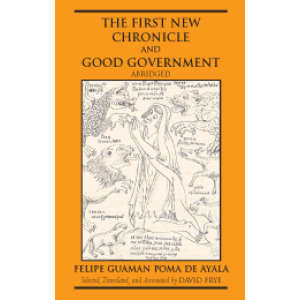
The First New Chronicle and Good Government, AbridgedDavid Frye's skillful translation and abridgment of Felipe Guaman Poma de Ayala's monumental First New Chronicle and Good Government (composed between 1600-1616) offers an unprecedented glimpse into pre-colonial Inca society and culture, the Spanish conquest of Peru (1532-1572), and life under the corrupt Spanish colonial administration. An Introduction provides essential historical and cultural background and discusses the author's literary and linguistic innovations. Maps, a glossary of terms, and seventy-five of Guaman Poma's ink drawings are also included.
Learn More -
![]() An Account, Much Abbreviated, of the Destruction of the Indies
An Account, Much Abbreviated, of the Destruction of the Indies“This is a splendid new translation of Brevísima Relación, the famous denunciation of the Spanish conquest of the Americas, written by Dominican friar Bartolomé de Las Casas (1483-1566). . . . The Hackett edition of Brevísima Relación . . . has a lot to offer to undergraduates. . . . Knight’s introduction to the text makes in fact for a compelling read. . . . Together with Knight’s ample annotations, which refer students to the most up-to-date secondary literature, it makes for a wonderful introduction to the history of Europe’s expansion into the Western Hemisphere.”
Learn More
—Martine van Ittersum, Journal of Early Modern History