













- Category
The Hackett Signature Editions Collection Featuring Premium Hardcovers of Hackett Classics - Learn More Here.
Classical Literature in Translation
-
![]() On the War for Greek Freedom
On the War for Greek FreedomDesigned for students with little or no background in ancient Greek language, history, and culture, this new abridgment presents those selections that comprise Herodotus’ historical narrative. These are meticulously annotated, and supplemented with a chronology of the Archaic Age, Historical Epilogue, glossary of main characters and places, index of proper names, and maps.
Learn More -
![]() Lysistrata (Ruden Edition)
Lysistrata (Ruden Edition)"Presents a readable, clear translation with the assistance students will need to understand this play and the society that produced it. . . . A worthy addition to Hackett's growing series of translations of classical literature in accessible editions."
Learn More
—Anne Mahoney, New England Classical Journal -
![]() Oidipous at Colonus
Oidipous at ColonusThis is an English translation of Sophocles' tragedy of Oedipus who is banished from Thebes and confronts an array of obstacles that stand between him and the death he craves. Focus Classical Library provides close translations with notes and essays to provide access to understanding Greek culture. Includes maps, essays and suggestions for further reading.
Learn More -
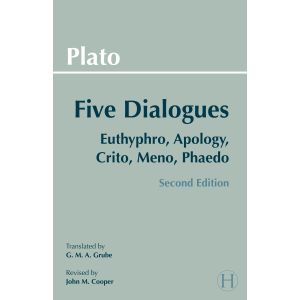
![]() Five Dialogues (Second Edition)
Five Dialogues (Second Edition)The second edition of Five Dialogues presents G. M. A. Grube’s distinguished translations, as revised by John Cooper for Plato, Complete Works. A number of new or expanded footnotes are also included along with an updated bibliography.
Learn More -
![]() Poems and Fragments
Poems and Fragments"I have long been an admirer of Stanley Lombardo's translations of Homer, and I was curious to see how he would adapt his fast-paced, lively style to Sappho. He has succeeded admirably. His translation of 73 poems of Sappho is clear, energetic, and close to the Greek. Pamela Gordon's Introduction gives a lucid and useful guide for the non-specialist to the last fifty years of scholarly debate on Sappho. This edition will be particularly useful for instructors of courses in translation seeking an introduction to Sappho for the Greekless student. It is also a pleasure to read."
Learn More
—Laurel Bowman, The Classical Bulletin -
![]() The Trials of Socrates
The Trials of SocratesLampooned in 406 B.C.E. in a blistering Aristophanic satire, Socrates was tried in 399 B.C.E. on a charge of corrupting the youth, convicted by a jury of about five hundred of his peers, and condemned to death. Glimpsed today through the extant writings of his contemporaries and near-contemporaries, he remains for us as compelling, enigmatic, and elusive a figure as Jesus or Buddha. Although present-day (like ancient Greek) opinion on "the real Socrates" diverges widely, six classic texts that any informed judgment of him must take into account appear together, for the first time, in this volume. Those of Plato and Xenophon appear in new, previously unpublished translations that combine accuracy, accessibility, and readability; that of Aristophanes' Clouds offers these same qualities in an unbowdlerized translation that captures brilliantly the bite of Aristophanes' wit. An Introduction to each text and judicious footnotes provide crucial background information and important cross-references.
Learn More -
![]() Georgics
Georgics"Chew's translation is, both in aesthetic and scholarly terms, an excellent piece of work. I find her approach refreshing and true to the spirit of the Georgics; her adventurousness strikes me as just the thing to rescue the poem from the appearance of blandness that a more straightforward style of translationese would inevitably, but misleadingly, impose upon it. This Georgics does not read much like any previous version of it. Chew helps the English reader to get a sense of Virgil's avant-garde poetics, which is the main thing that almost all translators of the Georgics work to eliminate, if indeed they are even aware of it.
Learn More
First-rate."
—Joseph Farrell, Professor of Classical Studies, University of Pennsylvania -
![]() Medea, Hippolytus, Heracles, Bacchae
Medea, Hippolytus, Heracles, BacchaeDrawn from four titles in the Focus Classical Library, this anthology includes four outstanding translations of plays by Euripides as well as a general introduction, extensive footnotes, and two interpretive essays. Included are Anthony J. Podecki’s translation of Medea, Michael R. Halleran's translation of Hippolytus and Heracles and Stephen Esposito’s translation of Bacchae.
Learn More -
![]() On the Nature of Things (Englert Edition)
On the Nature of Things (Englert Edition)"Englert's translation of the poem is indeed accurate and readable. He knows the poem as thoroughly as he knows the scholarship that bears on it . . . an admirable translation, admirably supported by scholarly tools."
Learn More
—W.R. Johnson, University of Chicago -
![]() King Oidipous
King OidipousThis is an English translation of Sophocles' famous tragedy of Oedipus and the fate he so much tries to avoid. Focus Classical Library provides close translations with notes and essays to provide access to understanding Greek culture.
Learn More -
![]() Theban Plays (Blondell Edition)
Theban Plays (Blondell Edition)This anthology includes English translations of three plays of Sophocles' Oidipous Cycle: Antigone, King Oidipous, and Oidipous at Colonus. The trilogy includes an introductory essay on Sophocles life, ancient theatre, and the mythic and religious background of the plays. Each of these plays is available from Focus in a single play edition. Focus Classical Library provides close translations with notes and essays to provide access to understanding Greek culture.
Learn More -
![]() Consolation of Philosophy
Consolation of Philosophy"Entirely faithful to Boethius' Latin; Relihan's translation makes the philosophy of the Consolation intelligible to readers; it gives equal weight to the poetry—in fact, Relihan's metrical translation of Boethius' metra are themselves contributions of the first moment to Boethian studies. Boethius finally has a translator equal to his prodigious talents and his manifold vision."
Learn More
—Joseph Pucci, Brown University -
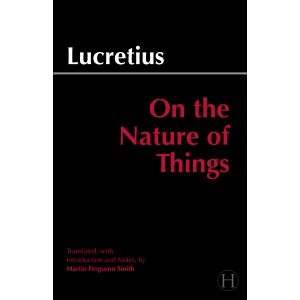
![]() On the Nature of Things (Smith Edition)
On the Nature of Things (Smith Edition)"Martin Ferguson Smith has for many years been one of the leading Lucretian scholars in the world. . . . We should expect from the beginning then that we are in the hands of a wise and learned guide as soon as we open his Lucretius, and this expectation is certainly borne out by the quality of this sensitive and thoughtful edition. . . . The Introduction . . . is excellent. Smith outlines in a highly accessible manner what little is known of Lucretius' life and times, the poem's position and status in the Epic and Didactic tradition, and the philosophy of Epicurus that Lucretius puts forward, but also manages to include some of the most up to date research, including recent scholarship on the Herculaneum papyri. . . . But of course, the translation is the most important part of the work . . . [and] it is streets ahead of the competition. . . . I can recommend this book unreservedly." —Gordon Campbell, Hermathena
Learn More -
![]() Hippolytus
HippolytusNo play of Euripides is more admired than Hippolytus. The tale of a married woman stirred to passion for a younger man was traditional, but Euripides modified this story and blended it with one of divine vengeance to create a masterpiece of tension, pathos, and dramatic power. In this play, Phaedra fights nobly but unsuccessfully against her desire for her stepson Hippolytus, while the young man risks his life to keep her passion secret. Both of them, constrained by the overwhelming force of divine power and human ignorance, choose to die in order to maintain their virtue and their good names.
Learn More -
![]() The Trial and Death of Socrates (Third Edition)
The Trial and Death of Socrates (Third Edition)The third edition of The Trial and Death of Socrates presents G. M. A. Grube’s distinguished translations, as revised by John Cooper for Plato, Complete Works. A number of new or expanded footnotes are also included along with a Select Bibliography.
Learn More -
![]() The Essential Homer
The Essential Homer"Not only does one get an excellent translation of both Homer's Iliad and Odyssey under one cover, but the selections included are infinitely better and longer than what one normally gets in anthologies of Greek literature. For courses in which entire texts cannot be used, this is by far the best choice available today." —Kostas Myrsiades, Westchester University
"A good idea—its utility far outweighs qualms purists have about students not reading every last item in the catalogue of ships. The translation is vigorous and readable." —Andrew Ford, Princeton University
"The Essential Homer fills a long-felt need for an edition that offers a sizable selection of the books and passages most likely to be used in undergraduate courses. It's a wonderful help." —Richard P. Martin, Stanford University
Learn More -
![]() The Essential Iliad
The Essential IliadWhile preserving the basic narrative of the Iliad, this selection also highlights the epic's high poetic moments and essential mythological content, and will prove especially useful in surveys of world literature.
Learn More -
![]() Homeric Hymns (Shelmerdine Edition)
Homeric Hymns (Shelmerdine Edition)This is a collection of the standard texts of ancient Greek which are important components of what we know about Greek myth, religion, language and culture. All of the works collectively known as the Homeric Hymns are collected and translated here in their entirety, and the work includes ample notes and an introduction to provide information on the works' historic importance, a chronological table, genealogical chart, maps of Greece and the Aegean Islands, and illustrations of vase paintings with mythological themes.
Learn More -
![]() Timaeus (Zeyl Edition)
Timaeus (Zeyl Edition)“Donald Zeyl’s fresh and faithful translation and his lucid, comprehensive commentary will bring the sublime Timaeus to life for contemporary students of cosmology, metaphysics, history of science, and philosophy.”
Learn More
—Sarah Broadie, Princeton University -
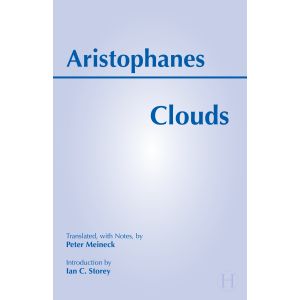
![]() Clouds (Meineck Edition)
Clouds (Meineck Edition)"Since the appearance of Sommerstein’s very successful literal translation less than twenty years ago, there have been at least five further new published attempts at rendering the play into English. It is certainly a bold enterprise to introduce yet one more translation onto the scene, but Peter Meineck has risen well to the challenge. The translation is straightforward and idiomatic, as well as well-paced and funny. . . Ian Storey’s Introduction is perfect for undergraduates.” —Max Nelson, Bryn Mawr Classical Review
Learn More -
![]() Odyssey
Odyssey"[Lombardo] has brought his laconic wit and love of the ribald. . . . to his version of the Odyssey. His carefully honed syntax gives the narrative energy and a whirlwind pace. The lines, rhythmic and clipped, have the tautness and force of Odysseus' bow." —Chris Hedges, The New York Times Book Review
"The definitive English version of Homer for our time." —The Common Review: The Magazine of the Great Books Foundation
"Lombardo weaves his cherished idioms into important patterns of repetition and transformation so familiar to the telling of the Odyssey. . . . Above all, such familiar phrases serve to remind us of the oral character of the original Odyssey, providing the reader with an uncanny immediacy and relevance." —Christina Zwarg, The Bryn Mawr Classical Review
Learn More -
![]() Satyricon
Satyricon"[Ruden] has caught, better than any translator known to me, both the conversational patterns of Petronian dialogue and the camera-sharp specificity and color of the Satyricon's descriptive passages.... A quite extraordinary achievement against heavy odds."
Learn More
—Peter Green, The Los Angeles Times Book Review -
![]() Oedipus Tyrannus
Oedipus Tyrannus"A clear, vigorous, spare, actable translation, and with it, excellent apparatus (Intro., notes, bibliography); all in a slim and affordable volume. I will use when I next teach Oedipus. Hackett is an invaluable resource!” —Rachel Hadas, Rutgers University
"I have enjoyed all of the recent Hackett editions of translations of Greek literature and "Oedipus Tyrannus” is certainly no exception. Meineck and Woodruff got things just right, from employing "Tyrannus” instead of "Rex” in the title (as has become traditional, though it lends an erroneous sense to the play from the outset) to Woodruff’s very fine and accessible Introduction to the suspenseful, poetic and powerful rendering of the play itself. Meineck’s theatrical sensibility and knowledge are evident, yet the text never becomes too "stagey” nor wanders far from the Greek. I will definitely use this text along with other terrific Hackett editions in my courses." —Lisa Rengs George, Arizona State University
Learn More -
![]() Plautus and Terence: Five Comedies
Plautus and Terence: Five Comedies"This is a book worthy of high praise. . . . All versions are exceedingly witty and versatile, in verse that ripples from one’s lips, pulling all the punches of Plautus, the knockabout king of farce, and proving that the more polished Terence can be just as funny. Accuracy to the original has been thoroughly respected, but look at the humour in rendering Diphilius’ play called Synapothnescontes as Three’s a Shroud. . . . Students in schools and colleges will benefit from short introductions to each play, to Roman stage conventions, to different types of Greek and Roman comedy, and there is a note on staging, with a diagram illustrating a typical Roman stage and further diagrams of the basic set for each play. The translators have paid more attention to stage directions than is usually given in translations, because they aim to show how these plays worked. This is a book to be used and enjoyed.”
Learn More
—Raymond J. Clark, The Classical Outlook -
![]() The Birds
The BirdsJeffrey Henderson's translation of Aristophanes' The Birds includes essays on Old Comedy and the Theater of Dionysus, suggestions for further reading, notes on production, and a general bibliography.
Learn More -
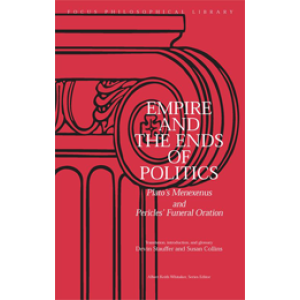
![]() Empire and the Ends of Politics
Empire and the Ends of PoliticsThis text brings together for the first time two complete key works from classical antiquity on the politics of Athens: Plato's Menexenus and Pericles' Funeral Oration (from Thucydides' history of the Peloponnesian War).
Learn More -
![]() Bacchae (Woodruff Edition)
Bacchae (Woodruff Edition)"[Woodruff’s translation] is clear, fluent, and vigorous, well thought out, readable and forceful. The rhythms are right, ever-present but not too insistent or obvious. It can be spoken instead of read and so is viable as an acting version; and it keeps the lines of the plot well focused. The Introduction offers a good survey of critical approaches. The notes at the foot of the page are suitably brief and nonintrusive and give basic information for the non-specialist."
Learn More
—Charles Segal, Harvard University -
![]() Oresteia
Oresteia“Peter Meineck’s new rendition of the Oresteia is that rare and wonderful thing: a text accessible to the Greekless audience while still preserving the vocabulary of Aeschylus. Those of us who have seen Peter Meineck's performances have long marveled at his ability to turn Greek into clear English, how he does not do ‘versions’ of the plays, how he does not rewrite the ancients into modern jargon (even his comedies maintain more Aristophanic text than is usual). Here lines that students have always needed explicated stand clear. . . . Helene Foley has provided a fine introduction for this translation. Introduction and translation together provide an exciting text, one that should be widely read, widely used.” —Karelisa Hartigan, University of Florida, in The Classical Outlook
Learn More -
![]() Aristophanes 1: Clouds, Wasps, Birds
Aristophanes 1: Clouds, Wasps, BirdsOriginally adapted for the stage, Peter Meineck’s revised translations achieve a level of fidelity appropriate for classroom use while managing to preserve the wit and energy that led The New Yorker to judge his Clouds “The best Greek drama we’ve ever seen anywhere,” and The Times Literary Supplement to describe his Wasps as “Hugely enjoyable and very, very funny.” A general Introduction, introductions to the plays, and detailed notes on staging, history, religious practice and myth combine to make this a remarkably useful teaching text.
Learn More -
![]() The Peloponnesian War
The Peloponnesian WarThe first unabridged translation into American English, and the first to take into account the wealth of Thucydidean scholarship of the last half of the twentieth century, Steven Lattimore’s translation sets a new standard for accuracy and reliability. Notes provide information necessary for a fuller understanding of problematic passages, explore their implications as well as the problems they may pose, and shed light on Thucydides as a distinctive literary artist as well as a source for historians and political theorists.
"[Lattimore] gets closer to the Greek than either of his two available rivals, Richard Crawley and Rex Warner. . . . Lattimore’s uncompromising version now leads the field." —Peter Green, The Los Angeles Times Book Review
Learn More -
![]() Bacchae (Esposito Edition)
Bacchae (Esposito Edition)English translation, with introductory material, notes, glossary and essay by Stephen Esposito, of Euripides' tragedy based on the mythological story of King Pentheus of Thebes.
Learn More -
![]() Terence: Brothers
Terence: BrothersThis is an English translation of Terence's Roman comedy that deals with questions of perennial interest: "How best to raise children?" and "How to give self-disinterested moral advice?"
Learn More -
![]() Antigone (Blondell Edition)
Antigone (Blondell Edition)"In her new translation of Antigone, Ruby Blondell demonstrates an unswerving sense of what the general reader needs to know in order not only to understand Sophocles, but to relish him as well… My own students have found that this edition not only makes the Antigone accessible, but also helps them understand why it continues to fascinate, to disturb, and to grip its readers century by century." —John T. Kirby, Comparative Literature, Purdue University
Learn More -
![]() Iliad
Iliad"Gripping. . . . Lombardo's achievement is all the more striking when you consider the difficulties of his task. . . . [He] manages to be respectful of Homer's dire spirit while providing on nearly every page some wonderfully fresh refashioning of his Greek. The result is a vivid and disarmingly hardbitten reworking of a great classic." —Daniel Mendelsohn, The New York Times Book Review
"It is hard to overstate the attractions of this translation. In a rhythm sinewy and flexible, with language that is precise, lyrical and fresh, Lombardo's Iliad pulses with all the power and luminosity of the Greek. He shows extraordinary sensitivity to the images and aural effects of the ancient poem. There are brilliant touches on every page. . . . Altogether this is as good as Homer gets in English." —Richard P. Martin, Princeton University
Learn More -
![]() Acharnians, Lysistrata, CloudsThis anthology offers English translations of three of Aristophanes' greatest comedies, Acharnians, Clouds, and Lysistrata, by Jeffrey Henderson, one of the most important scholars and translators of Greek comedy. Each comedy is also available in a single-play edition from Hackett Publishing's Focus imprint. Learn More
Acharnians, Lysistrata, CloudsThis anthology offers English translations of three of Aristophanes' greatest comedies, Acharnians, Clouds, and Lysistrata, by Jeffrey Henderson, one of the most important scholars and translators of Greek comedy. Each comedy is also available in a single-play edition from Hackett Publishing's Focus imprint. Learn More -
![]() The Greek and Roman Critics
The Greek and Roman Critics“An indispensable guide for anyone who wishes to study that . . . section of Greek and Latin literature which we should consider literary criticism.”
Learn More
—A. H. Armstrong -
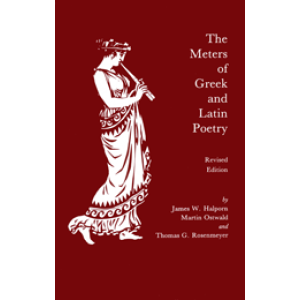
![]() The Meters of Greek and Latin Poetry
The Meters of Greek and Latin PoetryThis reliable text presents a clear and simple outline of Greek and Latin meters in order that the verse of the Greeks and Romans may be read as poetry.
Learn More -
![]() Clouds (Henderson Edition)
Clouds (Henderson Edition)Jeffrey Henderson, noted Greek scholar, has translated into English one of Aristophanes' greatest comedies. Offered with detailed notes and an enlightening introduction, this modern translation brings to life the wit and elegance of the language while putting the text in historical and cultural context.
Learn More -
![]() Works and Days & Theogony (Lombardo Edition)
Works and Days & Theogony (Lombardo Edition)“This is by far the best rendering of Hesiod’s poems in print. The translation is fully accurate but so readable one doesn’t want to stop; it exactly captures Hesiod’s rustic wisdom, his humour and his cautious pessimism. . . . Clear brief notes and a glossary make this a must for introductory courses: students will love it.”
Learn More
—Richard Janko, University College, London -
![]() Medea (Podlecki Edition)
Medea (Podlecki Edition)English translation. Includes essays on the play's mythical background and the work of Euripides, an introduction to Greek drama and the dramatic tradition, plot summaries and suggestions for further reading. For both students and the general reader.
Learn More -
![]() Symposium (Woodruff & Nehamas Edition)
Symposium (Woodruff & Nehamas Edition)"A model of the kind of text one needs for lecture courses: the translation is extremely readable and made even more accessible by intelligent printing decisions (on dividing the text, spacing for clarification, etc.); the notes are kept to a minimum but appear when they are really needed for comprehension and are truly informative. And the introduction admirably presents both basic information and a sense of current scholarly opinion." —S. G. Nugent, Princeton University
"A fantastic book. Translation is graceful and elegant yet uncannily accurate. Footnotes very useful, especially for teaching purposes, and the price is surprisingly low." —Eve Browning Cole, University of Minnesota
Learn More -
![]() Heracles
HeraclesEuripides' Heracles is an extraordinary play, innovative in its treatment of the myth, bold in its dramatic structure, and filled with affective human pathos. The play tells a tale of horror: Heracles, the greatest hero of the Greeks, is maddened by the gods to murder his wife and children. But this suffering and divine malevolence are leavened by the friendship between Heracles and Theseus, which allows the hero to survive this final and most painful labor. The Heracles raises profound questions about the gods and mortal values in a capricious and harsh world.
Learn More -
![]() Poetics (Janko Edition)
Poetics (Janko Edition)Richard Janko’s acclaimed translation of Aristotle’s Poetics is accompanied by the most comprehensive commentary available in English that does not presume knowledge of the original Greek. Two other unique features are Janko’s translations with notes of both the Tractatus Coislinianus, which is argued to be a summary of the lost second book of the Poetics, and fragments of Aristotle’s dialogue On Poets, including recently discovered texts about catharsis, which appear in English for the first time.
Learn More -
![]() Gorgias (Zeyl Edition)
Gorgias (Zeyl Edition)“This is an excellent translation. It achieves a very high standard of accuracy and readability, two goals very difficult to attain in combination when it comes to such a master of prose and philosophical argument as Plato. Because of this the book is suitable for courses at all levels in philosophy, from introductory courses on Plato, or problems in Philosophy, to graduate seminars.” —Gerasimos Santas, Teaching Philosophy
Learn More -
![]() The Meditations
The MeditationsIncludes a translator's Introduction, selected bibliography, note on the text, glossary of technical Terms, and a biographical index.
Learn More -
![]() Greek Particles (Second Edition)
Greek Particles (Second Edition)“This comprehensive scholarly work will not be superseded for another century. It is both a monumental and a readable book.”
—Classical PhilologyA reprint of the Oxford University Press edition of 1966. Co-published in the U.K. by Gerald Duckworth and Company, Ltd.
Learn More -
![]() The Verb 'Be' In Ancient Greek
The Verb 'Be' In Ancient Greek“It is great news that this book is available again. It deserves to be better known, both for its pioneering methods of linguistic analysis and for the results to which they lead. It transforms our understanding of the all-important Greek verb ‘to be.’”
Learn More
—Myles Burnyeat, All Souls College, University of Oxford