The Hackett Signature Editions Collection Featuring Premium Hardcovers of Hackett Classics - Learn More Here.

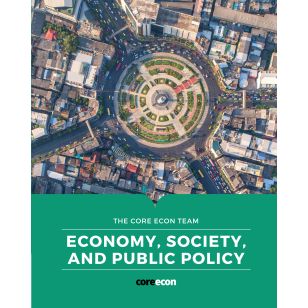
Economy, Society, and Public Policy
Economy, Society, and Public Policy is a new way to learn economics. The only resource to show students from any programme of study how to use economics to understand and articulate reasoned views on some of the most pressing policy problems facing our societies: inequality, financial instability, the future of work, environmental degradation, wealth creation, and innovation.
SKU
Economy, Society, and Public Policy
Economy, Society, and Public Policy (ESPP) is a new way to learn economics. The only resource to show students from any programme of study how to use economics to understand and articulate reasoned views on some of the most pressing policy problems facing our societies: inequality, financial instability, the future of work, environmental degradation, wealth creation, and innovation.
Excerpt from the Preface:
In order to be well-governed, a democracy needs voters who are fluent in the language of economics and who can do some quantitative analysis of social and economic policy. We also need a well-trained cadre of researchers and journalists who have more advanced skills in these fields.
Many students in other disciplines are drawn to economics so that they can engage with policy debates on environmental sustainability, inequality, the future of work, financial instability, and innovation. But, when they begin the study of economics, they find that courses appear to have little to do with these pressing policy matters, and are designed primarily for students who want to study the subject as their major, or even for those going on to post-graduate study in the field.
The result: policy-oriented students often find they have to choose between a quantitative and analytical course of study—economics—that is only minimally policy oriented in content and that downplays the insights of other disciplines, or a policy and problem-oriented course of study that gives them little training in modelling or quantitative scientific methods.
Economy, Society, and Public Policy changes this.
It has been created specifically for students from social science, public policy, business and management, engineering, biology, and other disciplines, who are not economics majors. If you are one of these students, we want to engage, challenge, and empower you with an understanding of economics. We hope you will acquire the tools to articulate reasoned views on pressing policy problems. You may even decide to take more courses in economics as a result.
The book is also being used successfully in courses for economics, business, and public policy majors, as well as in economics modules for Philosophy, Politics and Economics (PPE), and masters’ courses in Public Policy.
This textbook is the result of a worldwide collaboration among researchers, educators, and students who are committed to bringing the socially relevant insights of economics to a broader audience. We made it freely available online because we believe this understanding can contribute to richer participation of everyone—not just experts—in shaping our economies, and help to underpin an understanding of policy that is clearly based on evidence. We are grateful to the contributions of this entire team, and to the Nuffield Foundation for supporting the project financially.
Reviews:
"The best innovation in economic education that I have seen in my career. A smorgasbord of ideas that refresh our old concepts, moving our standard discourse from dismal to light, from a dehumanized science to a spirited vision of the world."
—Christian Gollier, Toulouse School of Economics, France
"We chose Economy, Society, and Public Policy because we have a very diverse cohort—most students were bored whilst others were struggling to keep pace. We wanted a more up-to-date, data-driven syllabus that covered the topics students wanted to discuss (inequality, climate change, etc.). I have just have finished teaching the first cohort of nearly 500 students and they seem to be highly engaged."
—Carlos Cortinhas, University of Exeter, UK
"Economy, Society, and Public Policy was a very successful text for non-economics majors. They really appreciated how they could get a great introduction to economics that focused on the real world and data, and was meaningful to their own experience of the world."
—Mark Dodd, University of Adelaide, Australia
"Other economics textbooks teach you about individual tools. Economy, Society, and Public Policy, on the other hand, teaches you how to address complex issues such as inequality and unemployment by simultaneously using all the tools in the toolbox. As a public policy student, this approach allowed me to evaluate current events and policy proposals through an economically comprehensive, rather than fragmented, lens."
—Alaina Leggette, MPA student at Columbia University (SIPA), US
Table of Contents:
- Unit 1. Capitalism and democracy: Affluence, inequality, and the environment
- Unit 2. Social interaction and economic outcomes
- Unit 3. Public policy for fairness and efficiency
- Unit 4. Work, wellbeing, and scarcity
- Unit 5. Institutions, power, and inequality
- Unit 6. The firm: Employees, managers, and owners
- Unit 7. Firms and markets for goods and services
- Unit 8. The labour market and the product market: Unemployment and inequality
- Unit 9. The credit market: Borrowers, lenders, and the rate of interest
- Unit 10. Banks, money, housing, and financial assets
- Unit 11. Market successes and failures
- Unit 12. Governments and markets in a democratic society
Instructor Resources:
Visit CORE Econ's ESPP support page for a complete list of free instructor and student resources tailored to this title.
FOR LEARNERS:
- Economist in Action videos by Al Roth, James Heckman, Anat Admati, Juliet Schor, Thomas Piketty, Petra Moser and others give you a glimpse of what economists do and how they engage in real policy questions
- Diagrams with step-by-step explanations
FOR INSTRUCTORS:
- Lecture slides in PowerPoint format
- Slides of figures
- Answers to exercises with teaching ideas
Economy, Society, and Public Policy is accompanied by Doing Economics, a free open-access e-book whichhelps students develop their quantitative skills using real-world problems and data: www.core-econ.org/doing-economics
Contributors:
The CORE Econ Team is made up of leading economists from around the world, led by:
Wendy Carlin, Director of CORE Econ, Professor of Economics at University College London, and a Research Fellow of the CEPR.
Samuel Bowles, Research Professor, Santa Fe Institute.
Margaret Stevens, Professor and former head of the Department of Economics at the University of Oxford.
Eileen Tipoe, Reader in School of Economics and Finance at Queen Mary, University of London.
Booksellers:
Starting in early 2025, Hackett Publishing Company will be the exclusive distributor of the forthcoming print book edition Economy, Society, and Public Policy. If you are a bookseller in North America, please email customer@hackettpublishing.com for bookseller terms and to place an order. If you are a bookseller in the U.K. or continental Europe, please contact our European distributor, Gazelle Book Services.