The Hackett Signature Editions Collection Featuring Premium Hardcovers of Hackett Classics - Learn More Here.

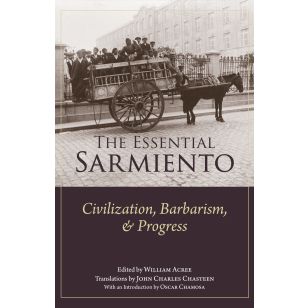
The Essential Sarmiento: Civilization, Barbarism, and Progress
"Domingo Sarmiento is a rhetorical and political giant whose garrulous, colorful, and troubling ideas about race, violence, politics, and literature have fascinated Spanish-language readers for over a hundred and fifty years. Thanks to William Acree's brilliant selection of writings and annotations, the sparkling translations of John Charles Chasteen, and Oscar Chamosa's excellent critical Introduction, readers of English can finally encounter this larger-than-life writer who was deeply committed to documenting his historical moment and assessing social and political ills. This book is a major—and long overdue—contribution to Latin American Studies."
—Christopher B. Conway, The University of Texas at Arlington
SKU
The Essential Sarmiento
"Domingo Sarmiento is a rhetorical and political giant whose garrulous, colorful, and troubling ideas about race, violence, politics, and literature have fascinated Spanish-language readers for over a hundred and fifty years. Thanks to William Acree's brilliant selection of writings and annotations, the sparkling translations of John Charles Chasteen, and Oscar Chamosa's excellent critical Introduction, readers of English can finally encounter this larger-than-life writer who was deeply committed to documenting his historical moment and assessing social and political ills. This book is a major—and long overdue—contribution to Latin American Studies."
—Christopher B. Conway, The University of Texas at Arlington
"Chasteen’s translations of Sarmiento’s writings are delightful reads. Chasteen is a master translator and shows his chops again here. The new translation of excerpts from Facundo especially captures the beauty of the original prose and reminds why—despite the morally complicated views contained therein—the work is still a canonical masterpiece of Latin American literature. Meanwhile, Acree's Preface provides a concise ‘instructor’s manual’ for how to use the text, and Chamosa’s Introduction is hands down one of the most eloquent accounts of Sarmiento’s life and its relationship to the birth and evolution of the United Provinces/Republic of Argentina ever written in English." —Michael Huner, Grand Valley State University
"Like the pampa pathfinders described in Facundo, a dream team of scholars has surveyed the vast landscape of Sarmiento's writings in order to assemble a field guide to the borderlands of civilization and barbarism. We observe Sarmiento inhabiting the urbane world he idealized and grasp the urgency of his hopes and fears. This book is kaleidoscopic in its views of nineteenth-century Latin America." —David Sartorius, University of Maryland
About The Authors:
William Acree is Professor of Spanish, American Culture Studies, and Performing Arts, Washington University in St. Louis.
John Charles Chasteen is Professor Emeritus of History, The University of North Carolina at Chapel Hill.
Oscar Chamosa is Associate Professor of History, University of Georgia.