The Hackett Signature Editions Collection Featuring Premium Hardcovers of Hackett Classics - Learn More Here.

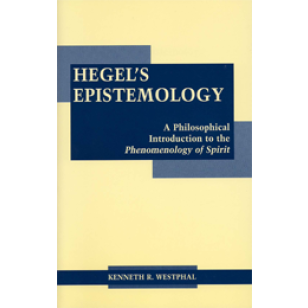
Hegel's Epistemology
"A reader-friendly, yet philosophically sharp and textually reliable introduction to one of the classics of western philosophy. Westphal shows why the dramatic, quasi-historical, structure of Hegel’s work is not accidental to it, but is rather required by the reflective, self-critical, nature of judgement that Hegel assumes from the beginning. The book will be of interest to readers who approach Hegel with analytical as well as phenomenological preconceptions, and of use (but for different reasons) to undergraduates and graduate students alike."
—George di Giovanni, McGill University
SKU
26253g
Provides a succinct philosophical introduction to Hegel’s Phenomenology of Spirit for non-specialists and students, focusing on Hegel’s unique and insightful theory of knowledge and its relations to 20th-century epistemology.
Reviews:
"A reader-friendly, yet philosophically sharp and textually reliable introduction to one of the classics of western philosophy. Westphal shows why the dramatic, quasi-historical, structure of Hegel’s work is not accidental to it, but is rather required by the reflective, self-critical, nature of judgement that Hegel assumes from the beginning. The book will be of interest to readers who approach Hegel with analytical as well as phenomenological preconceptions, and of use (but for different reasons) to undergraduates and graduate students alike."
—George di Giovanni, McGill University
"Westphal argues that epistemological realism is compatible with a social and historical constructivism, and that Hegel shows us how a self-critical community of human knowers can achieve (and reflectively appreciate) knowledge of the world around them and their place in it. Almost 200 years ago Hegel had the kind of epistemology we now know we need! I hope this book will put Hegel back into the canon of epistemology."
—Willem de Vries, University of New Hampshire
"Philosophically, the most satisfying and sophisticated account of the Phenomenology yet."
—Frederick Beiser, Syracuse University
"For philosophers interested in reading across the Continental/Analytic divide, this book opens new facets of Hegel's philosophy."
—Donn Welton, State University of New York, Stony Brook
"Anyone seriously interested in epistemology, and especially anyone who doubts Hegel’s importance for contemporary epistemology, should read Ken Westphal’s elegant and insightful book."
—Joseph Rouse, Wesleyan
About the Author:
Kenneth R. Westphal is Professor of Philosophy, University of East Anglia, United Kingdom.