The Hackett Signature Editions Collection Featuring Premium Hardcovers of Hackett Classics - Learn More Here.

Social & Political Philosophy
-
![]() Marx: Selected Writings
Marx: Selected WritingsFeaturing the most important and enduring works from Marx's enormous corpus, this collection ranges from the Hegelian idealism of his youth to the mature socialism of his later works. Organized both topically and in rough chronological order, the selections (many of them in the translations of Loyd D. Easton and Kurt H. Guddat) include writings on historical materialism, excerpts from Capital, and political works.
Learn More -
![]() Leviathan
LeviathanDesigned to meet the needs of both student and scholar, this edition of Leviathan offers a brilliant introduction by Edwin Curley, modernized spelling and punctuation of the text, and the inclusion, along with historical and interpretive notes, of the most significant variants between the English version of 1651 and the Latin version of 1668. A glossary of seventeenth-century English terms, and indexes of persons, subjects, and scriptural passages help make this the most thoughtfully conceived edition of Leviathan available.
Learn More -
![]() Wealth of Nations
Wealth of Nations"Has all the basic chapters for the illustration of all the various (and contradictory) points anyone might want to make about the text. Dickey's own texts are invaluable. The introductions to the chapters are essential to make clear to students where they fit in the overall argument of the book. The appendices, though clearly the expression of the author's own views about the text, are admirably objective in the treatment of competing views, and represent an important contribution to Smith scholarship."
Learn More
—J. W. Smit, Columbia University -
![]() Dewey: Political Writings
Dewey: Political WritingsIncludes notes on sources and editions and an editor's introduction.
Learn More -
![]() The Grand Inquisitor
The Grand Inquisitor"This collection gives us a sense of the depth of Dostoevsky's insights into human life and suffering and of his profound understanding of the tensions and dangers of modernity. Guignon's Introduction is a brilliant study that shows how profoundly the 'legend of the Grand Inquisitor' speaks to our day." —Charles Taylor, McGill University
"Guignon's Introduction is by far the best available to these texts, and is, for its clarity and depth, one of the finest Introductions to complex literary or philosophical material that I've ever read." —Stephen L. Collins, Babson College
Learn More -
![]() Republic (Grube, Second Edition)
Republic (Grube, Second Edition)The revised edition of Grube’s classic translation follows and furthers Grube’s noted success in combining fidelity to Plato’s text with natural readability, while reflecting the fruits of new scholarship and insights into Plato’s thought since publication of the first edition in 1974. A new introduction, index, and bibliography by Professor Reeve are included in this new rendering.
“C.D.C. Reeve has taken the excellent Grube translation and, without sacrificing accuracy, rendered it into a vivid and contemporary style. It is intensity that is often lost in translation, but not here. This is not just a matter of style. The Republic is full of brilliant thoughts, and one needs to preserve brilliance to capture them. In the cave of translations, Reeve’s revision of Grube’s Republic is closest to the sun.” —Jonathan Lear, University of Chicago
Learn More -
![]() Discourse on the Origin of Inequality
Discourse on the Origin of InequalityDonald Cress’s highly regarded translation, based on the critical Pléiade edition of 1964, is here issued with a lively introduction by James Miller, who brings into sharp focus the cultural and intellectual milieu in which Rousseau operated. This new edition includes a select bibliography, a note on the text, a translator’s note, and Rousseau’s own Notes on the Discourse.
Learn More -
![]() Rights of Man
Rights of Man“Claeys has done a fine job of situating Paine’s famous text in the intellectual and practical context, drawing out the most important themes, and referring the reader to the best secondary literature. . . . An excellent textbook for undergraduate courses in political theory.”
Learn More
—James Tully, McGill University -
![]() Man and Citizen
Man and CitizenContains the most helpful version of Hobbes’s political and moral philosophy available in English. Includes the only English translation of De Homine, chapters X-XV. Features the English translation of De Cive attributed to Hobbes.
Learn More -
![]() Montesquieu: Selected Political Writings
Montesquieu: Selected Political Writings“Professor Richter has long been one of our most knowledgeable commentators on the French intellectual tradition. Having written on Montesquieu, Tocqueville, and Durkheim, he is well positioned to provide us not only with an historically informed translation of Montesquieu’s major writings, but also with an excellent introduction to what is important about Montesquieu as a thinker.”
Learn More
—Lawrence Dickey, University of Wisconsin -
![]() Introduction to the Philosophy of History
Introduction to the Philosophy of History"An elegant and intelligent translation. The text provides a perfect solution to the problem of how to introduce students to Hegel in a survey course in the history of Western philosophy.
Learn More
—Graham Parkes, University of Hawaii -
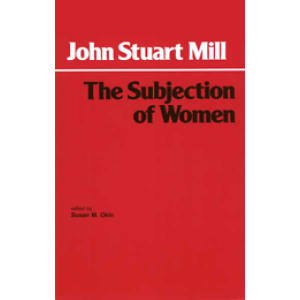
![]() The Subjection of Women
The Subjection of Women“An excellent and affordable edition, with a pithy introduction by Okin that that contextualizes and summarizes the argument well. Mill’s work affords insight not only into the issue of women’s emancipation, but also into the world of 19th century liberalism: its views of history, of class, and of slavery.”
Learn More
—Peter C. Caldwell, Rice University -
![]() Reflections on the Revolution in France
Reflections on the Revolution in France“Pocock is, without question, the leading historian of eighteenth-century British-American political thought. . . . All of his skills are brilliantly employed in the Introduction. . . . In addition to being the best treatment of Burke’s thought in context, it is . . . the best and most concentrated presentation of Pocock’s own view of the main contours of eighteenth-century political thought. . . . Finally, the Reflections and other texts by Burke are then woven into this rich fabric, thus providing the reader with an understanding of Burke’s thought which is deeper and more complex (and surely more historically sensitive) than any available in the secondary literature.”
Learn More
—James Tully, McGill University -
![]() On Crimes and Punishments
On Crimes and PunishmentsIncludes a translator’s preface, note on the text, and suggestions for further reading.
Learn More -
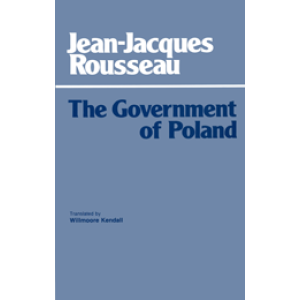
![]() The Government of Poland
The Government of Poland"The Government of Poland is the only finished work in which Rousseau himself dons the mantle of legislator, applying the principles of the Social Contract to the real world around him. Poland teaches us much about the mysterious art of the Social Contract's 'legislator,' how he transforms each individual into part of a larger whole. Only in . . . Poland do we find what this crucial transformation entails and what it presupposes. But probably the greatest lesson to be learned from . . . Poland concerns Rousseau's understanding of the proper relationship between theory and practice. . . . Time and again we see Rousseau advising the Poles to do things which are in gross violation of the strict principles of political right he had elaborated in the Social Contract."
Learn More
—Richard Myers in Canadian Journal of Political Science -
![]() An Introduction to Plato's Laws
An Introduction to Plato's LawsReading the Republic without reference to the less familiar Laws can lead to a distorted view of Plato's political theory. In the Republic the philosopher describes his ideal city; in his last and longest work he deals with the more detailed considerations involved in setting up a second-best 'practical utopia.' The relative neglect of the Laws has stemmed largely from the obscurity of its style and the apparent chaos of its organization so that, although good translations now exist, students of philosophy and political science still find the text inaccessible. This first full-length philosophical introduction to the Laws will therefore prove invaluable.
Learn More -
![]() A Letter Concerning Toleration
A Letter Concerning TolerationJohn Locke's subtle and influential defense of religious toleration as argued in his seminal Letter Concerning Toleration (1685) appears in this edition as introduced by one of our most distinguished political theorists and historians of political thought.
Learn More -
![]() Second Treatise of Government
Second Treatise of GovernmentThe Second Treatise is one of the most important political treatises ever written and one of the most far-reaching in its influence.
In his provocative 15-page introduction to this edition, the late eminent political theorist C. B. Macpherson examines Locke's arguments for limited, conditional government, private property, and right of revolution and suggests reasons for the appeal of these arguments in Locke's time and since.
"Macpherson provides for his readers a tightly written, meaty, and often invigorating critical assessment of Locke's argument. In it one finds some of the best of Macpherson's now famous criticism of liberal-democratic government."
Learn More
—Gregory E. Pyrcz in Canadian Philosophical Review -
![]() A Companion To Plato's Republic
A Companion To Plato's RepublicA step by step, passage by passage analysis of the complete Republic. White shows how the argument of the book is articulated, the important interconnections among its elements, and the coherent and carefully developed train of though which motivates its complex philosophical reasoning. In his extensive introduction, White describes Plato’s aims, introduces the argument, and discusses the major philosophical and ethical theories embodied in the Republic. He then summarizes each of its ten books and provides substantial explanatory and interpretive notes.
Learn More -
![]() On Liberty
On LibertyContents include a selected bibliography and an editor's Introduction broken into two sections. The first section provides a brief sketch of the historical, social, and biographical context in which Mill wrote and the second traces the central line of argument in the text to aid in the comprehension of the essay's structure, method, and major theses.
Learn More