The Hackett Signature Editions Collection Featuring Premium Hardcovers of Hackett Classics - Learn More Here.

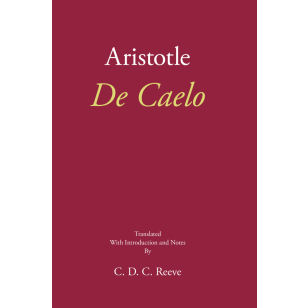
De Caelo
Series: The New Hackett Aristotle
"The De Caelo can be quite difficult for a first-time reader. C. D. C. Reeve's fluid and accurate translation, along with his superb Introduction and 560 endnotes (in effect functioning as a commentary), are bound to make this work much more accessible, while at the same time being a highly useful tool for seasoned Aristotle scholars." —Robert Mayhew, Professor of Philosophy, Seton Hall University
"Reeve's lucid and accurate translation of this difficult work will be of great value both to historians of philosophy and to philosophers interested in the topics Aristotle addresses for their own sake. The generous Introduction and notes provide the reader without Greek with full access to Aristotle's thinking." —William Charlton, author of many works on Aristotle's philosophy of nature and contributor of five volumes to the Ancient Commentators on Aristotle series
SKU
28186g
This new translation of De Caelo (On the Heavens) fits seamlessly with other volumes in the New Hackett Aristotle series, enabling Anglophone readers to study Aristotle’s work in a way previously not possible. The Introduction describes the book that lies ahead, explaining what it is about, what it is trying to do, how it goes about doing it, and what sort of audience it presupposes. Sequentially numbered endnotes provide the information most needed at each juncture, while a detailed Index indicates the places where focused discussion of key notions occurs.
Reviews:
"The De Caelo can be quite difficult for a first-time reader. C. D. C. Reeve's fluid and accurate translation, along with his superb Introduction and 560 endnotes (in effect functioning as a commentary), are bound to make this work much more accessible, while at the same time being a highly useful tool for seasoned Aristotle scholars."
—Robert Mayhew, Professor of Philosophy, Seton Hall University
"Reeve's lucid and accurate translation of this difficult work will be of great value both to historians of philosophy and to philosophers interested in the topics Aristotle addresses for their own sake. The generous Introduction and notes provide the reader without Greek with full access to Aristotle’s thinking."
—William Charlton, author of many works on Aristotle's philosophy of nature and contributor of five volumes to the Ancient Commentators on Aristotle series
"From among the eight Aristotelian treatises translated by C. D. C. Reeve thus far, De Caelo belongs, together with Generation of Animals (2019), to the less often rendered. This is the first complete English version since Guthrie (1939), and its virtues are the same as those of previous volumes, including the clarity of translation (here based on Paul Moraux’s 1965 Budé edition) and a thorough Introduction. In this case, the introductory study is especially welcome, since explaining the place of De Caelo in the corpus is no easy task. . . . All things considered, De Caelo adds another building block to Reeve's admirable Aristotelian edifice."
—Karel Thein, Charles University, Prague, in Bryn Mawr Classical Review
Abbout the Author:
C. D. C. Reeve is Delta Kappa Epsilon Distinguished Professor of Philosophy at The University of North Carolina at Chapel Hill.
Contents:
- Preface
- Abbreviations
- Introduction
De Caelo
Book I
- 1 The completeness of the universe.
- 2 The existence of a fifth elemental body (primary body, ether) whose spatial movement is circular.
- 3 This body is exempt from alteration and passing away.
- 4 Circular movement has no contrary.
- 5 Primary body is not unlimited.
- 6 Nor are any of the other elements.
- 7 In general, no body is unlimited.
- 8 There cannot be more than one heaven: proved on the basis of the natural movements and places of the elements.
- 9 Proved on the basis of form and matter.
- 10 The heaven is incapable of coming to be or passing away.
- 11 Ways in which things are incapable of coming to be or passing away.
- 12 Argument that the heaven is incapable of coming to be or passing away continued.
Book II
- 1 Corroboration of this conclusion about the heaven from the examination of ancient views.
- 2 Up, down, left, right in the heaven.
- 3 Why there are several spatial movements in the heaven.
- 4 Why the shape of the heaven must be spherical.
- 5 Why the primary heaven revolves in one direction rather than the other.
- 6 Why its movement is regular rather than irregular.
- 7 The stars: not composed of fire; the source of their heat and light.
- 8 Their spatial movement is due to the spheres to which they are attached.
- 9 No harmony of the spheres.
- 10 Their order.
- 11 Their spherical shape.
- 12 Resolutions of two puzzles about their movements.
- 13 The earth: previous views.
- 14 The earth: at rest at the center and spherical in shape.
Book III
- 1 Summary of previous books and of previous views on coming to be; why bodies cannot be composed of planes (Plato) or numbers (Pythagoreans).
- 2 Every simple body has a natural movement; how non-natural movement occurs.
- 3 The nature of elements. III 4 Their number; refutation of atomism.
- 5 There is more than one element.
- 6 Elements are not eternal but come to be from each other.
- 7 How they do so; the views of Empedocles and Plato refuted.
- 8 Elements not differentiated by their shape.
Book IV
- 1 Heavy and light; unconditionally vs. relatively so.
- 2 Examination of previous views.
- 3 The movement of heavy and light bodies.
- 4 The differentiae of heavy and light bodies.
- 5 The way in which their matter is one.
- 6 Shape and the movements of bodies.
Notes
- Appendix Plato, Timaeus 50b–57d, 61c–64a 243
- Further Reading
- Index