The Hackett Signature Editions Collection Featuring Premium Hardcovers of Hackett Classics - Learn More Here.

AIASCS 2025
-
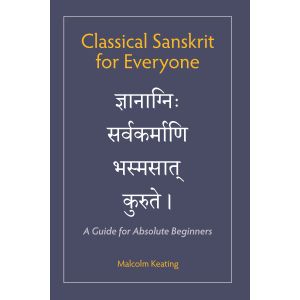
![]() Classical Sanskrit for Everyone
Classical Sanskrit for Everyone"Surprisingly, Classical Sanskrit for Everyone is indeed for everyone. Playing tour guide to the 'curious,' the 'Yoga aficionado,' and the 'scholar' on an efficient itinerary through Sanskrit grammar and its philosophical cultures, Keating’s book is refreshingly accessible and useful. Replete with an excellent analysis of important features of Sanskrit with analogies to English usage and learned 'pandit points,' it also provides supplemental discussions of Sanskrit poetry and philosophy and up-to-date online resources. Pop culture references and a playfully funny tone, at turns, disarm the uninitiated reader and give the scholar a fresh perspective on how to teach this language to a new generation of eager learners."
—Deven M. Patel, University of PennsylvaniaAdditional Resources: A translation key (PDF download) and links to free online resources, including dictionaries and instructional materials, are available on the Classical Sanskrit for Everyone title support page.
Learn More -
![]() Gilgamesh
GilgameshThis stirring new version of the great Babylonian epic includes material from the recently discovered “monkey tablet” as well as an Introduction, timeline, glossary, and correspondences between lines of the translation and those of the original texts.
"A comprehensive Introduction with a light touch (Beckman), a poetic rendering with verve and moxie (Lombardo): This edition of the colossal Babylonian Gilgamesh Epic should satisfy all readers who seek to plumb its wealth and depth without stumbling over its many inconvenient gaps and cruxes. A fine gift to all lovers of great literature." —Jack M. Sasson, Emeritus Professor, Vanderbilt University and The University of North Carolina at Chapel Hill
Learn More -
![]() Heroides
Heroides"An excellent piece of work. Lombardo and McClure have struck the right balance between literal and lyrical, formal and informal. Each of the letters has a distinct voice–something clear in the Latin but difficult to convey.
Learn More
"There are many small pleasures for the reader looking at the Latin (duplicated line-starts and -ends, verbal effects, etc.). Most are unobtrusive, which is all to the good. This translation is not designed to be a crib, though it wouldn’t be bad as one. More importantly, the poems read well in English. There are lots of glancing references to the tropes of elegy, but they won’t slow down the first-time reader of the poems. The translators have even made something of several of the puns (e.g. verbum/vela dare), an impressive feat.
"Welch's Introduction is perfectly pitched; it gives a lot of useful information in short compass, and it does so in a lively manner, with full attention to the scholarship but not so as the general reader would notice."
–Laurel Fulkerson, Professor Emerita of Classics, Florida State University -
![]() Lingua Latina: Pars I: Familia Romana (Second Edition, with Full-Color Illustrations)
Lingua Latina: Pars I: Familia Romana (Second Edition, with Full-Color Illustrations)Familia Romana (the main book of Pars I of the Lingua Latina per se illustrata series) contains thirty-five chapters and describes the life of a Roman family in the 2nd century A.D. It culminates in readings from classical poets and Donatus's Ars Grammatica, the standard Latin school text for a millennium. Each chapter is divided into two or three lessons (lectiones) of a few pages each followed by a grammar section (Grammatica Latina) and three exercises (Pensa). Hans Ørberg's impeccable Latin, humorous stories, and the Peer Lauritzen illustrations, reproduced in full color, make this work a classic. The book also includes a table of declensions, a Roman calendar, and a word index (index vocabulorum).
"Familia Romana and A Companion to Familia Romana came as a complete revelation. I'd heard they were unique, but they are literally nothing less than a work of genius. They would completely revolutionize the classroom, and I would urge all teachers of first-year Latin at universities and all high school teachers to seriously consider adopting this radical approach to learning Latin. The companion volume provides all the traditional exposure you would want, but the main volume shows every prospect of genuinely internalizing Latin in the learner's brain as a living language, calling on a whole set of language-acquisition skills and instincts normally neglected in the teaching of a dead language. Mind-blowing." —Jack Mitchell, Department of Classics, Dalhousie University
Familia Romana Essentials Online online courseware is also available. More information can be found in the links below:
COURSE INSTRUCTORS: Request free instructor preview access and learn more here.
INDIVIDUAL LEARNERS: See purchasing options and FAQs about the self-paced learner version of the course here.
Learn More -
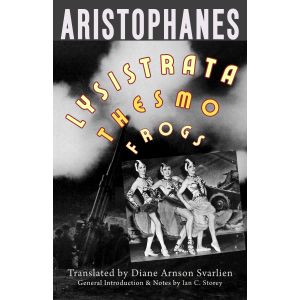
![]() Lysistrata, Women at the Thesmophoria, Frogs
Lysistrata, Women at the Thesmophoria, Frogs"Arnson Svarlien's translation offers fresh insight into three of Aristophanes's greatest comedies. The verse flows smoothly, and throughout it is stressed that these plays belong on a stage, with guidance on how that might be accomplished. At the same time, the detailed Introduction and interpretative notes on every page show that both Arnson Svarlien and Storey are deeply committed to presenting a vibrant, modern Aristophanes, and to giving the tools needed for readers and actors to form their own opinions on matters of ongoing scholarly controversy."
Learn More
—C.W. Marshall, FRSC, Professor of Greek, The University of British Columbia -
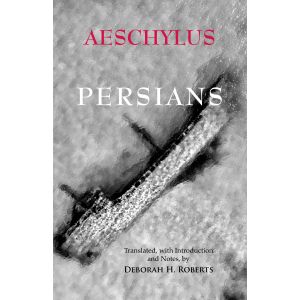
![]() Persians
Persians"The musicality of Deborah Roberts' translation of Aeschylus' Persians, the earliest Greek tragedy that has come down to us, rivals the playwright's own astonishing lyricism. She crafts extended speeches by the drama's characters into captivating set-pieces of performance poetry. Roberts also replicates Herodotus' celebrated storytelling energy in her translation of the passages from his Histories included in this volume. In her Introduction, Roberts examines Aeschylus' drama and Herodotus' representations of Persian culture as crucial records of ancient Greek conceptions of otherness and perceptively appraises the Persians itself as a sober contemplation upon the shared human toll of political ambition and warfare’s traumas and grief, making this book urgently relevant to contemporary audiences."
Learn More
—James Bradley Wells, PhD, Edwin L. Minar Professor of Classical Studies, DePauw University