The Hackett Signature Editions Collection Featuring Premium Hardcovers of Hackett Classics - Learn More Here.

Homeschool Philosophy
-
![]() Anselm: Basic Writings
Anselm: Basic WritingsRanging from his early treatises, the Monologion (a work written to show his monks how to meditate on the divine essence) and the Proslogion (best known for its advancement of the so-called ontological argument for the existence of God), to his three philosophical dialogues on metaphysical topics such as the relationship between freedom and sin, and late treatises on the Incarnation and salvation, this collection of Anselm's essential writings will be a boon to students of the history of philosophy and theology as well as to anyone interested in examining what Anselm calls "the reason of faith."
Learn More -
![]() Aquinas: Basic Works
Aquinas: Basic WorksDrawn from a wide range of writings and featuring state-of-the-art translations, Basic Works offers convenient access to Thomas Aquinas' most important discussions of nature, being and essence, divine and human nature, and ethics and human action. The translations all capture Aquinas's sharp, transparent style and display terminological consistency. Many were originally published in the acclaimed translation-cum-commentary series The Hackett Aquinas, edited by Robert Pasnau and Jeffrey Hause. Others appear here for the first time: Eleonore Stump and Stephen Chanderbahn’s translation of On the Principles of Nature, Peter King’s translation of On Being and Essence, and Thomas Williams’ translations of the treatises On Happiness and On Human Acts from the Summa theologiae.
Learn More -
![]() Classics of Western Philosophy (Eighth Edition)
Classics of Western Philosophy (Eighth Edition)The Eighth Edition of Steven M. Cahn's Classics of Western Philosophy offers the same exacting standard of editing and translation that made earlier editions of this anthology the most highly valued and widely used volume of its kind. But the Eighth Edition offers exciting new content as well, including Plato's Laches (complete), new selections from Aristotle's Nicomachean Ethics (on courage), Descartes' Discourse on Method (complete), all previously omitted sections of Berkeley's A Treatise Concerning the Principles of Human Knowledge, and Kant's Prolegomena to Any Future Metaphysics (complete).
Learn More -
![]() Confessions (Williams Edition)
Confessions (Williams Edition)"The best overall translation of Augustine's Confessions to date. . . . Williams captures the immediacy of Augustine's prayer, the playfulness of his language, and (without striving too hard) the properly elevated poetry of the text. As priest and philosopher and an Anglican with a good sense of English, Williams understands Augustine from the inside. For the foreseeable future, this will be my go-to translation for the Confessions."
Learn More
—Jared Ortiz, Hope College, in Catholic World Report -
![]() Discourse on Method and Meditations on First Philosophy (Fourth Edition)
Discourse on Method and Meditations on First Philosophy (Fourth Edition)This edition contains Donald Cress's completely revised translation of the Meditations (from the corrected Latin edition) and recent corrections to Discourse on Method, bringing this version even closer to Descartes's original, while maintaining the clear and accessible style of a classic teaching edition.
Learn More -
![]() Discovering Philosophy (Fourth Edition)
Discovering Philosophy (Fourth Edition)Are we free or determined? Are things really the way they appear to be? What’s the difference between right and wrong? Can God’s existence be demonstrated? Discovering Philosophy looks at these and other fundamental questions that have bedeviled thinkers for centuries. Designed for students who are more comfortable with secondary than primary sources, Discovering Philosophy is both accessible and intellectually challenging. While it examines the ideas of traditional philosophers, it also considers perspectives that have historically been underrepresented (feminist philosophers and Native American thought), draws examples from popular culture, and considers cutting-edge philosophical questions raised by scientific discoveries (are dolphins nonhuman persons with rights?). Each chapter includes discussion questions, boxed highlights, and suggestions for further reading.
Instructor Resources: Click here to request the Instructor's Manual (PDF) and Test Bank with Answer Key (PDF or Word file).
Learn More -
![]() Environmental Ethics: The Central Issues
Environmental Ethics: The Central IssuesEnvironmental Ethics provides an accessible, lively, and up-to-date introduction to the central issues and controversies in environmental ethics. Requiring no previous knowledge of philosophy or ethical theory, the book will be of interest to students, environmental scientists, environmental policy makers, and anyone curious to know what philosophers are saying today about the urgent environmental challenges we face.
Instructor Resources: Click here to download PowerPoint lecture slides and to request Environmental Ethics test banks with answer keys.
Learn More -
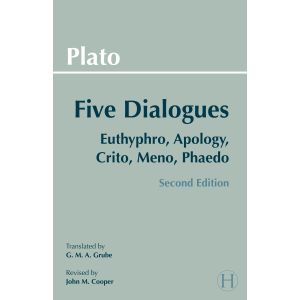
![]() Five Dialogues (Second Edition)
Five Dialogues (Second Edition)The second edition of Five Dialogues presents G. M. A. Grube’s distinguished translations, as revised by John Cooper for Plato, Complete Works. A number of new or expanded footnotes are also included along with an updated bibliography.
Learn More -
![]() How Do You Know?
How Do You Know?"An excellent and engaging introduction to epistemology, with a special focus on issues in social epistemology that are very relevant in today’s world. An accessible guide to practical epistemological questions about which experts you should trust, the pervasiveness of bias in oneself and others, the proliferation of misinformation on the internet, and how you should respond when lots of people disagree with you. Highly recommended." —James Beebee, State University of New York at Buffalo
"How Do You Know? is an accessible and engaging foray into the growing field of applied epistemology, and a welcome resource for students or anyone else coming to these issues for the first time." —David Coady, University of Tasmania
Learn More -
![]() Meditations, Objections, and Replies
Meditations, Objections, and RepliesThis edition features reliable, accessible translations; useful editorial materials; and a straightforward presentation of the Objections and Replies, including the objections from Caterus, Arnauld, and Hobbes, accompanied by Descartes' replies, in their entirety. The letter serving as a reply to Gassendi—in which several of Descartes' associates present Gassendi's best arguments and Descartes' replies—conveys the highlights and important issues of their notoriously extended exchange. Roger Ariew's illuminating Introduction discusses the Meditations and the intellectual environment surrounding its reception.
Learn More -
![]() Nicomachean Ethics (Sachs Edition)
Nicomachean Ethics (Sachs Edition)"Sachs's translations of Aristotle are truly exemplary. They combine a rare sensitivity to Aristotle's use of the Greek language with an English style that is straightforward and imaginative. But what makes Sachs's translations even more noteworthy is their attunement born of profound awareness of the untranslatability of this thought into modern philosophical concepts. For anyone seriously interested in Aristotle's philosophy, Sachs's translations are indispensable."
Learn More
—Burt Hopkins, Seattle University -
![]() Readings in Ancient Greek Philosophy (Fifth Edition)
Readings in Ancient Greek Philosophy (Fifth Edition)Soon after its publication, Readings in Ancient Greek Philosophy was hailed as the favorite to become "the 'standard' text for survey courses in ancient philosophy."* More than twenty years later that prediction has been borne out: Readings in Ancient Greek Philosophy still stands as the leading anthology of its kind. It is now stronger than ever: The Fifth Edition of Readings in Ancient Greek Philosophy features a completely revised Aristotle unit, with new translations, as well as a newly revised glossary. The Plato unit offers new translations of the Meno and Republic. In the latter, indirect dialogue is cast into direct dialogue for greater readability. The Presocratics unit has been re-edited and streamlined, and the pages of every unit have been completely reset.
* APA Newsletter for Teaching Philosophy
Learn More -
![]() Republic (Sachs Edition)
Republic (Sachs Edition)"Joe Sachs, known and respected for his excellent translations of Aristotle, deserves great praise for this new translation of Plato's Republic. Based on the latest definitive edition of the Greek text and guided by a sense that Greek in English need not read like an old, foreign tongue, Sachs' translation captures the flow of the conversation in an English that reads smoothly, even when the ideas expressed force one to pause and look again. Fluid, yet accurate, Sachs' translation allows the thoughtful reader deeper entry into this all-important book. The editorial guides and typographical signs to remind the reader of who has joined the argument most recently are all highly helpful and most welcome. I look forward to reading this with students." —Charles E. Butterworth, University of Maryland
Learn More -
![]() The Trial and Death of Socrates (Third Edition)
The Trial and Death of Socrates (Third Edition)The third edition of The Trial and Death of Socrates presents G. M. A. Grube’s distinguished translations, as revised by John Cooper for Plato, Complete Works. A number of new or expanded footnotes are also included along with a Select Bibliography.
Learn More -
![]() Utilitarianism (Sher, Second Edition)
Utilitarianism (Sher, Second Edition)This expanded edition of John Stuart Mill’s Utilitarianism includes the text of his 1868 speech to the British House of Commons defending the use of capital punishment in cases of aggravated murder. The speech is significant both because its topic remains timely and because its arguments illustrate the applicability of the principle of utility to questions of large-scale social policy.
Learn More