The Hackett Signature Editions Collection Featuring Premium Hardcovers of Hackett Classics - Learn More Here.

RSA 2025
-
![]() Black Protagonists of Early Modern Spain
Black Protagonists of Early Modern Spain** Awarded the MLA’s Aldo and Jeanne Scaglione prize for a translation of a literary work (December 2024). **
The prize committee’s citation: "In the three Spanish comedias included in Black Protagonists of Early Modern Spain, which appear together and in English for the first time, the seemingly rigid social hierarchies that form the setting of so many comedias are put to the test when three talented Black men break through the racial barriers. Michael Kidd’s selection of plays will appeal to students of literature, history, cultural studies, and the African diaspora. The plays themselves are framed between a highly informative preface and introduction and an extensive annotated glossary of people and places. However, it is the accessibility, fluidity, and vibrancy of language that make this volume an excellent choice for all readers to experience and enjoy in English the same kind of wordplay that was integral to the Spanish comedia of the early modern period."
Remarkable products of a nation deeply implicated in the Atlantic slave trade, the seventeenth-century Spanish plays Juan Latino, The Brave Black Soldier, and Virtues Overcome Appearances appear together in English for the first time in this volume. The three protagonists not only defy the period’s color-based prejudices but smash through its ultimate social barrier: marriage into the white nobility. Michael Kidd’s fluid translations and extensive critical introduction, bibliography, and glossary are enhanced by Hackett’s title support webpage. Black Protagonists of Early Modern Spain is essential reading for students of theater history, Spanish literature, and the African diaspora.
Additional Online Resources: Illustrations and maps referenced in the book are available for free on the title support page.
Learn More -
![]() Doctor Faustus
Doctor FaustusThis new edition of Christopher Marlowe’s Doctor Faustus offers the complete 1604 A-text with embedded selections from the 1616 B-text. Its innovative format will make it easier for readers to note differences between these texts and to consider what is gained and lost in viewing them both separately and together. A full Introduction to the play, notes, and a rich selection of related texts further enhance the value of this edition to students of Renaissance drama, Reformation theology, magic, and occult philosophy.
Learn More -
![]() The Book of the Courtier
The Book of the CourtierPeter Hainsworth’s sparkling, eminently readable new English translation of The Book of the Courtier, Baldesar Castiglione’s (1478–1529) literary and philosophical masterpiece, captures all the nuance, stylistic flair, and humor of this foundational work of Renaissance humanism.
Learn More -
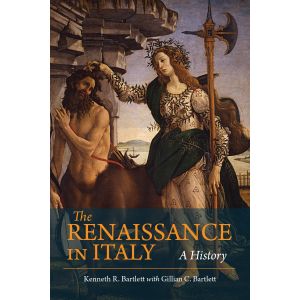
![]() The Renaissance in Italy: A History
The Renaissance in Italy: A History"An elegant tour of the republics and princely courts where the Italian Renaissance flourished. Bartlett presents a survey of glittering cultural, literary, and artistic achievements, never losing sight of the important political contexts in which they were made. The whole sweep of the Italian Renaissance—the fabulous wealth of its merchants, the ruthless schemes of its princes, the high ideals of its poets and writers, the astonishing works of its artists and architects, the struggles of its visionaries and reformers—comes into focus." —Margaret Meserve, University of Notre Dame
"Kenneth Bartlett (Univ. of Toronto, Canada), a prolific writer on Italy, the Renaissance, and humanism, and Gillian Bartlett, an author and educator, have produced a volume that will appeal to many scholars. Their book is organized as a series of biographies of prominent figures from the period—including Petrarch, Machiavelli, and Michelangelo, among others—and each chapter concludes with examples of appropriate works of art, accompanied by useful commentaries. The authors begin with Petrarch, describing how he introduced and popularized concepts that defined humanism. Geographically, Bartlett and Bartlett also focus more on minor states, such as Naples, than is customary, although they ultimately chart their narrative to Counter-Reformation Rome, where humanism died, leaving its traces in art and architecture. Happily, the spirit of humanism also survived elsewhere, to enrich our lives today. . . . [T]hose with some background knowledge will be fascinated by this beautifully written text, and will hopefully appreciate the poetic rhythm of the prose, appropriate for a book that celebrates Cicero, the ultimate Latin stylist. Summing Up: Highly recommended. All readership levels." —W. L. Urban, emeritus, Monmouth College (IL), in Choice
Learn More -
![]() The Tragedy of Antony and Cleopatra
The Tragedy of Antony and Cleopatra"Like the Blits edition of Julius Caesar, this new edition of Antony and Cleopatra restores one of Shakespeare's Roman plays to its rightful place among serious works of political philosophy devoted to understanding Roman politics and the characters who inhabit it. The Preface and Introduction are extremely well written. The Preface situates this edition in opposition to certain conventions of modern Shakespeare scholarship that are generally unhelpful to readers approaching the play from the perspective of political philosophy. It moreover identifies places where other editions and editors mislead the reader and bury Shakespeare's political wisdom in the process. The Introduction explores the impact of political change on the arc of Roman history, with special attention to the conditions that fostered republican Rome and the erosion of such conditions under the empire. It also provides ample opportunity to connect the politics of the play to modern political problems. The footnotes are unusually helpful for scholars interested in Shakespeare's political thought. References to relevant classical authorities such as Cicero, Livy, Plutarch, Appian, and Dio help clear the way for a more serious confrontation with the play." —Khalil Habib, Hillsdale College
"This edition of Antony and Cleopatra gives contemporary readers access to Shakespeare's meaning as no other edition does. While other editors may provide basic information about the historical setting of the play, Jan Blits makes palpable the shape and feel of the world in which the action unfolds. His annotations citing classical authors reveal a world of possibility that would have been available to earlier generations, that Shakespeare would have taken for granted, and that is lost on readers today. His excellent Introduction frames the drama in terms of questions regarding the relative place of the public and private in the polity’s life, the claims of the universal and the national on the allegiance of citizens, and the meaning of nobility that will be highly provocative for anyone interested in Shakespeare as a political thinker." —Joseph Alulis, North Park University
Learn More -
![]() The Tragedy of Macbeth
The Tragedy of MacbethThe fourth in a series of editions of Shakespeare’s most political and history-soaked plays, this Macbeth offers copious aids to understanding the play not found in any other edition. By attending to the play’s medieval Scottish setting in a way that rival editors have never matched—when they have even dug beyond the early seventeenth-century context in which it was produced—Jan H. Blits’s edition richly rewards readers left unsatisfied by “decodings” of the play’s supposed allusions to the politics of early modern England who wish to look deeper. In doing so, it opens the text for readers to encounter, in new ways, the play’s historical, political, and psychological significance.
Learn More