The Hackett Signature Editions Collection Featuring Premium Hardcovers of Hackett Classics - Learn More Here.

History






-
![]() The Russian Revolution and Its Global Impact
The Russian Revolution and Its Global ImpactSeries: Passages: Key Moments in History
"Thoughtful, readable, and concise, this little book sets the Russian Revolution in its global context. Though primarily focused on the period from 1917 to the 1930s, it nicely illustrates the many ways in which the effects of the Revolution are still being felt today." —Rex Wade, George Mason University
Learn More -
![]() The East India Company, 1600–1858
The East India Company, 1600–1858Series: Passages: Key Moments in History
"Ian Barrow has written a concise yet engaging, rich, and detailed history of the East India Company—its rise to power, evolution, and eventual demise. This book will be read with great interest by students as well as those general readers seeking a better knowledge of the world's first multi-national corporation and its important influence in the creation of the modern South Asian world." —Michael Dodson, Indiana University Bloomington
Learn More -
![]() The Accessible Federalist
The Accessible Federalist"I assign students to read The Federalist so they will grasp the ideas. But too often they can’t get past the words. Adam Seagrave's The Accessible Federalist will enable readers of all backgrounds to understand the ideas that shaped the Constitution. It will also spur many readers onward to study and appreciate the original texts. I hope it gets wide attention and classroom use." —James H. Read, Professor of Political Science, College of Saint Benedict and Saint John’s University
Learn More -
![]() The American Debate over Slavery, 1760–1865
The American Debate over Slavery, 1760–1865"The American Debate over Slavery, 1760–1865 will be a superb resource for teachers and students of early American history. Editors Lubert, Hardwick, and Hammond have carefully assembled and introduced a rich collection of significant documents that bring the slavery debate into sharp and illuminating focus. This is easily the best book in its field." —Peter S. Onuf, University of Virginia and Thomas Jefferson Foundation (Monticello)
Learn More -
![]() Records of the Three Kingdoms in Plain Language
Records of the Three Kingdoms in Plain Language"Idema and West have been collaborating on the production of scholarly works on, and translations of, Chinese vernacular literature for decades and their work has set a very high standard for scholarly value, accuracy, and readability. This is their second volume on popular treatments of the famous Three Kingdoms period, a fascinating age that has dominated as a topic both traditional Chinese fiction and drama. . . . Records of the Three Kingdoms in Plain Language . . . presents a comprehensive introduction to all of the main characters (Liu Bei, Guan Yu, Zhang Fei, Cao Cao, Zhou Yu, etc.) and events (the Oath in the Peach Garden, The Battle at the Red Cliff, The Single Sword Meeting, etc.) that are so well known in China and deserve to be even better known in the West." —David Rolston, University of Michigan
Learn More -
![]() Protests in the Streets: 1968 Across the Globe
Protests in the Streets: 1968 Across the GlobeSeries: Critical Themes in World History
"A really interesting and provocative take on 1968. This book addresses the truly global dimensions—and the unexpected, often long-term consequences—of that year of protest. It’s an original and highly usable comparative history sure to attract student interest." —Peter N. Stearns, George Mason University
Learn More -
![]() Reformation Thought
Reformation Thought"A superb anthology of primary sources relating most directly to sixteenth-century Reformation movements. The initial selection is from the late fourteenth century and the final two from the mid-eighteenth century. The fifty texts here are wide and well focused. They are drawn from forty-one authors with diversities across many categories—birth, occupation, gender, religious orders, and 'the rest married women of middling and noble rank.' . . . This book has many excellencies. It can be highly recommended as a well-conceived collection of well-constructed presentations and as an eminently useful textbook."
Learn More
—Donald K. McKim, in Renaissance Quarterly -
![]() Sunjata: A New Prose Version"After existing orally for hundreds of years, Sunjata was written down in the twentieth century. David Conrad, who recorded a new version of the epic, has now crafted a prose translation that preserves the oral flavor of live performance. The result is a captivating work of literature that will finally give the story of Sunjata its well-deserved place among the great epics of world literature."
Sunjata: A New Prose Version"After existing orally for hundreds of years, Sunjata was written down in the twentieth century. David Conrad, who recorded a new version of the epic, has now crafted a prose translation that preserves the oral flavor of live performance. The result is a captivating work of literature that will finally give the story of Sunjata its well-deserved place among the great epics of world literature."
—Martin Puchner, Byron and Anita Wien Professor of Drama and of English and Comparative Literature, Harvard University Learn More -
![]() Daily Life in Ancient Rome
Daily Life in Ancient Rome"There’s a tremendous amount to admire in Brian Harvey’s new Daily Life in Ancient Rome: A Sourcebook. And it stands out as a superior work against all the competing texts. Specifically, much careful thought, attention, and effort has gone into ensuring that the work is ideal for students and interested non-professionals. The texts are all translated into clear, accurate English. They are also thoroughly contextualized, both in categories as well as individually. This insistence on the historicity of the sources sets the book apart from the norm. The book also benefits from Harvey’s extensive, almost encyclopedic, knowledge of inscriptions, which are used as important sources along with the literary excerpts. Finally, the many photos by the author himself augment the texts and are themselves analyzed as unique sources."
Learn More
—Steven L. Tuck, Miami University, Ohio -
![]() The Description of the World
The Description of the World"Marco Polo’s account provided both what was thought to be a reliable guide to East Asia—Columbus carried with him a heavily annotated copy of Marco Polo’s work during his own expedition to the Americas—and an intriguingly fantastical account that for centuries has continued to fuel the imagination of poets and artists. Kinoshita’s superb, groundbreaking translation brilliantly renders into modern English this crucial text of the Middle Ages. Indispensable in the undergraduate and graduate classroom, The Description of the World will also appeal to a wide range of readers curious about the medieval encounter of East and West."
Learn More
—Suzanne Conklin Akbari, University of Toronto -
![]() Matteo Ricci and the Catholic Mission to China, 1583–1610
Matteo Ricci and the Catholic Mission to China, 1583–1610Series: Passages: Key Moments in History
"A highly accessible introduction to the history of the Jesuits in China. Hsia offers a clear and concise overview of the key figures in this crucial episode of intercultural encounter: the first intellectual and cultural meeting of Europeans and Chinese. . . . In addition to providing a broad vision of the European and Asian contexts for Ricci’s work in the introductory essay, Hsia gives a valuable selection of documents from both Chinese and Western sources in translation . . . [including] items that genuinely demonstrate the two sides of this cultural exchange."
—Liam Matthew Brockey, Professor of History, Michigan State University
Learn More -
![]() Shackles of Iron: Slavery Beyond the Atlantic
Shackles of Iron: Slavery Beyond the AtlanticSeries: Critical Themes in World History
"Gordon’s survey of the topic makes it clear that slavery in the Americas can be understood much better if we put it in this larger context, in terms of both time and place. His chapters on East African and Mediterranean slavery are especially valuable, since these were contemporary with so-called Atlantic slavery and can provide students with valid points of comparison, revealing both the similarities and the variable nature of early-modern bondage. The final chapter is especially timely, reminding readers that much of what we think of as enslavement hasn’t really gone away, but simply slipped below the radar of the world media. All in all, Gordon makes it clear that, though it has arisen in different guises and at many different times and places, slavery has been and remains deeply rooted in human society. A rewarding introduction for anyone looking to better understand slavery as a world-wide institution."
Learn More
—Robert Davis, The Ohio State University -
![]() The Essential Douglass
The Essential Douglass"For years I have wanted a compact, carefully edited collection of Frederick Douglass’ writings and speeches spanning his whole career—from the antebellum years to the Civil War and Reconstruction to the retreat from racial democracy in the 1870s, ’80s, and ’90s. Finally, in Nicholas Buccola’s expertly edited The Essential Douglass: Selected Writings & Speeches, I have it. Buccola has done teachers and scholars of American political thought a tremendous service by making a truly representative selection of Douglass’ achievement available in an affordable volume. I am excited to assign this book to my students and share with them the full breadth of Douglass’ intellectual fire." —Jack Turner, University of Washington
Download a PDF of the Table of Contents.
Learn More -
![]() Seven Myths of the Crusades
Seven Myths of the CrusadesSeries: Myths of History
"Crusade historians frequently lament the wide gulf that separates modern scholarship from popular beliefs regarding the holy wars of the Middle Ages. In this lively book a group of those scholars tackle seven of the most intractable myths that obscure our view of the crusades. With erudition, energy, and a dose of humility this book makes the case that solid historical research brings us ever closer to historical accuracy—and that matters. The myths of the crusades may be legion, but breaking down seven of them is an excellent place to start."
Learn More
—Thomas F. Madden, St. Louis University -
![]() Civil War
Civil War"Brian Walters has given us what too few translators of classical poetry do—an authorial presence. Here is Lucan himself in all his drastic modes—everything from his enraged indignation to his paradoxical aphorisms—recreating the ruptured Neronian world he lived in as he recounts the nefarious civil war that destroyed the Roman Republic."
Learn More
—Stanley Lombardo, University of Kansas -
![]() Afro-Latino Voices, Shorter Edition
Afro-Latino Voices, Shorter EditionIdeally suited for use in broad, swift-moving surveys of Latin American and Caribbean history, this abridgment of McKnight and Garofalo's Afro-Latino Voices: Narratives from the Early Modern Ibero-Atlantic World, 1550-1812 (2009) includes all of the English translations, introductions, and annotation created for that volume.
Learn More -
![]() On Law, Morality, and Politics (Second Edition)
On Law, Morality, and Politics (Second Edition)The second edition of Aquinas, On Law, Morality, and Politics retains the selection of texts presented in the first edition but offers them in new translations by Richard J. Regan—including that of his Aquinas, Treatise on Law (Hackett, 2000). A revised Introduction and glossary, an updated select bibliography, and the inclusion of summarizing headnotes for each of the units—Conscience, Law, Justice, Property, War and Killing, Obedience and Rebellion, and Practical Wisdom and Statecraft—further enhance its usefulness.
Learn More -
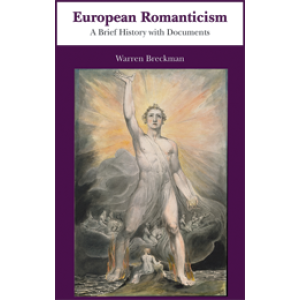
![]() European Romanticism
European Romanticism"The introductory essay is superb, the best short introduction to Romanticism I know. It is comprehensive, covering both the wide range of spheres that Romanticism affected—literature, philosophy, art, music, politics, nationalism—and the broad spectrum of European countries in which it was an influential cultural current. It offers a distinctive, unified interpretation of Romanticism that nonetheless does justice to the complexities of Romantic ideas."
Learn More
—Gerald Izenberg, Washington University in St. Louis -
![]() The Essential Thirty Years War
The Essential Thirty Years WarThis abridgment of Tryntje Helfferich's acclaimed 2009 anthology The Thirty Years War features an expanded General Introduction and annotation designed to support student readings in swift-moving surveys of European and World history.
Learn More -
![]() On the Genealogy of Morality
On the Genealogy of Morality"Hackett’s On the Genealogy of Morality (we now have even the correct title!) may very well change the entire climate for reading Nietzsche in English—especially if read in conjunction with their equally splendid Twilight of the Idols. . . . Competing translations of Nietzsche’s late, utterly influential masterpieces have often made them a chore, rather than a delight, to read; and their introductions generally obscure, rather than illuminate, the texts’ situations. Clark and Swensen (and Polt and Strong) have made the Genealogy and Twilight accessible and exhilarating—while leaving them, as they are, enigmatic and problematic. Finally, readers of Nietzsche in English can—begin!”
Learn More
—William Arctander O’Brien, University of California, San Diego -
![]() The Secret History
The Secret History"This translation will be especially useful in undergraduate classes because, in the final section, Kaldellis appends translations of related passages from Prokopios's longer History of the Wars, from Justinian's legislation, and from other sixth-century primary sources. Students can use these passages to judge for themselves how accurately the Secret History portrayed Justinian's career as well as that of this controversial empress. Summing up: Essential."
Learn More
—T. S. Miller, Salisbury University, in CHOICE -
![]() The Trial of Galileo
The Trial of Galileo"Finocchiaro is the foremost scholar and translator of Galileo's works and this book an invaluable collection of key documents concerning the 'greatest scandal of Christendom'—the trial and condemnation of the founder of modern science as a heretic by the Roman Inquisition in 1633. The book follows and complements Finocchiaro's magisterial work Retrying Galileo: 1633-1992, and provides essential, original source material concerning the facts and issues indispensable for scholars, students and educated lay persons. Finocchiaro’s masterly introductory essay provides a valuable guide to the history and issues, particularly helping to dispel the many myths regarding the scientific, philosophical, theological and political issues raised by Galileo’s trial. An unrivaled resource for understanding the 'Galileo Affair'."
Learn More
—Peter Slezak, University of New South Wales -
![]() The Haitian Revolution
The Haitian Revolution"A landmark collection of documents by the field's leading scholar. This reader includes beautifully written introductions and a fascinating array of never-before-published primary documents. These treasures from the archives offer a new picture of colonial Saint-Domingue and the Haitian Revolution. The translations are lively and colorful." —Alyssa Sepinwall, California State University San Marcos
"Extraordinary . . . offers a fascinating window into the slave uprising that began in Saint-Dominique in 1791 and culminated with the emergence of an independent black Haiti in 1803. . . . [Geggus] offers more detailed coverage than Laurent Dubois and John D. Garrigus's Slave Revolution in the Caribbean, 1789-1804: A brief History with Documents (Bedford/St. Martin's, 2006) by providing twice the number of primary documents. . . . The introduction is crisp and concise. . . . Summing up: Essential."
Learn More
—B.N. Newman, Virginia Commonwealth University, in CHOICE -
![]() The Gaucho Juan Moreira
The Gaucho Juan Moreira"Chasteen conveys [the novel's] power and action, as well as the colorful language and humor of the gaucho found in the original text. Acree's astute introduction contextualizes the life and exploits of Argentina’s great 19th-century bandit hero. Moreira's humanity and heroism come through clearly to the modern reader. Thanks to Gutiérrez's skillful blending of fact and fiction about Moreira, readers today will learn a great deal about the social realities and folk customs of 19th-century gauchos. General readers will enjoy the action and pathos of this early work of ‘true crime.’ Instructors seeking to engage their students with a compelling tale of 19th-century Latin American class conflict and social injustice will want to assign the book in their courses."
Learn More
—Richard W. Slatta, North Carolina State University -
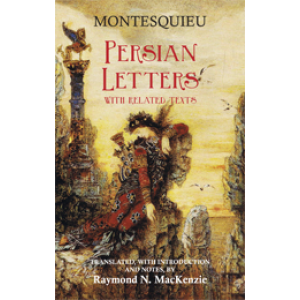
![]() Persian Letters (MacKenzie Edition)
Persian Letters (MacKenzie Edition)"An excellent edition that will give students a clean, well-translated text without too much clutter. The introduction is magisterial."
—Srinivas Aravamudan, Duke UniversityWith skill and artistry, Raymond MacKenzie’s stunning new translation accurately reflects the mood and character of the work. In his richly conceived Introduction, MacKenzie seamlessly weaves together an overview of the period with details of Montesquieu’s life, including the influences that inspired the Persian Letters, the character and power of the book, and its reception.
This edition also includes a Calendar of the Persian Letters, a Bibliography of Works in English, and a Bibliography of Works in French. Related texts provide insight into the legacy of the Persian Letters. They include selections from works by George Lyttelton, Voltaire, Oliver Goldsmith, and Maria Edgeworth. Learn More -
![]() The Wars of Justinian
The Wars of Justinian"At last . . . the translation that we have needed for so long: a fresh, lively, readable, and faithful rendering of Prokopios' Wars, which in a single volume will make this fundamental work of late ancient history-writing accessible to a whole new generation of students."
Learn More
—Jonathan Conant, Brown University -
![]() The Essential Díaz
The Essential DíazIdeally suited for use in swift-moving surveys of World, Atlantic, and Latin American history, this abridgment of Ted Humphrey and Janet Burke’s 2012 translation of the True History provides key excerpts from Diaz’s text and concise summaries of omitted passages. Included in this edition is a new preface outlining the social, economic, and political forces that motivated the European “discovery” of the New World.
Learn More -
![]() Ancient Rome
Ancient Rome"Terrific . . . exactly the sort of collection we have long needed: one offering a wide range of texts, both literary and documentary, and that—with the inclusion of Sulpicia and Perpetua—allows students to hear the voices of actual women from the ancient world. The translations themselves are fluid; the inclusion of long extracts allows students to sink their teeth into material in ways not possible with traditional source books. The anonymous texts, inscriptions, and other non-literary material topically arranged in the 'Documentary' section will enable students to see how the documentary evidence supplements or undermines the views advanced in the literary texts. This is a book that should be of great use to anyone teaching a survey of the history of Ancient Rome or a Roman Civilization course. I look forward to teaching with this book which is, I think, the best source book I have seen for the way we teach these days."
Learn More
—David Potter, University of Michigan -
![]() Histories
Histories"This edition reproduces the fluent pace and readability of Herodotus' world-encompassing work. Mensch has produced a close translation of Herodotus' Greek that is also an engrossing read in English. As an old-time Herodotean, I found myself drawn into Herodotus' universe of history and story all over again. Combined with Romm's elegant introduction, which conveys the lure of Herodotus' work, the lucid maps and tables, and the pertinent, uncluttered notes, this is an edition to read for pleasure and for education. I recommend it to future students of Herodotus and their instructors, and to any reader who wants to discover and rediscover Herodotus in a vibrant new translation."
Learn More
—Emily Greenwood, Yale University -
![]() Daily Life of the Ancient Greeks (Second Edition)
Daily Life of the Ancient Greeks (Second Edition)Significantly expanded and updated in light of the most recent scholarship, the second edition of Garland's engaging introduction to ancient Greek society brings this world vividly to life—and, in doing so, explores the perspectives and morals of typical ancient Greek citizens across a wide range of societal levels. Food and drink, literacy, the plight of the elderly, the treatment of slaves, and many more aspects of daily life in ancient Greece also come into sharp focus. More than sixty illustrations are included, as are maps, a chronology, a glossary of Greek terms, and suggestions for further reading.
Learn More -
![]() Renaissance Humanism
Renaissance Humanism"By far the best collection of sources to introduce readers to Renaissance humanism in all its many guises. What distinguishes this stimulating and useful anthology is the vision behind it: King shows that Renaissance thinkers had a lot to say, not only about the ancient world—one of their habitual passions—but also about the self, how civic experience was configured, the arts, the roles and contributions of women, the new science, the 'new' world, and so much more."
Learn More
—Christopher S. Celenza, Johns Hopkins University -
![]() Race and Ethnicity in the Classical World
Race and Ethnicity in the Classical World"This highly affordable, lively and wide-ranging anthology will be an invaluable study resource for courses on ancient identities and ideas about foreigners. . . . It will also appeal to the general reader interested in exploring what Greeks and Romans thought and wrote about peoples often styled 'barbarian,' not least because knowledge of such material was instrumental in the formation of the modern disciplines of anthropology, ethnography and geography. Both the high quality of the translation and the fact that it presents sizable chunks of text for students to ponder make it an ideal teaching text. Wild flights of fancy, tales of mythical monstrosity and cruel/bizarre stereotypes sit side-by-side. Dicaeopolis's response seems the most apt: 'Wowzers!'" —Journal of Classics Teaching
Learn More -
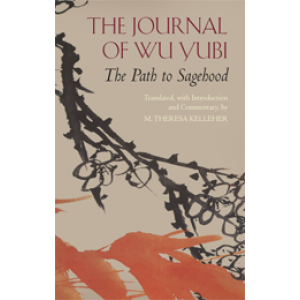
![]() The Journal of Wu Yubi
The Journal of Wu YubiIn this rare firsthand account of an individual's pursuit of sagehood, the early Ming dynasty scholar and teacher Wu Yubi chronicles his progress and his setbacks, as he strives to integrate the Neo-Confucian practices of self-examination and self-cultivation into everyday life. In more than three hundred entries, spanning much of his adult life, Wu paints a vivid picture, not only of the life of the mind, but also of the life of a teacher of modest means, struggling to make ends meet in a rural community.
Learn More -
![]() On the Freedom of a Christian
On the Freedom of a Christian"The translations are accurate and clear, and the introductory essay does a wonderful job of distilling complicated theological controversies into terms that are comprehensible by an undergraduate audience. The edition's greatest asset, though, is the range of texts that it includes. By including works by Luther's Catholic opponents and his erstwhile allies, this edition demonstrates that On the Freedom of a Christian represented not only a high point in Luther's thought, but also a starting point in a debate that spanned Christendom and had massive social and political implications." —Philip Haberkern, Boston University
"On the one hand, [the related texts] introduce readers to the key theological concepts taught by Luther, the Catholic theologians, and the radical reformers. On the other hand, they disclose the social, cultural, and economic aspects—topics that are of paramount interest in recent Reformation scholarship. The introductory essay in each section is crisp, clear, and concise. The success of this work is the ability to distill complicated theological controversies and divergent contents into nuances that are accessible to a wider audience." —Dennis Ngien, Tyndale University College & Seminary, in Renaissance and Reformation
Learn More -
![]() A Vindication of the Rights of Woman
A Vindication of the Rights of Woman"A thoughtful and useful abridgement of an essential historical, political, and philosophical text. [Barnard and Shapiro] have managed to preserve the tone and arguments of the original while shedding much of the redundancy and lengthy quotations of external sources that can be off-putting and cumbersome for today's readers. The explanatory footnotes added to the text are helpful without being overbearing."
Learn More
—Katrin Schultheiss, George Washington University -
![]() Addresses to the German Nation
Addresses to the German NationThis new edition of the Addresses is designed to make Fichte’s arguments more accessible to English-speaking readers. The clear, readable, and reliable translation is accompanied by a chronology of the events surrounding Fichte’s life, suggestions for further reading, and an index. The groundbreaking introductory essay situates Fichte’s theory of the nation state in the history of modern political thought. It provides historians, political theorists, and other students of nationalism with a fresh perspective for considering the interface between cosmopolitanism and republicanism, patriotism and nationalism.
Learn More -
![]() The Alienist and Other Stories of Nineteenth-Century Brazil
The Alienist and Other Stories of Nineteenth-Century Brazil"An engaging entry point for students, readers who enjoy a well-crafted short story, or anyone interested in the legacy of slave-holding society in the Western Hemisphere. I attribute the success of [t]his volume to the way Chasteen highlights points of personal identification for an English-speaking readership, especially students, and the way he frames these short stories by Machado as relevant sources for a comparative history of racial politics in Brazil and the USA. . . . In my evaluations of Chasteen's translations, I am drawing from student reactions to their first exposure to Machado through this volume in a course about Brazilian culture taught at the University of California, Los Angeles. In short, they loved Machado and quickly made him their own. I credit this immediate embrace with the way Chasteen has selected, ordered, and framed the collection with a young student audience in mind. He introduces Machado with selections that reflect the concerns of an educated class through the eyes of a young university student." —Machado de Assis em linha, The Electronic Journal of Machado Studies
Learn More -
![]() Lives that Made Greek History
Lives that Made Greek HistoryIn this compilation from Plutarch's Greek Lives, James Romm gathers the material of greatest historical significance from fifteen biographies, ranging from Theseus in earliest times to Phocion in the late fourth century BCE. While preserving the outlines of Plutarch's character portraits, Romm focuses on the central stories of classical Greece: the rivalry between Athens, Sparta, and Thebes, the rise of Macedon, and the conflicts between these European states and the Achaemenid Persian empire. Bridging Plutarch’s gaps with concise summaries, Romm creates a coherent narrative of the classical Greek world.
Learn More -
![]() Discourse on Voluntary Servitude
Discourse on Voluntary Servitude"An excellent translation: clear, crisp and accurate. The introduction is also a helpful contextualization of the text, Boétie's relation to Montaigne, and a brief discussion of the history of this important text on non-cooperation in the 20th-Century. I highly recommend it for courses in the history of political theory and of non-cooperation as a means of regime change."
Learn More
—James Tully, Department of Political Science, University of Victoria -
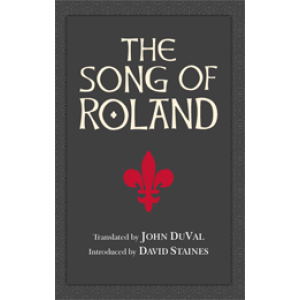
![]() The Song of Roland
The Song of Roland"The true poetry of the most well-known French epic springs vividly to life here in an entirely new way. DuVal's unique translation captures the meter and assonance of the original at the same time that it conveys the breathless pace, as simple as it is complex, of one of the most moving tales of all time. One can hear—and feel—the singer of tales speaking to us today. I cannot wait to teach this text in the classroom." —Jody Enders, University of California, Santa Barbara
"This translation is a substantial improvement over what is otherwise available. . . . The editorial remarks provide a healthy perspective on the religious chauvinism of the poem. . . . I appreciate having the Old French version included. The narrative is clear and engaging and it effectively captures the fast-paced intensity of the original." —Linda Marie Zaerr, Boise State University
Learn More -
![]() The Arthaśāstra
The Arthaśāstra"The translations are the collaborative product of the two leading authorities today on the Arthaśāstra. . . . Their work is consistently, meticulously accurate throughout, yet written in the most straightforward and direct manner imaginable. The material prefatory to each translated section is, again, clear and accessible. . . . Complex matters are effectively distilled in plain language, and the key issues brought out. Superb on all counts. I have been awaiting such a volume for a long time." —Timothy Lubin, Washington and Lee University
"McClish and Olivelle's general Introduction to the Arthaśāstra is destined to become a classic in the field of South Asian studies; they have translated the text itself in an accessible style that students and general readers alike will comprehend and enjoy.” —James Frey, University of Wisconsin, Oshkosh
Learn More -
![]() Augsburg During the Reformation Era
Augsburg During the Reformation Era"Sixteenth-century Augsburg comes to life in this beautifully chosen and elegantly translated selection of original documents. Ranging across the whole panoply of social activity from the legislative reformation to work, recreation, and family life, these extracts make plain the subtle system of checks and balances, violence, and self-regulation that brought order and vibrancy to a sophisticated city community. Most of all we hear sixteenth-century people speak: in their petitions and complaints, their nervous responses under interrogation, their rage and laughter. Tlusty has done an invaluable service in crafting a collection that should be an indispensable part of the teaching syllabus."
Learn More
—Andrew Pettegree, University of St. Andrews -
![]() Rousseau: The Basic Political Writings (Second Edition)
Rousseau: The Basic Political Writings (Second Edition)This substantially revised new edition of Rousseau: The Basic Political Writings features a brilliant new Introduction by David Wootton, a revision by Donald A. Cress of his own 1987 translation of Rousseau’s most important political writings, and the addition of Cress’ new translation of Rousseau's State of War. New footnotes, headnotes, and a chronology by David Wootton provide expert guidance to first-time readers of the texts.
Learn More -
![]() The True History of The Conquest of New Spain
The True History of The Conquest of New Spain"Bernal Díaz’s True History of the Conquest of New Spain, the chronicle of an ‘ordinary’ soldier in Hernando Cortés’s army, is the only complete account (other than Cortés’s own) that we have of the Spanish conquest of ancient Mexico. Although it is neither so ‘true’ nor so unassumingly direct as its author would have us believe, it is unmistakably the voice of the often unruly, undisciplined body of untrained freebooters who, in less than three years, succeeded against all apparent odds, in bringing down the once mighty ‘Aztec Empire.’ It makes for consistently fascinating reading, and Ted Humphrey and Janet Burke have provided the best, and the most engaging, translation ever to have appeared in English."
Learn More
—Anthony Pagden, UCLA -
![]() Montaigne: Selected Essays
Montaigne: Selected Essays"A superb achievement, one that successfully brings together in accessible form the work of two major writers of Renaissance France. This is now the default version of Montaigne in English." —Timothy Hampton, University of California, Berkeley
"Inspired. In every page—beginning with Atkinson's brilliant Introduction—this magical Montaigne betrays a lifetime of meditation on its subject." —Stephen G. Nichols, Johns Hopkins University
Learn More -
![]() The Battle over Free Will
The Battle over Free WillThis compilation of writings from Erasmus and Luther’s great debate—over free will and grace, and their respective efficacy for salvation—offers a fuller representation of the disputants’ main arguments than has ever been available in a single volume in English. Included are key, corresponding selections from not only Erasmus’ conciliatory A Discussion or Discourse concerning Free Will and Luther’s forceful and fully argued rebuttal, but—with the battle now joined—from Erasmus’ own forceful and fully argued rebuttal of Luther. Students of Reformation theology, Christian humanism, and sixteenth-century rhetoric will find here the key to a wider appreciation of one of early modern Christianity’s most illuminating and disputed controversies.
Learn More -
![]() A Pioneer in Yokohama
A Pioneer in Yokohama"A great read—I couldn’t put it down! A Pioneer in Yokohama truly brings the earliest months of the Japanese treaty port to life. From the brief Japanese 'Gold Rush' to duels and terrorist attacks, from the perils of international commerce to hilarious problems of translation and miscommunication, Dutchman De Coningh’s memoir provides vivid insights into both nineteenth-century trade and Yokohama’s international community. Moreover, the extraordinary sleuth work done by translator Chaiklin to identify even the most preposterous-seeming events and characters adds the spice of historical confirmation to the drama. . . . A great resource for researchers, classrooms, and casual readers alike."
Learn More
—Sarah Thal, University of Wisconsin-Madison -
![]() Ireland and Britain, 1798-1922
Ireland and Britain, 1798-1922"Impressive . . . Dworkin offers a survey of Anglo-Irish history that conveys the complexity of the topic while at the same time remaining clear, highly readable, and accessible to beginning students. He recognizes that ‘Irish’ cannot be equated with ‘Catholic’ and ‘nationalist,’ and rightly emphasizes the importance of region and class as well as religion in shaping the modern history of the Irish nations. The introductions that accompany each primary source excerpt keep to the high standard of the opening essay: the right amount of detail for contextualization and comprehensibility, without overwhelming the reader. The selection of excerpts is solid."
Learn More
—Meredith Veldman, Louisiana State University -
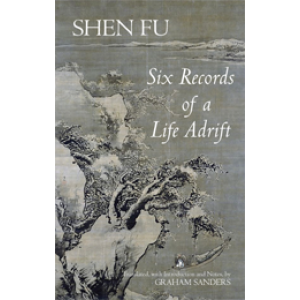
![]() Six Records of a Life Adrift
Six Records of a Life Adrift"Shen Fu’s Six Records of a Life Adrift is the most intimate document at our disposal of private life in late imperial China. Graham Sanders now provides us with a new translation for the 21st century, which is not only well researched but also highly readable." —Wilt Idema, Harvard University
Learn More -
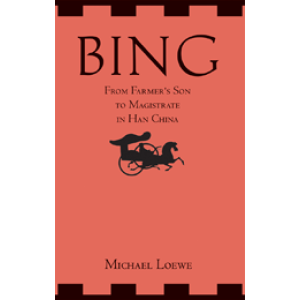
![]() Bing: From Farmer's Son to Magistrate in Han China
Bing: From Farmer's Son to Magistrate in Han China"This book is wonderful. Only someone with Loewe's deep and broad knowledge could provide such a work of historical fiction that gives life to the gleanings of historical research that are too scattered and incomplete for the less skilled to harvest. Add to this the interesting story and this makes for an effective, useful supplementary reading for courses on Chinese history." —Steven Davidson, Southwestern University
"Only a master of the history of the early empires in China such as Michael Loewe could have spun this story tracing the gradual rise of a sympathetic character from plow boy to the official ranks at the Han court. Teachers will surely want to assign it to their students, as it perfectly illustrates key points that Loewe has made in more academic publications, for example, his Everyday Life in Early Imperial China during the Han Period 202 BC-AD 220. Comparative historians will find a wealth of information in it, including helpful notes suggesting further readings. Bing is as good as it gets in historical fiction." —Michael Nylan, University of California, Berkeley
Learn More















Filter
History
- 17th & 18th Century History
- 19th & 20th Century History
- African Studies
- American Intellectual History & Political Thought
- American Social History
- Ancient History
- Asian History
- History of Science
- Latin American & Caribbean Literature & History
- Medieval, Renaissance, & Reformation History
- Military History
- Middle Eastern History
- Modern European History
- Series in History
- Travel Literature