The Hackett Signature Editions Collection Featuring Premium Hardcovers of Hackett Classics - Learn More Here.

Literature





-
![]() Medea (Podlecki Edition)
Medea (Podlecki Edition)English translation. Includes essays on the play's mythical background and the work of Euripides, an introduction to Greek drama and the dramatic tradition, plot summaries and suggestions for further reading. For both students and the general reader.
Learn More -
![]() Symposium (Woodruff & Nehamas Edition)
Symposium (Woodruff & Nehamas Edition)"A model of the kind of text one needs for lecture courses: the translation is extremely readable and made even more accessible by intelligent printing decisions (on dividing the text, spacing for clarification, etc.); the notes are kept to a minimum but appear when they are really needed for comprehension and are truly informative. And the introduction admirably presents both basic information and a sense of current scholarly opinion." —S. G. Nugent, Princeton University
"A fantastic book. Translation is graceful and elegant yet uncannily accurate. Footnotes very useful, especially for teaching purposes, and the price is surprisingly low." —Eve Browning Cole, University of Minnesota
Learn More -
![]() On Poetry and Style
On Poetry and StyleContains the Poetics and the first twelve chapters of the Rhetoric, Book III.
Learn More -
![]() Lysistrata (Henderson Edition)
Lysistrata (Henderson Edition)Henderson's English translation of Lysistrata, the most popular of Aristophanes' plays, appeals to the modern reader because of its lively and imaginative plot, strong and memorable heroine, good jokes, and appeal for peace and tolerance between nations and between the sexes. Jeffery Henderson, noted Greek scholar, puts the work in historical and cultural context in his comprehensive introduction. Suggestions for further reading, notes, and map are also included.
Learn More -
![]() Heracles
HeraclesEuripides' Heracles is an extraordinary play, innovative in its treatment of the myth, bold in its dramatic structure, and filled with affective human pathos. The play tells a tale of horror: Heracles, the greatest hero of the Greeks, is maddened by the gods to murder his wife and children. But this suffering and divine malevolence are leavened by the friendship between Heracles and Theseus, which allows the hero to survive this final and most painful labor. The Heracles raises profound questions about the gods and mortal values in a capricious and harsh world.
Learn More -
![]() Introduction to Positive Philosophy
Introduction to Positive PhilosophyIncludes an introduction, selected bibliography, works by Comte in English translation, and works about Comte in English - I. The Nature and Importance of the Positive Philosophy, II. The Classification of the Positive Sciences.
Learn More -
![]() Poetics (Janko Edition)
Poetics (Janko Edition)Richard Janko’s acclaimed translation of Aristotle’s Poetics is accompanied by the most comprehensive commentary available in English that does not presume knowledge of the original Greek. Two other unique features are Janko’s translations with notes of both the Tractatus Coislinianus, which is argued to be a summary of the lost second book of the Poetics, and fragments of Aristotle’s dialogue On Poets, including recently discovered texts about catharsis, which appear in English for the first time.
Learn More -
![]() Critique of Judgment
Critique of Judgment“Pluhar maintains a fine, even tone throughout. . . . Those who have found the prospect of teaching the third Critique daunting will admire its clarity. . . . No one will be disappointed.”
Learn More
—Timothy Sean Quinn, The Review of Metaphysics -
![]() Gorgias (Zeyl Edition)
Gorgias (Zeyl Edition)“This is an excellent translation. It achieves a very high standard of accuracy and readability, two goals very difficult to attain in combination when it comes to such a master of prose and philosophical argument as Plato. Because of this the book is suitable for courses at all levels in philosophy, from introductory courses on Plato, or problems in Philosophy, to graduate seminars.” —Gerasimos Santas, Teaching Philosophy
Learn More -
![]() Theogony
TheogonyThis translation contains an introduction, commentary and interpretive essay and well as numerous notes and annotations to provide the history and background of the epic, and the mythological context in which it is placed. Hesiod's straightforward account of family conflict among the gods is the best and earliest evidence of what the ancient Greeks believed about the beginning of the world. Includes Hesiod's Works and Days, lines 1-201 and the Library of Apollodorus.
Learn More -
![]() The Meditations
The MeditationsIncludes a translator's Introduction, selected bibliography, note on the text, glossary of technical Terms, and a biographical index.
Learn More -
![]() Ways of Worldmaking
Ways of Worldmaking“In a way reminiscent of Einstein, Goodman leads us to the very edge of relativism, only then to step back and to suggest certain criteria of fairness and rightness. More so than any other commentator, he has provided a workable notion of the kinds of skills and capacities that are central for anyone who works in the arts.”
Learn More
—Howard Gardner, Harvard University -
![]() Languages of Art
Languages of Art“Like Dewey, he has revolted against the empiricist dogma and the Kantian dualisms which have compartmentalized philosophical thought. . . . Unlike Dewey, he has provided detailed incisive argumentation, and has shown just where the dogmas and dualisms break down.”
Learn More
—Richard Rorty, The Yale Review -
![]() Republic (Grube, First Edition)
Republic (Grube, First Edition)"Those interested in the Republic primarily as a work of philosophy can not do better than Grube. . . . [He] renders Plato's arguments in unfussy, idiomatic English . . . sensitive to nuances of argument and the connection of philosophical ideas." —John M. Cooper, Princeton University
Learn More -
![]() The Nuts and Bolts of College Writing (Second Edition)
The Nuts and Bolts of College Writing (Second Edition)A new edition of The Nuts and Bolts of College Writing is now available and the 2nd edition is out of print. Click here for more information about the new edition.
Learn MoreOut of stock -
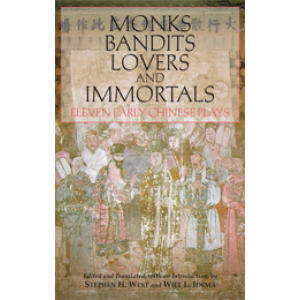
![]() Monks, Bandits, Lovers, and Immortals
Monks, Bandits, Lovers, and Immortals"This magnificent collection of eleven early [1250–1450] Chinese plays will give readers a vivid sense of life and a clear understanding of dramatic literature during an extraordinarily eventful period in Chinese history. Not only are the eleven plays in this volume expertly translated into lively, idiomatic English; they are each provided with illuminating, scholarly introductions that are yet fully intelligible to the educated lay reader. A marvelous volume."
Learn More
—Victor Mair, University of Pennsylvania -
![]() Greek Particles (Second Edition)
Greek Particles (Second Edition)“This comprehensive scholarly work will not be superseded for another century. It is both a monumental and a readable book.”
—Classical PhilologyA reprint of the Oxford University Press edition of 1966. Co-published in the U.K. by Gerald Duckworth and Company, Ltd.
Learn More -
![]() Reconceptions in Philosophy and Other Arts and Sciences
Reconceptions in Philosophy and Other Arts and Sciences"The authors argue against certain philosophical distinctions between art and science; between verbal and nonverbal meaning; and between the affective and the cognitive. The book continues Goodman's argument against one traditional mode of philosophizing which privileges the notions of 'truth' and 'knowledge'. Hence, the book is in a broadly pragmatic tradition. It also deals in detail with such topics as meaning in architecture and the concept of 'variation' in art, and contains a superb critique of some important views in contemporary epistemology. This work will be savored even by those who will not accept all aspects of Goodman and Elgin's approach. Essential for all undergraduate philosophy collections."
Learn More
—Stanley Bates, Choice -
![]() A History of Greek Literature
A History of Greek Literature“If the student of Greek literature has room on his shelf for only one volume besides his texts, lexica, and grammar, that book should be Lesky.”
Learn More
—Moses Hadas, The Classical World -
![]() The Verb 'Be' In Ancient Greek
The Verb 'Be' In Ancient Greek“It is great news that this book is available again. It deserves to be better known, both for its pioneering methods of linguistic analysis and for the results to which they lead. It transforms our understanding of the all-important Greek verb ‘to be.’”
Learn More
—Myles Burnyeat, All Souls College, University of Oxford -
![]() The Complete Poems and Major Prose
The Complete Poems and Major Prose“This is by far the most thorough, most inspired and inspiring gathering of Milton's thought in one volume. It is a boon to teachers and students of Milton. Your keeping it in print is commendable and appreciated.”
Learn More
—Cicero Bruce, Dalton State College













Filter
Literature
- 17th to 20th Century Literature
- Aesthetics & Literary Theory
- Asian Literature
- British Literature
- Classical Literature in Translation
- Drama
- Early English Literature
- Epic
- Folklore & Mythology
- French Literature in Translation
- German Literature in Translation
- Hispanic Literature in Translation
- Italian Literature in Translation
- Latin American & Caribbean Literature & History
- Medieval & Early Modern Literature
- Rhetoric & Composition
- Russian Literature in Translation
- Shakespeare
- Studies in Classical Language & Literature
- Travel Literature
- The Western Literary Tradition Anthologies