The Hackett Signature Editions Collection Featuring Premium Hardcovers of Hackett Classics - Learn More Here.

Philosophy





-
![]() Confessions (Sheed, Second Edition)
Confessions (Sheed, Second Edition)"This translation is already a classic. It is the translation that has guided three generations of students and readers into a renewed appreciation of the beauty and urgency of a masterpiece of Christian autobiography. This is largely because the translator has caught not only the meaning of Augustine’s Confessions, but a large measure of its poetry. It makes the Latin sing in English as it did when it came from the pen of Augustine, some sixteen hundred years ago. Deeply rooted in the tradition of which Augustine was himself a principal founder, this translation is not only modern: it is a faithful echo, in a language that has carried throughout the ages, of its author’s original passion and disquiet." —Peter Brown
"To my ears, Sheed’s translation is the most beautiful English translation available. The same electric current that runs through Augustine’s original can be felt in this translation, which combines a slightly elevated style (more elevated in direct prayers) combined with the immediacy and transparency of a street preacher (not that different from Augustine’s own style). The latest edition includes an introduction by Peter Brown, the best biographer of Augustine, and notes and commentary by Michael Foley, a truly excellent reader of Augustine." —Jared Ortiz, Hope College, in Catholic World Report
Learn More -
![]() Poetics (Sachs Edition)
Poetics (Sachs Edition)"I find the Introduction extremely convincing, lucid, learned, fair to past scholarship, and truly illuminating about the meaning of tragedy in general and about the very specific acceptions of hamartia, katharsis, ekplêxis, and thauma, in the context of an appropriate understanding of the Poetics. Another remarkable feature is the dexterity and ease with which it draws on all the relevant parts of the Aristotelian corpus to shed light on troublesome textual passages in the Poetics. Finally, the style of the Introduction is straightforward, free of unnecessary jargon, direct, and economical, the best interpretation of the Poetics I ever read." —Sabetai Unguru, Tel Aviv University
Learn More -
![]() Plato on Love
Plato on LoveThis collection features Plato's writings on sex and love in the preeminent translations of Stanley Lombardo, Paul Woodruff and Alexander Nehamas, D. S. Hutchinson, and C. D. C. Reeve. Reeve's Introduction provides a wealth of historical information about Plato and Socrates, and the sexual norms of classical Athens. His introductory essay looks closely at the dialogues themselves and includes the following sections: Socrates and the Art of Love; Socrates and Athenian Paiderastia; Loving Socrates; Love and the Ascent to the Beautiful; The Art and Psychology of Love Explained; and Writing about Love.
Learn More -
![]() Gorgias (Arieti & Barrus Edition)
Gorgias (Arieti & Barrus Edition)"Arieti and Barrus have provided us with a fine contribution to the literature on Plato's Gorgias. This text includes a literal translation of the Gorgias with a helpful introductory essay, and copious notes. It includes a priceless appendix of the only literal translations available today of several key speeches from Thucydides, as well as a valuable glossary and appendices on the rules of dialectic that may be derived from the arguments of the Gorgias, and on Plato's use of the terms mythos and logos, with which not all scholars may agree, but which I think all should find of interest."
Learn More
—Michael Palmer, University of Maine -
![]() Engaging Philosophy
Engaging Philosophy"Provides a wonderful and unique introduction to philosophy—not just to its central questions and the creative answers (some classic and enduring, some cutting-edge) that philosophers have given, but also to the shared techniques, style, and wonderment that makes philosophy so, well, engaging. The book can clearly be used on its own, or along with a selection of the philosophical texts it discusses. Particularly useful in this regard are the study questions and further reading suggestions that come at the end of each chapter."
Learn More
—Joseph G. Moore, Amherst College -
![]() The Essential Analects
The Essential AnalectsThe Essential Analects offers a representative selection from Edward Slingerland's acclaimed translation of the full work, including passages covering all major themes. An appendix of selected traditional commentaries keyed to each passage provides access to the text and to its reception and interpretation. Also included are a glossary of terms and short biographies of the disciples of Confucius and the traditional commentators cited.
Learn More -
![]() The Treatise on the Divine Nature
The Treatise on the Divine Nature"Fr Shanley's translation is clear, idiomatic, and accurate. A particular virtue of the translation is that it frequently indicates along the way which Latin terms are being rendered into English as Fr Shanley renders them. This kind of flagging will help readers to get a better sense of what Aquinas is saying than they might otherwise do. . . . [The] commentary is lucid, well informed, clearly written, and, given its word count, very comprehensive. Fr Shanley homes in on just what one would look for in a volume like the present. Hence we find him explaining Aquinas's technical terms and showing how bits of Summa Theologiae I, 1-13 connect with each other. He also relates Aquinas to previous and contemporary thinkers with whom Aquinas is engaging. The end product is something that can be warmly recommended to anyone looking for what Fr Shanley has tried to provide."
Learn More
–Brian Davies, Notre Dame Philosophical Reviews -
![]() Philosopher-Kings
Philosopher-Kings"Philosopher-Kings broke new ground on its first appearance by delivering to an audience accustomed to looking for flaws in Plato's thinking an interpretation of the Republic that celebrates the coherence of Plato's argument as it ramifies through every cranny of that controversial work. Reeve's book swiftly became a classic of Platonic scholarship and has never lost its grip. Its reissue by Hackett is a very welcome event."
Learn More
—G.R.F. Ferrari, University of California, Berkeley -
![]() The Essential Spinoza
The Essential Spinoza"Absolutely magnificent edition! I will be using it in all my introductory courses. . . . I also will use it in my 16th and 17th-century History of Philosophy course. . . . Just a wonderful collection, great translations, good editorial additions as well. Terrific selection!"
Learn More
—Abba Lessing, Professor of Philosophy, Lake Forest College -
![]() Early Buddhist Discourses
Early Buddhist DiscoursesTwenty discourses from the Pali Canon—including those most essential to the study and teaching of early Buddhism—are provided in fresh translations, accompanied by introductions that highlight the main themes and set the ideas presented in the context of wider philosophical and religious issues. Taken together, these fascinating works give an account of Buddhist teachings directly from the earliest primary sources.
Learn More -
![]() The Practice of Virtue
The Practice of VirtueThis collection provides readings from five classic thinkers with importantly distinct approaches to virtue theory, along with five new essays from contemporary thinkers that apply virtue theories to the resolution of practical moral problems. Jennifer Welchman's Introduction discusses the history of virtue theory. A short introduction to each reading highlights the distinctive aspects of the view expressed.
Learn More -
![]() Six Myths about the Good Life
Six Myths about the Good Life"This is the best introduction to philosophical accounts of the good life available. An excellent choice for any student of philosophy, this original and revealing study will inform, stimulate, and challenge even the most sophisticated reader. Kupperman combines the distinctive care, precision, and analytic power of philosophy with the best insights of contemporary psychology and a sophisticated, sensitive, and wise appreciation of the Indian, Chinese, and Western philosophical traditions. The result is a modern classic."
Learn More
—Philip J. Ivanhoe, City University of Hong Kong -
![]() On Academic Scepticism
On Academic Scepticism"Brittain's On Academic Scepticism is more than a translation. It is a thorough introduction to the study of one of Cicero's most important philosophical dialogues, a work which is the key to understanding Hellenistic scepticism and a great deal of the Latin philosophical tradition shaped by Cicero. The translation is sharp and philosophically sensitive without betraying Cicero's elegant style; the Introduction (historical, philosophical, and philological) is compact, lucid, and authoritative. At last this important work is accessible to those who do not read Latin; even those who do will turn to Brittain's book as a fundamental resource for years to come."
Learn More
—Brad Inwood, Canada Research Chair in Ancient Philosophy, University of Toronto -
![]() Apologies
Apologies"Kremer's is an attractive text because of its combination of simplicity and strong delivery, and this is true regarding his translation and his interpretive essay alike. He has striven for a scrupulous accuracy in his translation, and he has achieved this without sacrificing readability or neglecting the distinctive tone of Plato and Xenophon."
Learn More
—Norma Thompson, Yale University -
![]() Political Treatise
Political TreatiseThe Political Treatise, Spinoza’s final work, is a largely theoretical inquiry into the fundamental principles of political philosophy. This edition offers an exceptional translation by Samuel Shirley and a prefatory essay by Douglas Den Uyl that discusses why the Political Treatise deserves the attention of contemporary scholars. Steven Barbone and Lee Rice provide ample notes, a substantial bibliography, complete indexes of names and terms, and a comprehensive general introduction, which considers the evolution of Spinoza’s political thought in the context of the political and intellectual turmoil of the times, the relationship between the Political Treatise and the Theological-Political Treatise, and the importance of the Political Treatise to a full understanding of Spinoza’s political philosophy.
Learn More -
![]() Walden Two
Walden TwoThis fictional outline of a modern utopia has been a center of controversy ever since its publication in 1948. Set in the United States, it pictures a society in which human problems are solved by a scientific technology of human conduct.
Learn More -
![]() Faith, Myth, and Reason in Han China
Faith, Myth, and Reason in Han ChinaIn his classic study of the cultural history of Han China, Michael Loewe uses both archaeological discoveries and written records to sketch the conceptual background of various artifacts of the Han period, and shows how ancient Chinese thought is as much informed by mythology as it is dependent on reason.
Learn More -
![]() Reading Plato's Theaetetus
Reading Plato's Theaetetus"Timothy Chappell's Reading Plato's Theaetetus offers a translation of the Theaetetus, presented in small chunks of texts preceded by a summary and followed by in-depth analysis of the passages. The text would be an excellent companion to an upper level undergraduate course or graduate course on the Theaetetus, and is an invaluable resource for anyone working in this range of Plato's dialogues. . . . This translation is a major accomplishment in terms of style and accuracy, and it is a pleasure to read. . . . Timothy Chappell's Reading Plato's Theaetetus is a first-rate piece of scholarship that will be of great service to students of the dialogue for years to come."
Learn More
—G. S. Bowe, Bryn Mawr Classical Review -
![]() Pensées
PenséesThis eloquent and philosophically astute translation is the first complete English translation based on the Sellier edition of Pascal’s manuscript, widely accepted as the manuscript that is closest to the version Pascal left behind on his death in 1662. A brief history of the text, a select bibliography of primary and secondary sources, a chronology of Pascal’s life and works, concordances between the Sellier and Lafuma editions of the original, and an index are provided.
Learn More -
![]() Republic (Reeve Edition)
Republic (Reeve Edition)"Reeve's new translation of Republic is the one to order for students. . . . Reeve draws on his thorough understanding of Plato's central work to provide an informed translation and properly brief supporting apparatus. A highlight is the concise, substantive Introduction that usefully encapsulates much of Reeve's own scholarship." —P.W. Wakefield, CHOICE
"Taking full advantage of S. R. Slings' new Greek text of the Republic, Reeve has given us a translation both accurate and limpid. Loving attention to detail and deep familiarity with Plato's thought are evident on every page. Reeve's brilliant decision to cast the dialogue into direct speech produces a compelling impression of immediacy unmatched by other English translations currently available." —Lloyd P. Gerson, University of Toronto
Learn More -
![]() A Debate on Jewish Emancipation and Christian Theology in Old Berlin
A Debate on Jewish Emancipation and Christian Theology in Old Berlin"One of the most fascinating and, indeed, seminal debates in the protracted struggle of German Jewry to gain full citizenship and civic equality. As the translators make clear in their learned and generally lucid Introduction, this debate illuminates the enduring difficulty of modern nation states to establish a civic society that is, if not religiously neutral, at least inclusive. . . . It will surely enter the canon of standard works in the study of modern Jewish history."
Learn More
—Paul Mendes-Flohr, Hebrew University -
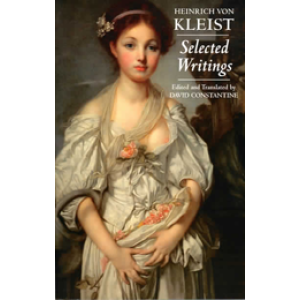
![]() Kleist: Selected Writings
Kleist: Selected Writings“If ever a literary work was a sleep of reason, bruised by menacing shapes, it is Kleist’s. He was one of the first of a line of German writers whose inwardness is so intense it seems to dissolve the weak bonds of his society. . . . Even as order and paternalism struggled to assert themselves in the private and public life of the nineteenth century, Kleist was introducing scenes of mob violence, cannibalism, and less than benevolent fathers. . . . David Constantine, a distinguished poet and Germanist, and a translator of Hölderlin, has taken pains to give us a literary Kleist, ‘a writer we cannot do without.’ . . . This book, containing all the stories and three key plays, provides a compelling view of a misfit genius who, in one of his last notes, remarked ‘the world is a strange set-up.’”
Learn More
—Iain Bamforth, The Times Literary Supplement -
![]() Spinoza's Theologico-Political Treatise
Spinoza's Theologico-Political TreatiseA complete translation in English of this modern text, with substantive apparatus to allow the student and serious reader to grapple in a meaningful way with this seminal text. The text includes ample footnotes, Spinoza's annotations, an interpretative essay, glossary and other indices.
Learn More -
![]() The Vocation Lectures
The Vocation Lectures"[Owen and Strong] beautifully weave together the historical, philosophical, academic and personal circumstances that shaped Weber's world-view and these efforts reward the reader with a nuanced and thorough understanding. . . . Students, and even established academics, will benefit tremendously from this new edition. Rating: *****"
Learn More
—Jeffrey Roberts, University of Kent, in Political Studies Review -
![]() Another Philosophy of History and Selected Political Writings
Another Philosophy of History and Selected Political Writings"Evrigenis and Pellerin should be congratulated for editing this volume, which publishes Herder's smaller and early work, Another Philosophy of History, including six smaller essays on the same topic. This volume offers the opportunity to introduce Herder to students in a survey of the history of political thought, along with his better-known contemporaries such as Rousseau, Kant, Burke, and Hegel, as well as their predecessors Machiavelli, Locke, and Hobbes. Evrigenis and Pellerin's edition gives the reader a fine introduction to Herder and his thought. The selections of the smaller essays are very helpful in allowing someone unfamiliar with Herder to see how his important thoughts could be responsible in shaping how thinkers in the later half of the 19th Century thought about the nation and the role of politics in general. Rating: * * * * *"
Learn More
—Clifford Angell Bates, Jr., Political Studies Review -
![]() Principles of Political Economy: With Some of Their Applications to Social Philosophy (Abridged)
Principles of Political Economy: With Some of Their Applications to Social Philosophy (Abridged)Stephen Nathanson’s clear-sighted abridgment of Principles of Political Economy, Mill’s first major work in moral and political philosophy, provides a challenging, sometimes surprising account of Mill’s views on many important topics: socialism, population, the status of women, the cultural bases of economic productivity, the causes and possible cures of poverty, the nature of property rights, taxation, and the legitimate functions of government. Nathanson cuts through the dated and less relevant sections of this large work and includes significant material omitted in other editions, making it possible to see the connections between the views Mill expressed in Principles of Political Economy and the ideas he defended in his later works, particularly On Liberty. Indeed, studying Principles of Political Economy, Nathanson argues in his general Introduction, can help to resolve the apparent contradiction between Mill’s views in On Liberty and those in Utilitarianism, making it a key text for understanding Mill’s philosophy as a whole.
Learn More -
![]() Theaetetus (Sachs Edition)
Theaetetus (Sachs Edition)"Sachs's outstanding new translation of Plato's Theaetetus is lucid, readable, and faithful to the original. More than that, it is a translation for the thoughtful reader. Through his striking translations of key terms, Sachs compels the reader to think more deeply about Plato's intent. He shows that Plato's return within the dialogue to the same word or to its cognates is no accident but signals a philosophical trope in Plato's thought. The work's introduction avoids presenting a stock summary of the topics covered or a rehearsal of the failed arguments. Instead, it makes the case for regarding the Theaetetus as Plato's 'missing' work on The Philosopher. Through the 'variety of attempts, errors, new beginnings, and false turns that the dialogue presents,' Sachs argues, Socrates provokes his interlocutors and Plato's readers to strive to cross the boundary between mere opinion and the kind of thinking that is philosophy."
Learn More
—Roslyn Weiss, Lehigh University -
![]() Neoplatonic Philosophy
Neoplatonic PhilosophyThe most comprehensive collection of Neoplatonic writings available in English, this volume provides translations of the central texts of four major figures of the Neoplatonic tradition: Plotinus, Porphyry, Iamblichus, and Proclus. The general Introduction gives an overview of the period and takes a brief but revealing look at the history of ancient philosophy from the viewpoint of the Neoplatonists. Historical background—essential for understanding these powerful, difficult, and sometimes obscure thinkers—is provided in extensive footnotes, which also include cross-references to other works relevant to particular passages.
Learn More -
![]() Analects
Analects"Confucius taught that 'virtue is never solitary; it always has neighbors.' (4.25). Based on the best modern and traditional Chinese and Western scholarship, Edward Slingerland's exemplary new translation of the Analects—including selections from the traditional commentaries on each passage of the text—is a welcome edition. Contemporary readers will be enlightened as to what Confucius taught his disciples and will share the experience of being a neighbor to all the generations of students who have pondered the sometimes cryptic and enigmatic words of Confucius. Slingerland's use of commentary gives readers a fighting chance at understanding and appreciating this foundational Confucian classic." —John Berthrong, Boston University
Learn More -
![]() Deductive Logic
Deductive Logic"Warren Goldfarb's long-awaited Deductive Logic is an unusually perspicuous and effective logic textbook. It succeeds in achieving great precision without seeming pedantic and great depth without compromising accessibility. One main advantage of this book relative to its competitors is the lucidity with which it explains, in ways that even beginners can fully appreciate, the rapport between semantic and syntactic captures of logical consequence. Another marked advantage is the book's emphasis on deduction and its insistence on motivating the various clauses of the rules of deduction by showing, for example, what would ensue had these clauses been flouted. In this, Deductive Logic fills a real lacuna in logic-instruction and avoids the common pedagogical pitfalls of instruction via the tree method, where students find it rather mysterious why and how the method really works. The book is written in a clear and lively style and contains numerous exercises of varying degrees of difficulty. It is ideally suited for students in philosophy and computer science."
Learn More
—Ori Simchen, University of British Columbia -
![]() Apology for Raymond Sebond
Apology for Raymond Sebond“Roger Ariew and Marjorie Grene, with the help of Hackett’s modest pricing scheme, have made this challenging, infuriating, ironic and hilarious classic readily available in a faithful and well-presented translation. . . . Scholars will find this volume a fine choice for introducing students to early modern philosophy. . . . This is a welcome publication.”
Learn More
—Craig Walton, Philosophy in Review -
![]() To Perpetual Peace
To Perpetual PeaceIn this short essay, Kant completes his political theory and philosophy of history, considering the prospects for peace among nations and addressing questions that remain central to our thoughts about nationalism, war, and peace. Ted Humphrey provides an eminently readable translation, along with a brief introduction that sketches Kant’s argument.
Learn More -
![]() Hegel's Epistemology
Hegel's Epistemology"A reader-friendly, yet philosophically sharp and textually reliable introduction to one of the classics of western philosophy. Westphal shows why the dramatic, quasi-historical, structure of Hegel’s work is not accidental to it, but is rather required by the reflective, self-critical, nature of judgement that Hegel assumes from the beginning. The book will be of interest to readers who approach Hegel with analytical as well as phenomenological preconceptions, and of use (but for different reasons) to undergraduates and graduate students alike."
Learn More
—George di Giovanni, McGill University -
![]() The Daodejing of Laozi
The Daodejing of Laozi"Why another translation of the Daodejing? Ivanhoe manages, unlike some scholarly translators, to respect the intellectual, social, philosophic, historic, and spiritual integrity of the text and to put the text into a readable, insightful, and elegant English rendering of the most famous of the early Daoist classics."
Learn More
—John Berthrong, Boston University School of Theology -
![]() Images of Women in Chinese Thought and Culture
Images of Women in Chinese Thought and CultureThis rich collection of writings—many translated especially for this volume and some available in English for the first time—provides a journey through the history of Chinese culture, tracing the Chinese understanding of women as elucidated in writings spanning more than two thousand years. From the earliest oracle bone inscriptions of the Pre-Qin period through the poems and stories of the Song Dynasty, these works shed light on Chinese images of women and their roles in society in terms of such topics as human nature, cosmology, gender, and virtue.
Learn More -
![]() Phaedrus (Scully Edition)
Phaedrus (Scully Edition)"This is a fine translation, both fluent and accurate. It captures the range of tonalities of the original in elegant English that is neither stiffly formal nor cheaply colloquial. . . . The supplementary matter is appropriate and useful. The introduction is crisp and clear, the interpretive essay illuminating. . . . Scully has done a sound and serious job of translating and annotating for the general reader. Above all, his translation is excellent in respect to style and clarity: really a pleasure to read."
Learn More
—David Konstan, Brown University -
![]() Sieyès: Political Writings
Sieyès: Political Writings"This new English edition of some of Sieyes' key texts is to be warmly welcomed. . . . Michael Sonenscher's scholarly Introduction is devoted to a discussion of different aspects of Sieyes' political ideas, rather than to a detailed examination of the texts themselves. He concentrates mainly, and quite properly, on Sieyes' concept of representation, which he analyses with sensitivity, linking it to Sieyes' concept of the nation, and distinguishing it carefully from the conventional view of representation held by the man in the street. . . . Sonenscher has researched widely and his allusions are original and stimulating. . . . [He] has done a good service in making these compelling and subversive writings more widely available."
Learn More
—Murray Forsyth, History of Political Thought -
![]() God (Second Edition)
God (Second Edition)“I have found God to be the most balanced, readable, and enjoyable synthesis of philosophy of religion materials available today. My students insist it is the book they will not re-sell at the close of the semester.”
Learn More
—Dr. Virginia Osborn, Belmont University -
![]() Before and after Hegel
Before and after Hegel“A good elementary introduction to the study of Hegel and his influence. . . . It places Hegel’s work in the intellectual context of his time very well.”
Learn More
—H. S. Harris, Glendon College, York University -
![]() The Classical Utilitarians: Bentham and Mill
The Classical Utilitarians: Bentham and MillThis volume includes the complete texts of two of John Stuart Mill’s most important works, Utilitarianism and On Liberty, and selections from his other writings, including the complete text of his “Remarks on Bentham’s Philosophy.” The selection from Mill’s “A System of Logic” is of special relevance to the debate between those who read Mill as an Act-Utilitarian and those who interpret him as a Rule-Utilitarian. Also included are selections from the writings of Jeremy Bentham, founder of modern Utilitarianism and mentor (together with James Mill) of John Stuart Mill.
Learn More -
![]() A Summary of Philosophy
A Summary of Philosophy“Those who want to approach [the Summa Theologiae] in English cannot do better than study Regan’s volume. It will provide them with a solid and reliable basis from which to take their studies of Aquinas further. . . . Regan’s translations are always accurate. . . . And, in producing them, he has managed to deliver texts written in elegant, intelligible, and idiomatic English.”
Learn More
—Brian Davies, International Philosophical Quarterly -
![]() Locke: The Political Writings
Locke: The Political WritingsThis comprehensive collection brings together the main published works (excluding polemical attacks on other people’s views) with the most important surviving evidence from among Locke’s papers relating to his political philosophy. David Wootton’s wide-ranging and scholarly Introduction sets the writings in the context of their time, examines Locke’s developing ideas and unorthodox Christianity, and analyzes his main arguments. The result is the first fully rounded picture of Locke’s political thought in his own words.
Learn More -
![]() Athenian Funeral Orations
Athenian Funeral OrationsThis volume collects all of the surviving state funeral orations from Athens, including Thucydides, Gorgias, Lysias, Plato Menexenus, Demosthenes, and Hyperides. To stimulate student discussion and comparison, Lincoln's address at Gettysburg is included in an appendix. Translations are in English, including introduction and notes, as well as literary and historical commentary.
Learn More -
![]() The Treatise on Human Nature
The Treatise on Human Nature“Pasnau’s fine translation renders Aquinas’ Latin into contemporary English prose that avoids, as much as possible, scholastic as well as contemporary jargon. The translation is precise, but technical only when it has to be, and should give readers a very good sense for what Aquinas was trying to accomplish. The commentary will be exceptionally useful to readers at all levels. Those unfamiliar with Aquinas will find helpful introductions and guides, while even scholars will find useful hints and convincing corrections of time-honored mistakes.”
Learn More
—Jeffrey Hause, Creighton University -
![]() The People of Plato
The People of Plato"A treasure-house of vital information, exhaustively and meticulously researched, presented with clarity and verve. Students of Plato's dialogues—and other Socratic writings—will no longer be frustrated by wading through dispersed and difficult to use scholarly tomes to find out about Meno's family and career or Plato's brothers or uncles or who Thucydides son of Melesias was, and his relation to the historian. With philosophical readers foremost in mind, Nails tells all. From now on, anyone reading Plato will always have this book nearby."
Learn More
—John M. Cooper, Princeton University -
![]() The Philosophy of Right
The Philosophy of RightDesigned for graduate and advanced undergraduate courses in philosophy and political science, this edition features a glossary keyed to the primary occurrences of important terms in the text and provides insights into the concepts beyond the translation—an especially useful pedagogical device for students coming to Hegel for the first time.
Learn More -
![]() Substantial Knowledge
Substantial Knowledge"C.D.C. Reeve has made a remarkable contribution to the study of Aristotle’s metaphysics, not least because his interpretation restores Aristotle’s theology to its central place. His book will be important reading not only for scholars engaged in debate about Aristotle’s text, but also for the rest of us, because it is both an interpretation of Aristotle and a significant metaphysical inquiry in its own right."
Learn More
—Alasdair MacIntyre, Duke University -
![]() Spinoza: The Complete Works
Spinoza: The Complete Works"This elegant volume has been produced to a very high standard, is easy to handle, affordably priced, and, most importantly, renders Spinoza accurately into clear and graceful English. It will undoubtedly become an indispensable tool for all serious readers of Spinoza. . . . The supporting editorial material of this volume—the work of Michael L. Morgan—is . . . judicious and reliable. His eight-page Introduction offers a succinct interpretive overview of Spinoza’s system that will be thought-provoking for specialists, while also basic enough to be accessible to novice Spinozists. Morgan also provides a very useful chronology of Spinoza’s life, a brief introduction to each work, and a light apparatus of footnotes."
Learn More
—Adam Sutcliffe, The Jewish Quarterly Review -
![]() Socrates & Alcibiades: Four Texts
Socrates & Alcibiades: Four TextsSocrates and Alcibiades: Four Texts gathers together translations our four most important sources for the relationship between Socrates and the most controversial man of his day, the gifted and scandalous Alcibiades. In addition to Alcibiades’ famous speech from Plato’s Symposium, this text includes two dialogues, the Alcibiades I and Alcibiades II, attributed to Plato in antiquity but unjustly neglected today, and the complete fragments of the dialogue Alcibiades by Plato’s contemporary, Aeschines of Sphettus. These works are essential reading for anyone interested in Socrates’ improbable love affair with Athens’ most desirable youth, his attempt to woo Alcibiades from his ultimately disastrous worldly ambitions to the philosophical life, and the reasons for Socrates’ failure, which played a large role in his conviction by an Athenian court on charges of impiety and corrupting the youth.
Learn More -
![]() Critique of Practical Reason
Critique of Practical ReasonWith this volume, Werner Pluhar completes his work on Kant’s three Critiques, an accomplishment unique among English language translators of Kant. At once accurate, fluent, and accessible, Pluhar’s rendition of the Critique of Practical Reason meets the standards set in his widely respected translations of the Critique of Judgment (1987) and the Critique of Pure Reason (1996). Stephen Engstrom's Introduction discusses the place of the second Critique in Kant's critical philosophy, its relation to Kant's ethics, and its practical purpose and provides an illuminating outline of Kant's argument.
Learn More















Filter
Philosophy
- 19th Century Philosophy
- 20th Century Philosophy
- Aesthetics & Literary Theory
- American Philosophy
- Ancient Philosophy
- Asian & Middle Eastern Philosophy
- Existentialism
- Focus Philosophical Library
- Introductory Texts & Dialogues
- Logic & Critical Thinking
- Medieval & Renaissance Philosophy
- Metaphysics & Epistemology
- Modern Philosophy
- Moral Philosophy
- Phenomenology & Related Texts
- Philosophy & History of Science
- Philosophy of Mind & Language
- Philosophy of Religion
- Series in Philosophy
- Social & Political Philosophy
- Critical Thinking Spotlight