The Hackett Signature Editions Collection Featuring Premium Hardcovers of Hackett Classics - Learn More Here.

Virtual Exhibits and Special Events
-
![]() Seven Myths of Native American History
Seven Myths of Native American HistorySeries: Myths of History
"Seven Myths of Native American History will provide undergraduates and general readers with a very useful introduction to Native America past and present. Jentz identifies the origins and remarkable staying power of these myths at the same time he exposes and dismantles them."
—Colin G. Calloway, Dartmouth College"Misconceptions continue to shape public perceptions of American Indians. Deeply ingrained cultural fictions, what Jentz (history, North Hennepin Community College) refers to as myths, have had a lasting hold on popular understanding of Native Americans. In this readable and engaging overview, Jentz provides an important corrective, one that not only catalogs key stories and stereotypes but also lays a foundation for challenging them. As the title indicates, Jentz seeks to demystify seven fundamental ideas about American Indians through critical histories. Following a helpful introductory discussion, he devotes a chapter to each myth. Specifically, he unpacks (1) the noble savage, (2) the ignoble savage, (3) wilderness and wildness, (4) the vanishing native, (5) the authentic Indian, (6) the ecological Indian, and (7) the mystical native. Throughout, Jentz employs clear language and tangible examples to clarify each myth and its significance. [T]his work will greatly benefit nonspecialists, including high school teachers and students. The volume will be useful as either a textbook in introductory courses in Native American studies or as secondary reading. Summing Up: Highly recommended."
Learn More
—C. R. King, Washington State University, in Choice -
![]() Seven Myths of the American Revolution
Seven Myths of the American Revolution"In fast-paced, crystal-clear prose, these four veteran historians quash not just seven myths about the American Revolution but dozens. If you think that slavery was inevitable, that British commanders were lazy nincompoops, or that Indigenous warriors were nothing more than British pawns, you will savor the challenge of Seven Myths of the American Revolution just as much as I did."
Learn More
—Woody Holton, University of South Carolina, author of Liberty Is Sweet: The Hidden History of the American Revolution (Simon & Schuster, 2021) -
![]() Seven Myths of the Civil War
Seven Myths of the Civil WarSeries: Myths of History
"Readers of this book who thought they knew a lot about the U.S. Civil War will discover that much of what they 'knew' is wrong. For readers whose previous knowledge is sketchy but whose desire to learn is strong, the separation of myth from reality is an important step toward mastering the subject. The essays will generate lively discussion and new insights." —James M. McPherson, Professor Emeritus, Princeton University
"Wesley Moody's clear, engaging book tackles enduring Civil War myths with grace, candor, and persuasive evidence. By exploring a wide range of subjects including the war's causes, soldiers, leaders, prisons, and battlefields, this volume's group of talented historians accomplishes more than myth busting. Each scholar reveals deeper, more satisfying stories hidden beneath Civil War fallacies and falsehoods. As a result, Civil War students and enthusiasts will find more than facts in this compelling book; they’ll encounter the complexities of real war, the long shadows of memory, and the hard work that historians conduct to illuminate the past." —Jason Phillips, Eberly Professor of Civil War History, West Virginia University
Learn More -
![]() Sir Gawain and the Green Knight
Sir Gawain and the Green Knight“A dazzling recreation of the most memorable Middle English poem, and one that captures the original alliterative verse in all its dimensions: sense, sound, and rhythm.”—Ad Putter, Professor of Medieval English Literature, University of Bristol
"Nicely fills the gap between overly technical scholarly editions and too-simplified student editions. The translation and overview provide a solid introduction to the Middle English masterpiece and assures that future readers will be as willing as Glaser has been to devote the time and energy necessary to explore the poem's many facets. A worthy effort to bring the complex poem to modern students." —Ryan Naughton, Ohio University, in The Medieval Review
Learn More -
![]() Sitting Bull Speaks
Sitting Bull Speaks“Sitting Bull is arguably one of the best-known Native American leaders, and his life has been extensively documented. In Sitting Bull Speaks, Brad Lookingbill doesn’t aim to retell these familiar stories. Instead, he allows Sitting Bull to speak for himself. Drawing from various archives and sources, the book weaves a compelling and well-researched narrative centered on Sitting Bull’s own words and thoughts. Lookingbill introduces each document with thoughtful commentary, guiding the reader through the historical context. Though the title Sitting Bull Speaks echoes that of Neihardt’s classic Black Elk Speaks, this work goes further by presenting an authentic account of Sitting Bull’s voice. It offers a deeper understanding not only of the man himself but also of the Lakota world in which he lived.”
Learn More
—Rani-Henrik Andersson, University of Helsinki -
![]() The Accessible Federalist
The Accessible Federalist"I assign students to read The Federalist so they will grasp the ideas. But too often they can’t get past the words. Adam Seagrave's The Accessible Federalist will enable readers of all backgrounds to understand the ideas that shaped the Constitution. It will also spur many readers onward to study and appreciate the original texts. I hope it gets wide attention and classroom use." —James H. Read, Professor of Political Science, College of Saint Benedict and Saint John’s University
Learn More -
![]() NEWThe Art of Assemblage: Studies on Plato and Aristotle
NEWThe Art of Assemblage: Studies on Plato and AristotleThe Art of Assemblage: Studies on Plato and Aristotle is a collection of twelve essays—six on Plato and six on Aristotle—written by an international group of eminent scholars. In recognition of the work of author, translator, and distinguished professor of philosophy C. D. C. Reeve, the essays address a wide range of topics—ethics and politics, poetics and rhetoric, and metaphysics—reflecting the breadth of Reeve's own scholarship. They exemplify how the "art of assemblage"—that is, the art of interpreting ancient Greek texts—can address some of the most intriguing questions posed by Plato and Aristotle. Together, they reveal continuities between Platonic and Aristotelian thought.
Learn More -
![]() The Book of the Courtier
The Book of the CourtierPeter Hainsworth’s sparkling, eminently readable new English translation of The Book of the Courtier, Baldesar Castiglione’s (1478–1529) literary and philosophical masterpiece, captures all the nuance, stylistic flair, and humor of this foundational work of Renaissance humanism.
Learn More -
![]() The Buddha's Teachings As Philosophy
The Buddha's Teachings As PhilosophyA shorter and less technical treatment of its subject than the author’s acclaimed Buddhism As Philosophy (second edition, Hackett, 2021), Mark Siderits's The Buddha’s Teachings As Philosophy explores three different systems of thought that arose from core claims of the Buddha. By detailing and critically examining key arguments made by the Buddha and developed by later Buddhist philosophers, Siderits investigates the Buddha's teachings as philosophy: a set of claims—in this case, claims about the nature of the world and our place in it—supported by rational argumentation and, here, developed with a variety of systematic results. The Buddha’s Teachings As Philosophy will be especially useful to students of philosophy, religious studies, and comparative religion—to anyone, in fact, encountering Buddhist philosophy for the first time.
Learn More -
![]() The Canterbury Tales in Modern Verse
The Canterbury Tales in Modern Verse"This version of The Canterbury Tales is indeed 'fast-paced and entertaining'. It includes translations of most of the tales (certainly all of the most popular ones) and abridgments and summaries of a few others. Glaser's main innovation in this translation is a rather striking decision to render Chaucer's standard iambic pentameter line in iambic tetrameter. . . . Those who read his translation of The Canterbury Tales will likely be motivated to tackle a linguistically more challenging, yet more rewarding Middle English edition. Those who lack the time for such a task will still be able to appreciate the humor and variety of one of Chaucer's greatest works and will, through the basic and clear Introduction, get a sense of the historical and literary background of Chaucer, his times, and his works. The near conversational tone of the Introduction, furthermore, makes for an unintimidating encounter with a period of literature that, for many, is foreign and remote. As a kind of gateway text, therefore, Glaser's new translation of The Canterbury Tales will be much appreciated and valued by a non-specialist audience." —Jennifer A. Smith, Comitatus
Learn More -
![]() The Creative Argument: Rhetoric in the Real World, with Readings
The Creative Argument: Rhetoric in the Real World, with ReadingsThe Creative Argument sets itself apart from its competitors by presenting a series of compelling works of literary nonfiction that challenge what students think they know about arguments. Each chapter begins with an engaging argument from a work of nonfiction, followed by an in-depth yet accessible analysis of a key aspect of argumentation. Suitable for both courses in argument and first-year writing, the principles and strategies outlined in the text help students become more creative and critical as rhetoricians, both inside the classroom and out.
Instructor Resources: A PDF-only teacher's guide is available for qualified instructors. Please use this form to request a copy. A Facebook group for instructor support, moderated by author Thomas Girshin, is also free and available for request at this link.
Supplementary Readings: Download a PDF with suggested supplemental readings and resources for each chapter.
"For faculty, The Creative Argument's careful organization provides a blueprint for the semester or supplemental material for generating lectures and learning activities. For students, the efficient chapters, thoughtful readings, and refined explanations make reading and learning nearly effortless. The Creative Argument is the best way to get students to quickly understand how and why argument is paramount for personal and societal growth. This is the book to excite students about writing, research, and argument."
Learn More
—Tyrell Stewart-Harris, Cornell University -
![]() The Economy 2.0: Microeconomics
The Economy 2.0: MicroeconomicsThe Economy 2.0 equips students with the tools to address today’s pressing problems by facilitating mastery of the conceptual and quantitative tools of contemporary economics. It challenges students to address various forms of inequality and social problems, introduces them to the most important tools and concepts used by people working with the economy, and motivates all models and concepts by evidence and real-world applications.
"Teaches both the tools of the discipline and the way real economies work, making it useful and fun at the same time." —Dani Rodrik, Harvard University
Learn More -
![]() The End of the Ottoman Empire and the Forging of the Modern Middle East
The End of the Ottoman Empire and the Forging of the Modern Middle East"In one hundred and twenty pages this book provides a compelling account of the shaping of the modern Middle East, and the critical part played in that process by the Ottoman Empire, even as it fell apart. It offers a mine of background information for anyone wishing to understand the current scene. Thirty-four well-chosen documents, mainly culled from the archives, buttress and illuminate the story."
Learn More
—Jonathan Schneer, Georgia Institute of Technology, author of The Balfour Declaration: The Origins of Arab-Israeli Conflict -
![]() The Essential Aeneid
The Essential AeneidStanley Lombardo's deft abridgment of his 2005 translation of the Aeneid preserves the arc and weight of Virgil's epic by presenting major books in their entirety and abridged books in extended passages seamlessly fitted together with narrative bridges. W. R. Johnson's Introduction, a shortened version of his masterly Introduction to that translation, will be welcomed by both beginning and seasoned students of the Aeneid, and by students of Roman history, classical mythology, and Western civilization.
Learn More -
![]() The Essential Douglass
The Essential Douglass"For years I have wanted a compact, carefully edited collection of Frederick Douglass’ writings and speeches spanning his whole career—from the antebellum years to the Civil War and Reconstruction to the retreat from racial democracy in the 1870s, ’80s, and ’90s. Finally, in Nicholas Buccola’s expertly edited The Essential Douglass: Selected Writings & Speeches, I have it. Buccola has done teachers and scholars of American political thought a tremendous service by making a truly representative selection of Douglass’ achievement available in an affordable volume. I am excited to assign this book to my students and share with them the full breadth of Douglass’ intellectual fire." —Jack Turner, University of Washington
Download a PDF of the Table of Contents.
Learn More -
![]() The Essential Federalist and Anti-Federalist Papers
The Essential Federalist and Anti-Federalist Papers“An excellent edition of the key writings surrounding the adoption of the American Constitution. The learned Introduction brings to life the key intellectual debates at the heart of modern constitutionalism as well as those concerning the American Constitution. A fine critical edition.”
—Frederick Rosen, University College London“This is an excellent collection that fills a need—of all the document collections on the founding era, there is no one-volume collection with both Federalist and Anti-Federalist opinions—and none so affordably priced! I look forward to adopting this book in my general U.S. history and advanced U.S. legal history courses.”
Learn More
—Christopher Capozzola, History Department, MIT -
![]() The Essential Greek Historians
The Essential Greek HistoriansIncludes an introduction, maps, and selections from Herodotus' The Histories, Thucydides' History of the Peloponnesian War, Xenophon's The Hellenica, Aristotle's The Constitution of Athens, The Parian Marble, Polybius' The Histories, Memnon's History of Heracleia, Plutarch's Life of Alexander. See the full Table of Contents (PDF) here.
"Burstein’s The Essential Greek Historians is an excellent collection of texts representing the development of historiography in the ancient Greek world. Each text is presented in an engaging and readable translation, with an insightful introduction exploring the purposes behind its composition, the significance of its contribution to the growth of historiography as a literary genre, and the context in which its author thought and wrote. These texts include not only familiar favorites like Herodotus and Thucydides, but also sources such as The Parian Marble and Memnon's History of Heracleia, which give a broader and richer view of the ways in which Greeks engaged with history. In one economical volume, Burstein has created an indispensable introduction to the historical thought of the ancient Greeks. No student of Greek historiography should be without it." —Erik Jensen, Salem State University
Learn More -
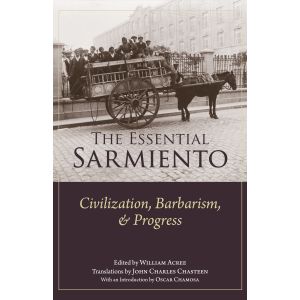
![]() The Essential Sarmiento: Civilization, Barbarism, and Progress
The Essential Sarmiento: Civilization, Barbarism, and Progress"Domingo Sarmiento is a rhetorical and political giant whose garrulous, colorful, and troubling ideas about race, violence, politics, and literature have fascinated Spanish-language readers for over a hundred and fifty years. Thanks to William Acree's brilliant selection of writings and annotations, the sparkling translations of John Charles Chasteen, and Oscar Chamosa's excellent critical Introduction, readers of English can finally encounter this larger-than-life writer who was deeply committed to documenting his historical moment and assessing social and political ills. This book is a major—and long overdue—contribution to Latin American Studies."
Learn More
—Christopher B. Conway, The University of Texas at Arlington -
![]() The Essential Thucydides: On Justice, Power, and Human Nature (Second Edition)
The Essential Thucydides: On Justice, Power, and Human Nature (Second Edition)Thucydides was the first ancient Greek historian to double as a social scientist. He set out to understand human events entirely in human terms, without recourse to myth. He sought to know why people go to war and how they are affected by its violence. He studied the civil war in Corcyra, which began when radicals burst into the council house and killed leaders who favored democracy. The strengths and weaknesses of democracy are a major theme of his History. Its larger story shows how the Athenians tried to expand their empire too far and came to a crushing defeat. Here are vivid stories of land and sea battles, interspersed with fascinating and disturbing debates about war and policy. All of Thucydides’s History is here, either in summary or translation, in a volume short enough for a wide readership. This Second Edition is expanded to include all the important debates and battle scenes, and the entire translation has been revised in accord with the latest scholarship. The Essential Thucydides is the second edition of Paul Woodruff's On Justice, Power, and Human Nature: Selections from The History of the Peloponnesian War (first published by Hackett 1993, paperback ISBN 978-0-87220-168-2, cloth ISBN 978-0-87220-169-9).
“At last—a good way to navigate the choppy waters of Thucydides’s account of the Great War! Woodruff has focused on themes of lasting importance—human nature, justice, and war itself. These have guided his skillful selection of passages and his deft explanatory comments, all in a fast-moving, readable style.”
Learn More
—W. R. Connor, Andrew Fleming West Professor of Classics, Emeritus, Princeton University -
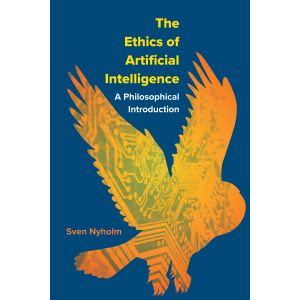
![]() NEWThe Ethics of Artificial Intelligence
NEWThe Ethics of Artificial Intelligence“With remarkable clarity and insight, Sven Nyholm guides readers through the central moral issues and questions raised by artificial intelligence—from alignment and accountability to moral status and human flourishing. Refusing both hype and moral panic, the book offers a steady and humane account of how traditions in moral philosophy can inform and guide technological innovation even as AI compels us to reexamine what it means to think and act ethically. An exceptionally accessible work that speaks equally to students, scholars, and general readers alike.”
Learn More
—David J. Gunkel, Northern Illinois University; author of The Machine Question: Critical Perspectives on AI, Robots and Ethics and Person, Thing, Robot: A Moral and Legal Ontology for the 21st Century and Beyond -
![]() The French Revolution
The French Revolution"This new edition of Mason and Rizzo's anthology is a welcome addition to the study of the revolutionary and Napoleonic French Atlantic. It includes a wealth of documents related to life in metropolitan and colonial France from the middle of the eighteenth century through the Napoleonic Consulate as well as concise section overviews that detail experiences on the continent and in Saint-Domingue, France’s wealthiest Caribbean colony, during this tumultuous era. These features, along with images, maps, and a detailed timeline, provide an invaluable resource for scholars and students alike."
Learn More
—Rebecca Hartkopf Schloss, Texas A&M University -
![]() The Greco-Persian Wars
The Greco-Persian WarsSeries: Passages: Key Moments in History
"Erik Jensen's The Greco-Persian Wars offers a refreshing introduction to a critical (but often misunderstood) historical event in world history. Rejecting dated models of East-West confrontation, this book usefully frames the Persian invasions of Greece in terms of imperial expansion and frontier development, and also considers the long-term evolution of Greco-Persian relations after 480–479 BC. The source selections draw on both Achaemenid documents as well as Greek narratives to contextualize the conflict." —John Hyland, Christopher Newport University
"I like Jensen’s book very much. This 'key moment' in world history has traditionally been read almost exclusively through Greek eyes, and having these translations of the Persian sources provides the opportunity and impetus for a fresh interpretation of this classic encounter. . . . The Introduction provides an excellent background to the Persian sources and sheds invaluable light on the people and society that produced them." —Robert Garland, Colgate University
Learn More -
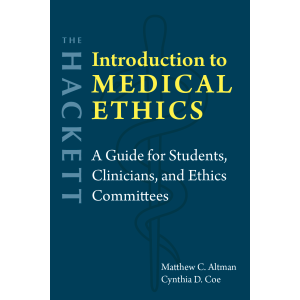
![]() The Hackett Introduction to Medical Ethics
The Hackett Introduction to Medical EthicsThe Hackett Introduction to Medical Ethics addresses key debates and analyzes prominent ethical perspectives on clinical medicine, healthcare policy, and human experimentation. Using numerous examples and case studies, Altman and Coe apply value theory to contemporary medical practice and trace the repercussions for such philosophical issues as autonomy, death, and justice. The book invites a range of readers to investigate urgent moral questions at the intersection of the body and social institutions. Free online resources include PowerPoint lecture slides, a sample syllabus, links to case studies (to help facilitate small group discussion and apply theoretical concepts), and more.
"With remarkable breadth and depth, Altman and Coe provide up-to-date discussions of both classic bioethical issues (such as informed consent and reproductive technologies) and more recent developments in the field (such as relational autonomy and the impact of racial disparities on healthcare). The Hackett Introduction to Medical Ethics balances contemporary theory with clinical examples and cases in ways that will benefit both students and professionals in philosophy, bioethics, and healthcare."
Learn More
—Jamie Watson, Cleveland Clinic Center for Bioethics and Cleveland Clinic Lerner College of Medicine -
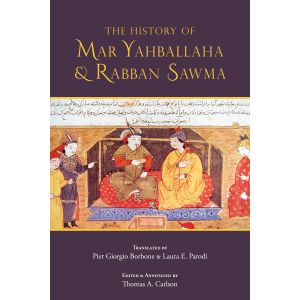
![]() NEWThe History of Mar Yahballaha and Rabban Sawma
NEWThe History of Mar Yahballaha and Rabban Sawma"For anyone interested in the extraordinary journey of Rabban Sauma from 13th-century China to Latin Christian Europe, Thomas A. Carlson's The History of Mar Yabhallaha & Rabban Sawma is a godsend. Based on Pier Giorgio Borbone's and Laura E. Parodi's magisterial edition and translation, Carlson’s new text is excellent for courses in world literature, travel literature, medieval biography, church history, comparative Christianities, global pilgrimage studies, religious studies, and even hagiographic writing. The book's lively, engaging introduction supplies important background on the history of the Mongols, Eurasia, Central Asia, the Church of the East, the peoples of the steppe, the Ilkhanate of West Asia, and key historical events of the 13th and early 14th centuries, making what might seem esoteric and strange crystal clear and easy to understand. This book is indispensable for teaching, as well as a delight and pleasure for the general reader."
Learn More
—Geraldine Heng, author of The Global Middle Ages: An Introduction, and The Invention of Race in the European Middle Ages -
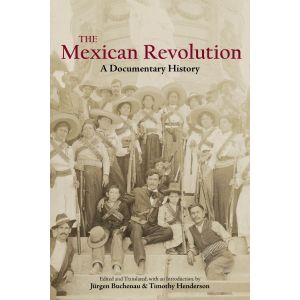
![]() The Mexican Revolution
The Mexican RevolutionSelected as one of the best historical materials of 2023 by the Reference and User Services Association, a division of The American Library Association.
"Henderson and Buchenau have done an excellent and thoughtful job of collecting a wide range of voices for students to learn about the Mexican Revolution and its causes, both from ‘above’ and from ‘below’. I’m particularly appreciative of the authors’ inclusion of women’s voices and women’s issues of the era, including the point of view of the first woman elected to public office in Mexico. They deserve praise for including documents that complicate widely accepted, heroic revolutionary narratives of the period for students—such as the experience of soldaderas and the massacre of Chinese people in Torreón. It is also worth mentioning that the editors have done an admirable job in choosing documents from across Mexico’s many diverse and heterogenous regions. The general Introduction is excellent; it is both accurate and highly readable for students. It is no easy feat to succinctly describe both the events and the significance of this period in Mexican history as the authors have done here." —Sarah Osten, The University of Vermont
Learn More -
![]() The Poetic Edda (1st Edition)
The Poetic Edda (1st Edition)"The poems of the Poetic Edda have waited a long time for a Modern English translation that would do them justice. Here it is at last (Odin be praised!) and well worth the wait. These amazing texts from a 13th-century Icelandic manuscript are of huge historical, mythological and literary importance, containing the lion's share of information that survives today about the gods and heroes of pre-Christian Scandinavians, their unique vision of the beginning and end of the world, etc. Jackson Crawford's modern versions of these poems are authoritative and fluent and often very gripping. With their individual headnotes and complementary general introduction, they supply today's readers with most of what they need to know in order to understand and appreciate the beliefs, motivations, and values of the Vikings." —Dick Ringler, Professor Emeritus of English and Scandinavian Studies at the University of Wisconsin–Madison
Audiobook: An audiobook edition, narrated by Jackson Crawford, is also available from Downpour, Audible, and other audiobook retailers.
Learn More -
![]() The Prince (Wootton Edition)
The Prince (Wootton Edition)"This is an excellent, readable and vigorous translation of The Prince, but it is much more than simply a translation. The map, notes and guide to further reading are crisp, to-the-point and yet nicely comprehensive. The inclusion of the letter to Vettori is most welcome. But, above all, the Introduction is so gripping and lively that it has convinced me to include The Prince in my syllabus for History of Western Civilization the next time that I teach it. . . . Great price, too! And lovely printing and layout."
Learn More
—Rachel Fulton, University of Chicago -
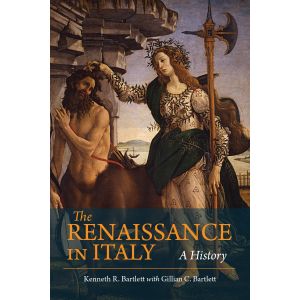
![]() The Renaissance in Italy: A History
The Renaissance in Italy: A History"An elegant tour of the republics and princely courts where the Italian Renaissance flourished. Bartlett presents a survey of glittering cultural, literary, and artistic achievements, never losing sight of the important political contexts in which they were made. The whole sweep of the Italian Renaissance—the fabulous wealth of its merchants, the ruthless schemes of its princes, the high ideals of its poets and writers, the astonishing works of its artists and architects, the struggles of its visionaries and reformers—comes into focus." —Margaret Meserve, University of Notre Dame
"Kenneth Bartlett (Univ. of Toronto, Canada), a prolific writer on Italy, the Renaissance, and humanism, and Gillian Bartlett, an author and educator, have produced a volume that will appeal to many scholars. Their book is organized as a series of biographies of prominent figures from the period—including Petrarch, Machiavelli, and Michelangelo, among others—and each chapter concludes with examples of appropriate works of art, accompanied by useful commentaries. The authors begin with Petrarch, describing how he introduced and popularized concepts that defined humanism. Geographically, Bartlett and Bartlett also focus more on minor states, such as Naples, than is customary, although they ultimately chart their narrative to Counter-Reformation Rome, where humanism died, leaving its traces in art and architecture. Happily, the spirit of humanism also survived elsewhere, to enrich our lives today. . . . [T]hose with some background knowledge will be fascinated by this beautifully written text, and will hopefully appreciate the poetic rhythm of the prose, appropriate for a book that celebrates Cicero, the ultimate Latin stylist. Summing Up: Highly recommended. All readership levels." —W. L. Urban, emeritus, Monmouth College (IL), in Choice
Learn More -
![]() The Rise of the Mongols: Five Chinese Sources
The Rise of the Mongols: Five Chinese Sources"Our modern fascination with the Mongol empire only increases with each passing year. One global myth even claims that Chinggis Khan’s DNA can be found among most of the races of the world today—a story of genetic seeding that surely testifies to the obsessive awe with which the rulers of the largest empire in the history of the world are still held. The Rise of the Mongols: Five Chinese Sources, is thus a timely, important, and welcome addition to the limited sources on the Mongols currently available to us in English translation. Unlike the Yuanshi—the Chinese history of the Mongol dynasty that is retroactively written—Christopher Atwood’s and Lynn Struve’s five Chinese sources recount the important early days of the Mongol ascension to power through contemporary and even eyewitness accounts situated in both southern and northern China. Whether you're teaching Marco Polo, or The Secret History of the Mongols, or courses in early globalism, you’ll find this invaluable collection of newly-translated Chinese sources indispensable.” —Geraldine Heng, author of The Invention of Race in the European Middle Ages, and Founder and Director of the Global Middle Ages Project
Learn More -
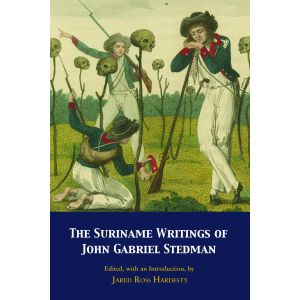
![]() The Suriname Writings of John Gabriel Stedman
The Suriname Writings of John Gabriel Stedman“Jared Ross Hardesty's new critical edition, The Suriname Writings of John Gabriel Stedman, makes an important and necessary intervention into the study of eighteenth-century Caribbean travel writing and natural history by foregrounding the previously unpublished diary entries Stedman authored in Suriname, rather than focusing solely on his writings printed in the metropoles of Europe. Hardesty's edition is especially useful because it includes both a transcription of Stedman's Suriname diary and a detailed appendix tracking key discrepancies between the diary and Stedman's heavily revised printed natural history. This focus on genre and the editorial process in the production of Anglophone transatlantic writing is an excellent resource for students and scholars of the eighteenth-century Caribbean and the Atlantic World. I can see this being a helpful resource in an early American or eighteenth-century history or literature course, as it would enable students to easily compare differing editions of Stedman's Suriname writings. What Hardesty's edition of The Suriname Writings of John Gabriel Stedman offers is a more accessible study of how eighteenth-century writing on maroonage, slavery, science, and abolition was heavily mediated in the print and production process, as this compiled edition offers critical insight into the gendered and racial politics of life in the colonial Caribbean as well as how printers in the metropole attempted to alter the writing of colonizing authors like Stedman.”
—Elizabeth Polcha, Drexel University
Learn More -
![]() The Tragedy of Antony and Cleopatra
The Tragedy of Antony and Cleopatra"Like the Blits edition of Julius Caesar, this new edition of Antony and Cleopatra restores one of Shakespeare's Roman plays to its rightful place among serious works of political philosophy devoted to understanding Roman politics and the characters who inhabit it. The Preface and Introduction are extremely well written. The Preface situates this edition in opposition to certain conventions of modern Shakespeare scholarship that are generally unhelpful to readers approaching the play from the perspective of political philosophy. It moreover identifies places where other editions and editors mislead the reader and bury Shakespeare's political wisdom in the process. The Introduction explores the impact of political change on the arc of Roman history, with special attention to the conditions that fostered republican Rome and the erosion of such conditions under the empire. It also provides ample opportunity to connect the politics of the play to modern political problems. The footnotes are unusually helpful for scholars interested in Shakespeare's political thought. References to relevant classical authorities such as Cicero, Livy, Plutarch, Appian, and Dio help clear the way for a more serious confrontation with the play." —Khalil Habib, Hillsdale College
"This edition of Antony and Cleopatra gives contemporary readers access to Shakespeare's meaning as no other edition does. While other editors may provide basic information about the historical setting of the play, Jan Blits makes palpable the shape and feel of the world in which the action unfolds. His annotations citing classical authors reveal a world of possibility that would have been available to earlier generations, that Shakespeare would have taken for granted, and that is lost on readers today. His excellent Introduction frames the drama in terms of questions regarding the relative place of the public and private in the polity’s life, the claims of the universal and the national on the allegiance of citizens, and the meaning of nobility that will be highly provocative for anyone interested in Shakespeare as a political thinker." —Joseph Alulis, North Park University
Learn More -
![]() The Tragedy of Macbeth
The Tragedy of MacbethThe fourth in a series of editions of Shakespeare’s most political and history-soaked plays, this Macbeth offers copious aids to understanding the play not found in any other edition. By attending to the play’s medieval Scottish setting in a way that rival editors have never matched—when they have even dug beyond the early seventeenth-century context in which it was produced—Jan H. Blits’s edition richly rewards readers left unsatisfied by “decodings” of the play’s supposed allusions to the politics of early modern England who wish to look deeper. In doing so, it opens the text for readers to encounter, in new ways, the play’s historical, political, and psychological significance.
Learn More -
![]() The Treatise on Happiness • The Treatise on Human Acts
The Treatise on Happiness • The Treatise on Human ActsThe fifth volume of The Hackett Aquinas, a series of central philosophical treatises of Aquinas in new, state-of-the-art translations accompanied by a thorough commentary on the text.
Learn More -
![]() The Treatise on Human Nature
The Treatise on Human Nature“Pasnau’s fine translation renders Aquinas’ Latin into contemporary English prose that avoids, as much as possible, scholastic as well as contemporary jargon. The translation is precise, but technical only when it has to be, and should give readers a very good sense for what Aquinas was trying to accomplish. The commentary will be exceptionally useful to readers at all levels. Those unfamiliar with Aquinas will find helpful introductions and guides, while even scholars will find useful hints and convincing corrections of time-honored mistakes.”
Learn More
—Jeffrey Hause, Creighton University -
![]() The Treatise on the Divine Nature
The Treatise on the Divine Nature"Fr Shanley's translation is clear, idiomatic, and accurate. A particular virtue of the translation is that it frequently indicates along the way which Latin terms are being rendered into English as Fr Shanley renders them. This kind of flagging will help readers to get a better sense of what Aquinas is saying than they might otherwise do. . . . [The] commentary is lucid, well informed, clearly written, and, given its word count, very comprehensive. Fr Shanley homes in on just what one would look for in a volume like the present. Hence we find him explaining Aquinas's technical terms and showing how bits of Summa Theologiae I, 1-13 connect with each other. He also relates Aquinas to previous and contemporary thinkers with whom Aquinas is engaging. The end product is something that can be warmly recommended to anyone looking for what Fr Shanley has tried to provide."
Learn More
–Brian Davies, Notre Dame Philosophical Reviews -
![]() The Trial and Death of Socrates (Third Edition)
The Trial and Death of Socrates (Third Edition)The third edition of The Trial and Death of Socrates presents G. M. A. Grube’s distinguished translations, as revised by John Cooper for Plato, Complete Works. A number of new or expanded footnotes are also included along with a Select Bibliography.
Learn More -
![]() The Wanderer's Journal
The Wanderer's JournalThe Wanderer's Journal, a pocket-sized (4" x 6") notebook, features a smyth-sewn binding with a ribbon marker and a flexible hardcover with a copper foil embossed image of Odin's ravens, Hugin and Munin, stamped on the front. In addition to 148 blank ruled pages, the journal includes 13 illustrated rune pages with rune translations on the reverse pages. The rune illustrations by E.L. Wilson are based on Dr. Jackson Crawford’s handwritten runes from 13 verses he selected from the Norse poem Hávamál. The translations are sourced from Dr. Crawford’s frank and down-to-earth translations from "The Cowboy Hávamál," included in his 2019 Hackett Publishing book, The Wanderer’s Hávamál. The Old Norse was written with the sixteen-letter Younger Futhark runic alphabet, which is used in this journal.
Learn More -
![]() The Western Literary Tradition, Volume 1: The Hebrew Bible to John Milton
The Western Literary Tradition, Volume 1: The Hebrew Bible to John MiltonThis compact anthology provides a thorough introduction to the major works of the Western literary tradition from Antiquity to 1700 covering the Hebrew Bible to John Milton (see the full Table of Contents in the link below). It includes excerpts from seventy texts translated from eight ancient and modern languages in genres as diverse as epic, lyric, and dramatic verse; prose narrative including story, romance, and novel; and nonfiction prose including autobiography, biography, letter, speech, dialogue, and essay. Further distinguishing this collection is the inclusion of works by women writers often overlooked in other literary anthologies. Margaret L. King's clear, engaging introductions and notes support an informed reading of the texts while extending students’ knowledge of particular authors and problems of interest.
Table of Contents: Click here to see the full Table of Contents for The Western Literary Tradition, Volume 1 (PDF)
Ebook flexibility: Find the The Western Literary Tradition eBook solution that best fits your syllabus. In addition to being available as a complete volume in print and eBook formats The Western Literary Tradition: Volume 1 is also available in four affordable ($9.95 each) eBook-only selections: Antiquity: Foundations of Western Literature, The Middle Ages: The Formation of the Western Literary Tradition, Renaissance Revisions: Recovery and Renewal, and Early Modern: New Horizons. Click here to learn more about the eBook-only selections, and to request instructor eBook exam copies.
Learn More -
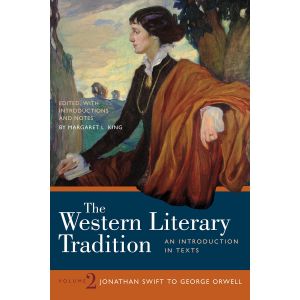
![]() The Western Literary Tradition, Volume 2: Jonathan Swift to George Orwell
The Western Literary Tradition, Volume 2: Jonathan Swift to George OrwellThis compact anthology—the second volume in Margaret L. King’s masterful introduction to the Western literary tradition—offers, in whole or in part, eighty key literary works of the eighteenth, nineteenth, and twentieth centuries. The texts provided here represent an unusually broad array of languages and traditions, ranging across a variety of genres such as verse, drama, philosophy, short- and long-form fiction, and non-fiction (including autobiography, speech, journalism, and essay). This second volume shares with the first a focus on works by women; numerous texts by Latin American writers are included here as well. King’s clear, engaging introductions and notes support an informed reading of the texts while extending students’ knowledge of particular authors and problems of interest. The Western Literary Tradition’s modest length and cost allow for the use of full-length works—many of which are available in Hackett Publishing’s own well-regarded and inexpensive translations and editions—alongside the anthology without adding undue cost to a student’s total textbook fees.
See the complete Table of Contents for volume 2 here (PDF).
Learn More -
![]() The World and Man
The World and ManIn late 1633, as Descartes was preparing The World and Man for publication, he learned that Galileo had been condemned by the Catholic Church for defending the motion of the earth. His reaction to the news was swift and powerful: as his own treatises also espoused the proposition deemed heretical, he canceled their publication. More than thirty years after Descartes had begun his project, these works were finally published, posthumously, both to acclaim and to controversy. Together, they profoundly influenced the course of modern philosophy.
Learn More -
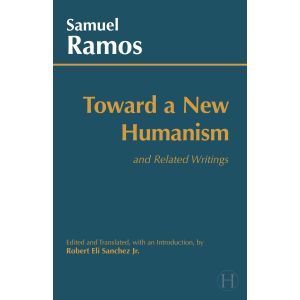
![]() Toward a New Humanism
Toward a New Humanism“Written in 1940 and available here for the first time ever in English, Samuel Ramos’ Toward a New Humanism is a prescient discussion of humanism, technology, mortality, and the tensions between the national and the universal. In addition to Sanchez’s thoughtful introduction, his superb translation of Ramos’s text, and the informative editorial notes running throughout, this volume is further enriched by the inclusion of translations of other, earlier, essays—written by Ramos and other influential philosophers from the period--on related topics as well as translations of assessments of Ramos’s ‘new humanism' by other leading philosophers in mid-century Mexico. More than eighty-five years after its original publication--and in this era of renewed global conflicts—Ramos’s call for a profound rethinking and reshaping of modern culture and society is as timely as when it was written, and Sanchez is to be commended for making this important text available for a new generation of readers.”
Learn More
—Manuel Vargas and Clinton Tolley, Mexican Philosophy Lab, UC San Diego -
![]() Treatise on the First Principle
Treatise on the First PrincipleSeeking what he describes as "the utmost limit of the knowledge our natural reason can achieve . . . concerning the True Existence [that is God]," John Duns Scotus (1265–1308) offers in this treatise one of philosophy’s most rigorous and ambitious attempts to deduce God’s existence from purely metaphysical theorems. As elucidated by its concise philosophical commentary, Thomas M. Ward's new translation of the Treatise on the First Principle puts a masterpiece of natural theology within reach of a new generation of English-reading students of philosophy.
"A very useful volume. The translation is clear, faithful, and eminently readable. The commentary hits exactly the right level. The writing is very clear; the difficulties are not shirked but instead carefully faced, and as an aid to study and comprehension of the text (which is a difficult one) it should be extremely valuable."
Learn More
—Thomas Williams, Isabelle A. and Henry D. Martin Professor of Medieval Philosophy, Georgetown University -
![]() Utilitarianism (Sher, Second Edition)
Utilitarianism (Sher, Second Edition)This expanded edition of John Stuart Mill’s Utilitarianism includes the text of his 1868 speech to the British House of Commons defending the use of capital punishment in cases of aggravated murder. The speech is significant both because its topic remains timely and because its arguments illustrate the applicability of the principle of utility to questions of large-scale social policy.
Learn More -
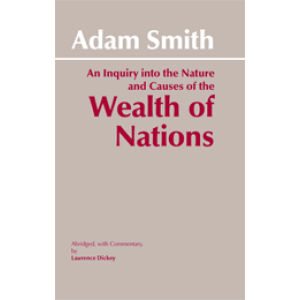
![]() Wealth of Nations
Wealth of Nations"Has all the basic chapters for the illustration of all the various (and contradictory) points anyone might want to make about the text. Dickey's own texts are invaluable. The introductions to the chapters are essential to make clear to students where they fit in the overall argument of the book. The appendices, though clearly the expression of the author's own views about the text, are admirably objective in the treatment of competing views, and represent an important contribution to Smith scholarship."
Learn More
—J. W. Smit, Columbia University -
![]() Writing with Sources (Third Edition)
Writing with Sources (Third Edition)The challenges of integrating and citing sources in academic work have expanded in scope and complexity in the digital age, but the basic principles and guidelines for doing so responsibly remain the same. The third edition of Writing with Sources is updated throughout, providing more examples of the proper use and citation of digital and print sources across disciplines—including current conventions specific to MLA, The Chicago Manual of Style, APA, and CSE citation styles—while preserving its concise and accessible format.
Learn More -
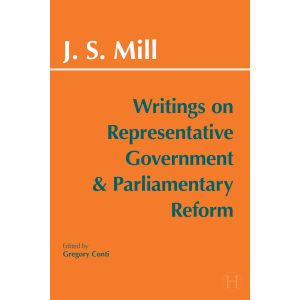
![]() NEWWritings on Representative Government and Parliamentary Reform
NEWWritings on Representative Government and Parliamentary ReformThis volume gathers, for the first time, Mill’s most important writings from across his long career on one of the principal subjects of his life: the nature and reform of representative government. By doing so, it sheds new light on Mill’s views about democracy, constitutional structure, parliamentary government, class conflict, the relation between elites and the people, and many other key themes of his political thought. It includes an extensive original Introduction situating Mill’s work in the context of the politics of nineteenth-century Britain, and connects his thought to questions that still confront liberal states today.
“Thanks to Gregory Conti, we finally have a nearly complete collection of J. S. Mill’s writings on representative government. This volume shows us the development of the theory of electoral representation and the ideal dialogue Mill entertained with the European protagonists of representative institutions—a text of documents and theoretical reflections central to understanding the history of our present.”
Learn More
—Nadia Urbinati, Kyriakos Tsakopoulos Professor of Political Theory, Columbia University

























Filter
Virtual Exhibits and Special Events